What to Consider When Buying a Machine Gun (part 2)

by John Keene, BATF Compliance/Inventory Manager & Class 3 Specialist

Classic Auto Ordnance Thompson Submachine Gun


In the previous newsletter article we discussed the three kinds of machine gun purchaser/owners, and what motivates them. Once you know which category of buyer that you are in, this will help you focus on the type of gun that is right for you.

In this article we will address what might be a good “first” machine gun for the shooting enthusiast. The assumption is that the would-be owner’s important considerations are to have a gun that is reliable, relatively straightforward and easy to maintain, and takes readily obtainable ammunition. This also assumes that, like most of us, you have a limited budget, and have had little or no opportunity to shoot a variety of machine guns. Perhaps you have never shot a machine gun at all, or have shot one incidental to military service, but not privately.

The Harrington and Richardson Reising Model 50 is a Good Beginner’s Machine Gun

Generally, your “first” machine gun, or at least one of your first, should fire pistol-type ammunition. Some good choices to consider would include .22 LR, .30 Carbine, 9mm, or .45 ACP. All these calibers are readily available and are not prohibitively expensive. An “assault rifle” intermediate cartridge caliber like the U. S. .223 (aka 5.56 mm) is also an excellent choice.

A relatively slow firing machine gun is generally the best option for a beginner. Also one which has a stock that allows the gun to be held against the shoulder when firing. This will allow for better controllability and comfort when firing.

The Reising M50, for example, is a good entry level machine gun. The Reising is a WWII era machine gun which saw limited use, mostly in the Pacific theater, with subsequent police use as well. It fires .45 ACP slowly (450 rounds per minute) from a closed bolt, which makes for accuracy. It is a select fire gun (can be fired semi-auto as well as full-auto), has a nice wooden shoulder stock, and is heavy enough to make it be controllable.

The Reising M50 also is easy to clean and spare parts can be found (although they seldom break), as well as spare magazines. They are also relatively less expensive than most other machine guns.

Another gun worthy of consideration is the U.S. M2 Carbine. It shares many of the above characteristics with the Reising with a wooden shoulder stock, closed bolt firing and select fire, yet it is a bit lighter with a lighter cartridge (.30 Carbine). It saw late WWII through the Vietnam era military use with subsequent police use as well, and falls into the same price range. Both the Reising and M2 Carbine have folding metal stock versions as well.

Any of the Military Armament Corporation MAC 11s, or MAC 10s in 9mm, or .45 ACP, are also relatively inexpensive machine guns which have widespread appeal, due to their fast-firing, compact design, and reliability. These guns fire from an open bolt, have short barrels, and consequently accuracy at anything other than short range is a challenge for anyone other than an extremely accomplished shooter. These guns recently have enjoyed a rise in popularity due to the excellent attachments being marketed for them, not the least of which are sound suppressors.

If you are ready to spend a little more, then consider stepping up to the Ruger AC-556 machine gun. It takes the common and popular 5.56mm (.223) cartridge, is select-fire, and comes in both fixed and folding stock versions, as well as both blued and stainless steel. There are also .22 LR caliber conversion kits out there for this model.

The Ruger AC-556 Machine Gun with Folding Stock has Much to Offer for the Beginner

While I hope they are helpful, these recommendations are no substitute for the person who knows the make and model of gun they “really want.” If there is a particular gun which “speaks to you,” then by all means, seek it out.

There are many other very suitable entry level machine guns. A personal favorite of mine is the iconic classic German WWII MP-40 machine gun. Featured in countless films, it is compact, simple, reliable, relatively slow-firing, and 9mm. Although it fires from an open-bolt and is full-auto only, due to its slow rate-of-fire (and with some practice) the shooter can manipulate the trigger so it shoots like a semi-auto with corresponding increase in accuracy.

One important factor to consider before you go too far down the road of selecting your first machine gun is making sure you know the laws about machine guns in your state of residence. California, Delaware, Hawaii, Illinois, Iowa, New York, New Jersey, Rhode Island, and Washington state generally do not allow private citizens to acquire/own machine guns, except in some cases with very few, and very specific exceptions. Massachusetts requires a state issued license, and Connecticut allows only “full-auto only” machine guns.

Please note that the laws surrounding the registration status and transfer of machine guns are complex. It is YOUR responsibility to know your own state and local laws. The experts at Julia’s will help potential buyers with the purchase and transfer process, but ultimately the buyer must know their own local restrictions, if any.

The experts here at Julia’s are always happy to provide advice when it comes to choosing the gun that fits what you are looking for. If you missed Part 1 of this series of articles, please take a moment and read it.

The next installment will address machine guns for the collector with historical priorities, and machine guns for the intermediate collector who is ready to, “take it to the next level.”

What to Consider When Buying a Machine Gun, Part 1

What to Consider When Buying a Machine Gun, Part 3


Bonus!
Watch Ian McCollum of ForgottenWeapons.com describe and shoot three of the guns mentioned in this article (please note that the Reisling in Ian’s video is a model 55, which is similar to the model 50 that John discusses in the article):


M2 Carbine (sold at James D. Julia, Spring 2017)

Reising M55 (sold at James D. Julia, Fall 2015)

Shooting an MP40 (not a Julia specific gun,
although we have sold several in recent years)
John Keene
John Keene

 
About the author:
John Keene is a full time staff member at Julia’s. He leads our BATF compliance efforts as well as being responsible for identifying, evaluating, appraising and cataloging specialty military firearms for auction. He specializes in Class 3 machine guns from the first half of the 20th century. He also has expertise with machine guns from the 1950s onward, as well as last century military firearms. Complementing this encyclopedic knowledge is his understanding of the complex rules and regulations associated with different machine gun classes as defined by the Bureau of Alcohol, Tobacco and Firearms (BATF). As such, he is a huge asset to Class 3 buyers and sellers, able to facilitate and complete transfer forms properly as well as make updates and corrections to the all-important BATF Class 3 registry.

Mr. Keene is a retired Army combat veteran who proudly served our country for over 28 years. Mr. Keene was a charter member and officer of the Hiram Maxim Historical Society. He can be reached at 207-453-7125 and jkeene@jamesdjulia.com.

Harold G. Stoner: San Francisco Architect and Artist

by William A. Gage, Department Head

Harold G. Stoner, Artist & Architect San Francisco, Signed ''Stoner 1926''   /></div>
<p><br clear=

Harold G. Stoner (1890-1971)

Harold G. Stoner (1890-1971) was an American architect and artist who lived in San Francisco and worked in the early and mid-20th century and helped define some of the architectural style of the San Francisco area. Born in Brighton, England he moved to Canada in 1908 and completed schooling in design drafting at the University of Saskatchewan. After graduating he worked for the Provincial government and went into private business. He next moved to the San Francisco area in 1915 and worked with the architect George Dixon in Oakland. He fought in France in WWI and shortly after became a US citizen. After working for several architectural firms he settled into the firm of Lang Realty Company as their chief architect in 1921. He worked on many of the housing developments in many of the San Francisco neighborhoods including the Marina, Monterey Heights, Sherwood Forest and many others.

Although most of Stoner’s work was involved in residential housing he did work on some commercial projects which became his most acclaimed work. These included the Tamalpais Theatre in San Anselmo, Sally Rand’s Nude Ranch at the Golden Gate International Exposition and Sutro’s Ice Rink. Two of his works are included in the National Trust Guide to Art Deco in America (Independent Order of Forester’s Lodge Hall and the Streamline Moderne Lakeside Medical Center Building). One of Stoner’s best achievements was designing “La Avenzada” the magnificent medieval mansion atop Mt. Sutro. It was featured in a 1930 issue of Architecture and Allied Arts. It succumbed to neglect and in 1948 was raised and replaced by the giant Sutro Tower which still stands today.

Lakeside Medical Building, designed by Harold G. Stoner image: 2000–2017 Western Neighborhoods Project
Lakeside Medical Building, designed by Harold G. Stoner image 000–2017 Western Neighborhoods Project

In 1937 Stoner was involved in the redesigning of the Tropic Beach into an ice rink. He was instrumental in designing the steel trusses which allowed an unobstructed area for the ice rink. It was on the walls of the ice rink we see Stoner’s artistic talent. Large murals surrounded the rink but succumbed to fire as the Sutro Baths burned down in 1966. It is this artistic talent we see in the oil painting that will be featured in our annual summer auction. It is in mural format with an image of Stoner kneeling down and at his feet are architectural blueprints. He is overlooking a large bridge being completed over the San Francisco bay with the city’s skyline beyond. It is signed “Stoner” and dated 1926. It was during this time when the city was soliciting plans and design concepts for the bridge that was to span the bay. In his vision is a bridge with an Art Deco design. Whether he fancied his participation in this project or was asked to participate, it was the prize of any architect at that time in the “City by the Bay.”

As Jacquie Proctor says, “throughout San Francisco and beyond, Harold G. Stoner’s British architectural philosophy and artistic talent have given the Bay Area a unique and timeless legacy that enriches the architectural character of some of its most beautiful neighborhoods.” For more information on Harold G. Stoner’s architectural legacy see Jacquie Proctor’s book: Bay Area Beauty: The Artistry of Harold G. Stoner, Architect.

James D. Julia’s June 16, 2017 Auction to Present an Astonishing Selection of World-Class Rare Lamps, Glass, and Fine Jewelry.

This can’t miss, nearly $4 million dollar sale features over 770 lots of merchandise, many fresh to the market offered without reserves.

Fairfield, Maine, May 18, 2017 – James D. Julia Auctioneers is pleased to announce its highly anticipated, annual early summer Lamps, Glass, and Fine Jewelry sale. This auction includes remarkable examples from collectible brands including Tiffany, Daum Nancy, Lalique, Loetz, Handel, and Pairpoint, among many others. The auction starts promptly at 10am on June 16th at the company’s Fairfield, Maine gallery. Previews will be held June 15th from 9am to 5pm, June 16th from 8am to 10am, or by special appointment.

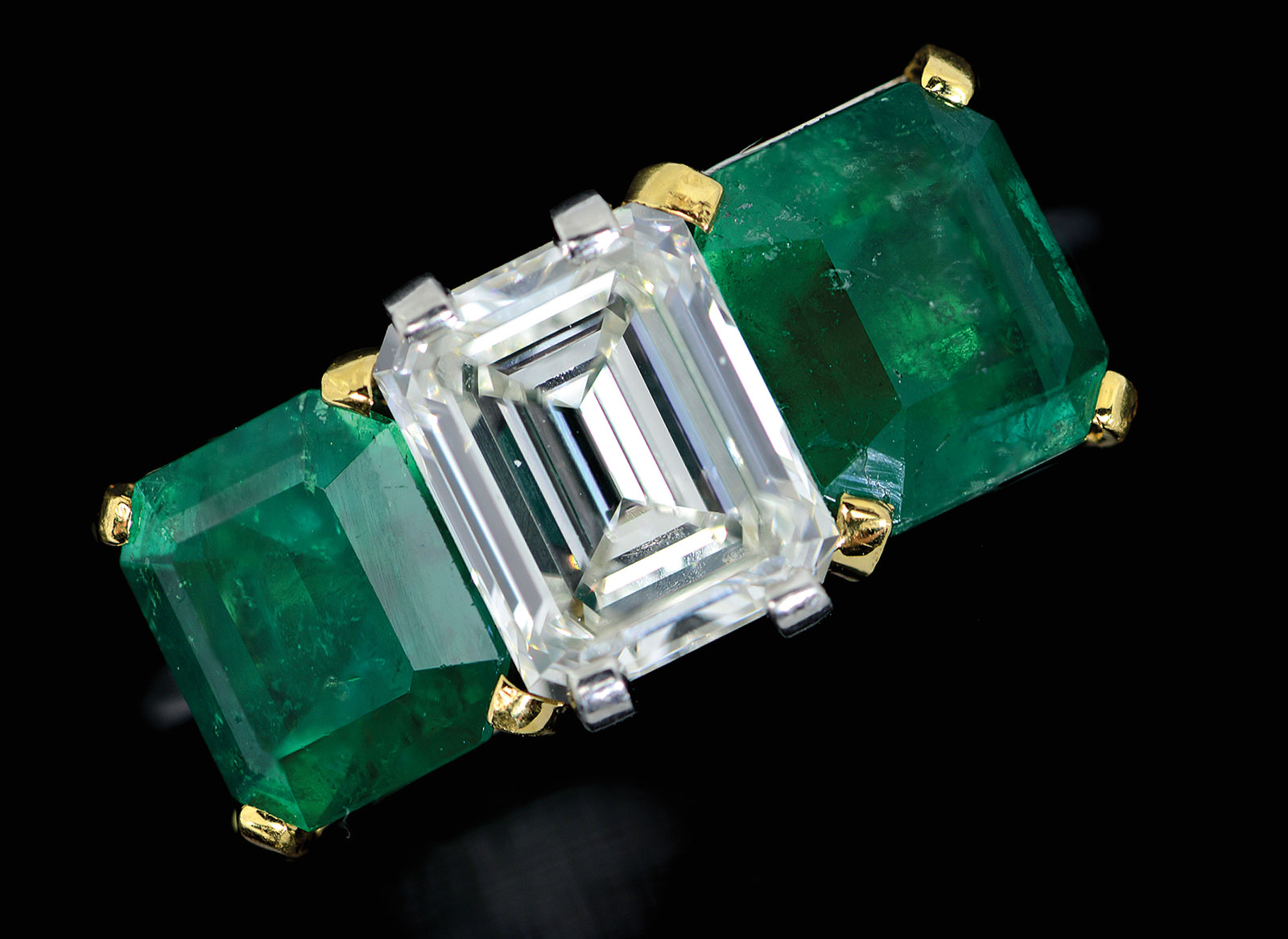
This gem of an auction kicks off with 60 lots of important jewelry, including fantastic selections of rings, earrings, bracelets, and necklaces. Many pieces are from an extensive, unreserved Texas Estate which also includes outstanding Tiffany Studios lighting and both French and American decorative art glass items. If bling’s your thing, then lot #1020, a Cartier ring centered by a 1.98ct diamond, will leave you speechless. This 18kt yellow gold and platinum ring features a VVS1 clarity and F color diamond and two well matched, rich, deep green emeralds and is estimated at $20,000-30,000.
Collectors are certain to light up over this sale’s amazing offering of extraordinary Tiffany lamps and chandeliers, many from the same unreserved Texas Estate. Two examples in this category deserve the spotlight. The first, lot #1099, is an outstanding Tiffany Studios dragonfly chandelier. Each dragonfly has a blue body, red eyes, and striated wings, set against a background of dichroic rippled glass and finished with amber and green cabochon glass jewels. It is estimated at $100,000-150,000. The second, lot #1108, is an impressive, possibly custom-order Tiffany Studios dogwood floor lamp with a massive 32” diameter shade. This fantastic rarity blooms with an all-over dogwood design with multi-colored confetti background and an unusual and eye-catching irregular floral lower border. This monumental and extremely rare example is estimated at $100,000-150,000.

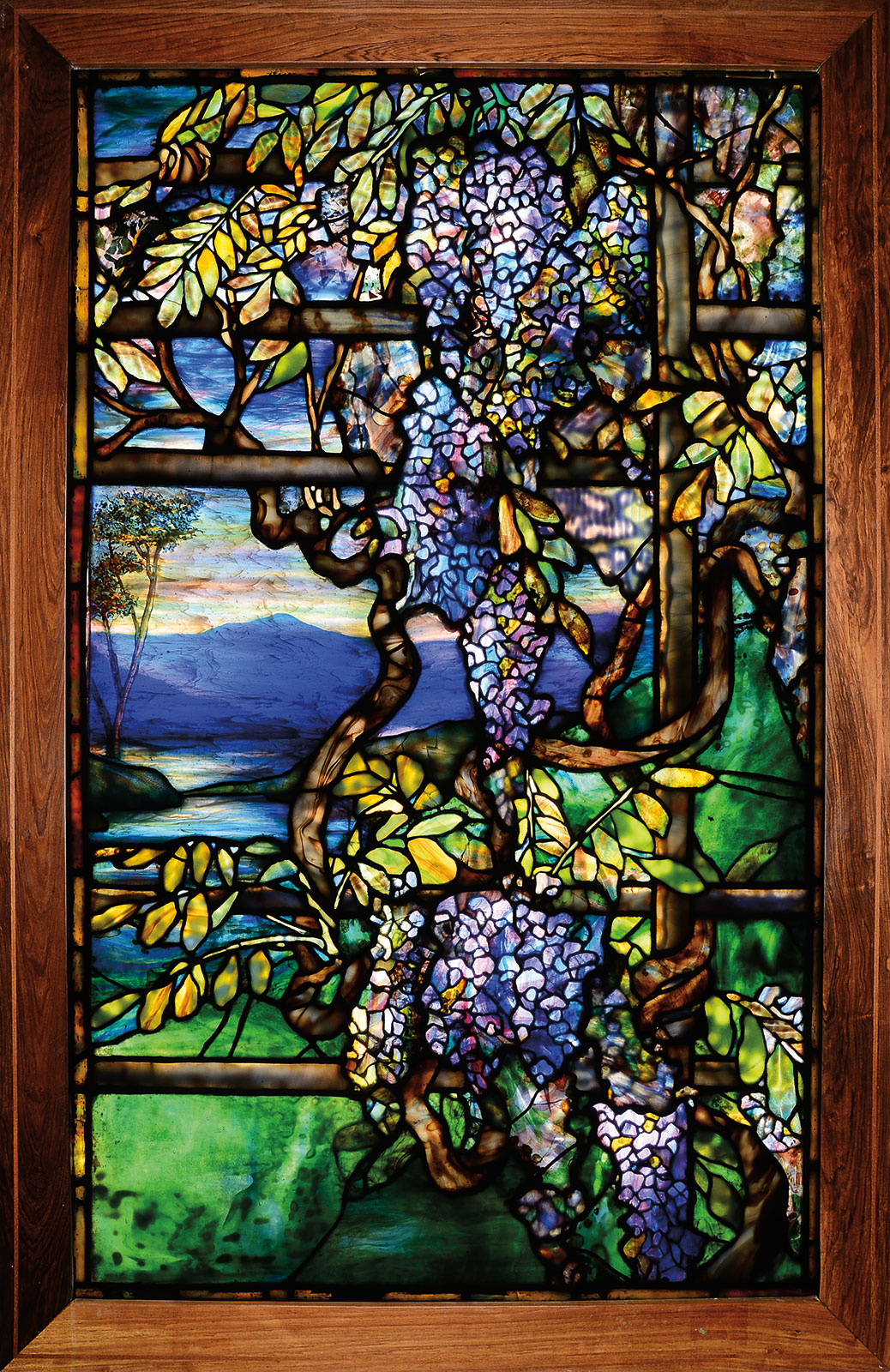
Perhaps the most incredible of the Tiffany being offered is lot #1365, an exceptional Tiffany Studios Wisteria window. Wisteria, given its intricate form as well as fantastic coloration, is one of the most desirable Tiffany Studios lamp and window patterns. This eye-popping example blossoms with multi-colored purple and blue glass, confetti and striated glass, a back painted panel of striated amber glass, and a red glass panel – all carefully layered to create great depth in the window presentation. It measures 31″ w x 47-3/4″ tall overall including its wooden frame. This breathtaking treasure – featured on the back cover of our auction catalog – is conservatively estimated at $100,000-150,000.

From the unreserved Estate of Lynda Cunningham of upstate New York, comes an impressive and diverse offering of fantastic Tiffany Studios metalware and candlesticks. One of many highlights of this group, lot #1183 is a fine Tiffany Glass and Decorating Company peacock mirror, that collectors will want to feather their nests with. This rare, period example is the smaller version produced and is in outstanding, like new condition. It features a cast bronze frame with a peacock feather design enhancing the base and back of the mirror, along with a stylized floral design framing the mirror. The eyes of each peacock feather are set with iridescent Favrile glass inlays. Circles throughout the stylized floral border are also set with small discs of blue iridescent glass. This extraordinary example reflects the finest of the Art Nouveau period and is offered at a very attractive $2,500-3,500 estimate.
Also perfect for a lady’s dressing table is lot #1488, a Webb cameo owl perfume scent bottle. This early example, with 1885 hallmarks, is decorated with a detailed wheel-carved owl resting on a branch among leaves of an English Oak tree, all set against a clear and internal red background. The quality of this piece, along with the rarity of its theme, make it a wise choice for any bidder interested in early English glass. This bottle, complete with its clear glass stopper and sterling hinged collar and cover is estimated at $10,000-20,000.

French art glass makes a strong appearance in this sale featuring a number of museum-quality Daum Nancy vases, with several highlights certain to capture the imagination of collectors both here and abroad.

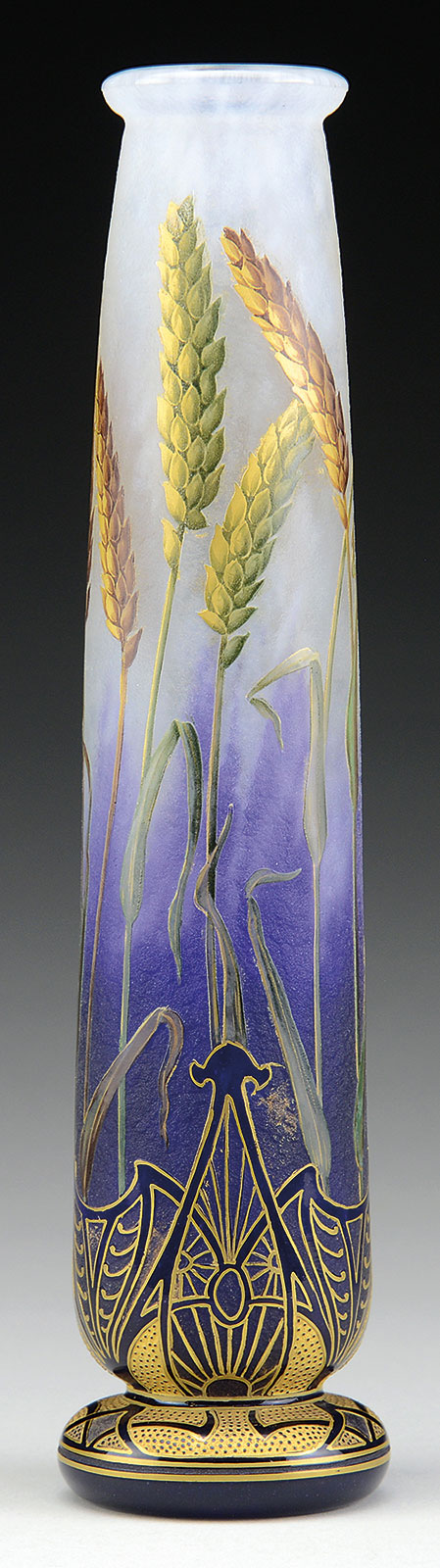
The first is from the well-curated Rudd Collection of Chicago, IL. It is lot #1516, is an exceptional Daum wheat vase decorated with cameo carved and enameled wheat stalks set against a mottled purple shading to white background. This “field of dreams” vase is further detailed at the foot with a stylized Art Nouveau cameo pattern and gilded highlights. Estimated at $15,000-20,000, its provenance includes the Pinhaus Collection from Los Angeles CA and is an exceptional example.

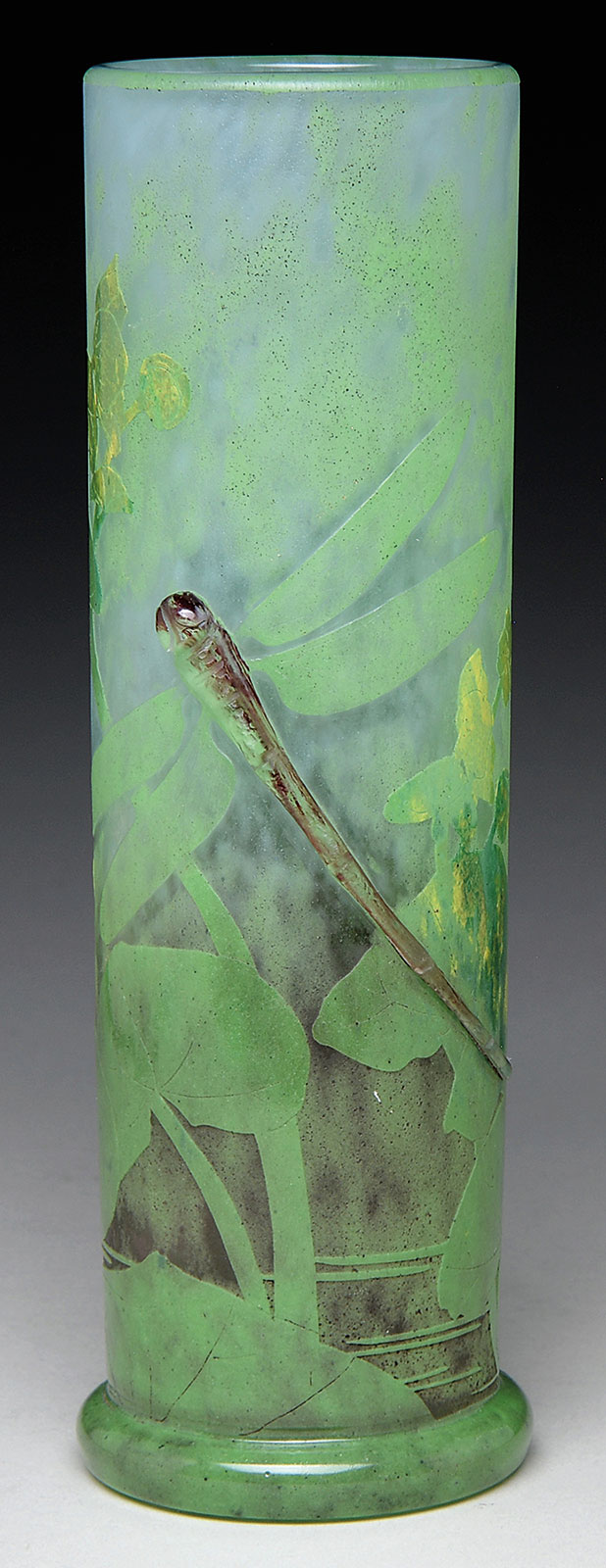
Another Daum highlight is lot #1606, an important and desirable dragonfly cameo vase. This 8-1/2” tall example has a mottled green and yellow glass cameo decoration of flowers, stems, and leaves against a mottled light blue background with an applied dragonfly. In this always popular decor, it will certainly take flight with its $12,000-15,000 estimate.

The last Daum Nancy highlight is by no means the least. Lot #1596 is a very desirable 13” tall cameo snail vase. Estimated at $17,500-22,500, this exceptional piece features an acid cut grapevine pattern in bright vitrified colors against an internally decorated yellow, pink, orange, and amethyst mottled background. The vase is detailed with applied glass grapes in the clusters and two applied and wheel-carved snails in all original, correct condition.

Also in the French glass category from a later period are several lots of Rene Lalique glassware. Lot # 1638, a Rene Lalique Tourbillons vase decorated with deeply impressed swirls and black highlighting estimated at $7,000-10,000.

This auction’s selection of fine American and European table lamps is truly electrifying. It’s the best of both worlds with lot #1637, a signed Loetz/Gurschner table lamp. This rare lamp has a Loetz art glass shade decorated with blue swirling lines and platinum oil spots against an orange iridescent background – and a bronze decorative base by Gurschner. It is estimated at $6,000-8,000. Lot # 1702, a Duffner & Kimberly table lamp, features pastel yellow, orange and green glass hyacinth flowers and leaves against a highly textured blue background simulating water. Its irregular border, created by petals and foliage, is particularly appealing. It is estimated at $10,000-15,000.

Quality reverse painted lighting will be led by lot #1685, a signed Handel reverse painted underwater lamp. This example is detailed with a painted shade featuring an underwater scene with fish swimming through aquatic vegetation against a shaded green background. It rests on an original Handel mermaid base and is estimated at $30,000-40,000. And there’s certain to be bunches of interest in lot #1697, a signed Pairpoint puffy grape table lamp. It features a blown-out shade with clusters of red grapes set against green, yellow, and orange grape leaves. The shade rests on its original Pairpoint base, with grape leaves and vines surrounding the foot and grape clusters hanging from the vine shaft. It is estimated at $9,000-12,000.
Fine contemporary glass windows, vases, paperweights, and decorative items add a splash of modern color to this auction. Lot #1723, a signed Stelz Studios leaded glass window is a literal garden of Eden. It is estimated at $6,000-8,000 and features red roses and green mottled leaves climbing along a yellow and green striated trellis, all against a blue, purple, cream, yellow, and brown background. The window is plated with random confetti panels on both the front and back and housed in a wooden door frame. It measures 24-1/4″ x 79-1/2″ overall. This item is one of a pair, with the second matching window, Lot #1724, also available in this sale.

This comprehensive auction rounds out with highly curated selections of Art Nouveau furniture, pottery, and fine decorative art items. Furniture enthusiasts are certain to gather around lot #1499, a fine Majorelle Art Nouveau walnut banquet table in Wheat motif, featuring a rectangular top and tapered, carved legs ending in square pad feet. Estimated at a reasonable $4000-$6000, it can be extended with five original table leaves, also included in the lot. For those looking for a complete dining room, other complementary patterned Majorelle furniture pieces, including chairs, are available through this sale.

Our final highlight is lot #1653, from the Austrian Art Nouveau Amphora genre. This nearly 14” tall Eastern Dragon baluster vase is decorated with a bronze colored ‘wrap-wing’ dragon with gold highlights, set against a mottled background and finished in an iridescent glaze. The workmanship and quality of this piece is so exquisite that you can see each individually formed sharp dragons tooth in his mouth! This signed vase is estimated at $6,000-$8,000.

According to Department Head Mike Fredericks, “I am delighted to offer our customers another incredible offering of exceptional lamps, glass, and jewelry through this sale. I have logged many miles combing the country from coast to coast to find the most extraordinary selections of fresh merchandise, and couldn’t be more pleased that we can offer many of the collections without reserve. This presents collectors with tremendous opportunities to purchase rare and spectacular Art Nouveau finds through this auction. Whether rare Daum and Galle art glass or high-end Tiffany Studios such as the Wisteria leaded window or rare table lamps, this grouping truly has both rarity and quality, and is mesmerizing to see in person. I welcome you to attend the auction in person and see these treasures firsthand.”

About James D. Julia, Inc.:

James D. Julia, Inc., one of the top ten antique auction houses in North America, is headquartered in Fairfield, Maine. The company also has an office in Boston, Massachusetts. In business for over 40 years, the company conducts high-end antique, collectible, and decorative arts auctions throughout the year. Julia’s routinely establishes new world records through its auctions. Julia’s has three divisions, including Rare Firearms and Militaria; Fine Art, Asian and Antiques; and Rare Lamps, Glass and Fine Jewelry. Each division is staffed by knowledgeable professionals and is internationally recognized and respected.

For more information on James D. Julia, Inc. and the company’s June 2017 Rare Lamps, Glass, and Fine Jewelry sale, please visit www.jamesdjulia.com.

Contact:
Mike Fredericks
Department Head, Rare Lamps, Glass, and Fine Jewelry
James D. Julia, Inc.
207-453-7125
lg@jamesdjulia.com

Image Description

Lot 1020. Cartier Emerald & Diamond ring, estimated at $20,000-30,000.

Lot 1099. Tiffany Studios Dragonfly chandelier, estimated at $100,000-150,000.

Lot 1108. Tiffany Studios Dogwood floor lamp, estimated at $100,000-150,000.

Lot 1183. Tiffany Glass & Decorating Company peacock mirror, estimated at $2,500-3,500.

Lot 1365. Tiffany Studios leaded glass Wisteria window, estimated at $100,000-150,000.

Lot 1488. Webb cameo Owl perfume bottle, estimated at $10,000-12,500.

Lot 1499. Majorelle Art Nouveau walnut banquet table, estimated at $4,000-6,000.

Lot 1516. Daum Nancy cameo and enamel Wheat vase, estimated at $15,000-20,000.

Lot 1596. Daum Nancy cameo Snail vase, estimated at $17,500-22,500.

Lot 1606. Daum Nancy Dragonfly cameo vase, estimated at $12,000-15,000

Lot 1685. Handel reverse painted underwater lamp, estimated at $30,000-40,000.

Lot 1702. Duffner & Kimberly Water Hyacinth table lamp, estimated at $10,000-15,000.

What to Consider When Buying a Machine Gun (part 1)

by John Keene, BATF Compliance/Inventory Manager & Class 3 Specialist

Highly sought after H&K Sear installed MG in an MP5 host (sold for $43,125)
Highly sought after H&K Sear installed MG in an MP5 host
(sold for $43,125)

When it comes to the buying and selling of machine guns, James D. Julia is the leader in North America, and in fact since 2008 more machine guns have been sold at auction here in Fairfield, Maine than at all other auction houses in North America combined. However, we still find that many gun collectors and potential gun collectors do not even realize that it is possible to legally own machine guns under Federal law. While there are some states that do prohibit or restrict private ownership of machine guns, most allow the ownership of machine guns as long as federal requirements are met.

Machine guns are impressive. The earlier models, often made with copious amounts of brass, because this metal was easier to work than steel, are beautiful to behold, and make outstanding historical display pieces whether the owner intends to shoot them or not.

For collectors of early 20th century American military firearms, adding the Browning Automatic Rifle, Colt 1895 “Potato Digger,” or the Browning 1917A1, 1919A4, or M2 .50 Caliber to their collections would enhance their collections significantly. Even for many firearm collectors, or would-be collectors, who don’t necessarily specialize in machine guns, the iconic Thompson submachine gun, aka the Tommy Gun, is the ultimate “I wish I had one” gun.

Classic machine guns are not only historic but also tremendously fun to shoot. I challenge any shooting enthusiast to try the B.A.R. or Thompson, and not crack a smile.

But when embarking on the journey of buying that first machine gun there are some important things to consider. The most important thing is this: Know yourself and know what appeals to you.

There are generally three categories of machine gun purchaser/owners:

  • The owner/shooter who wants effective, trouble free, automatic fire. Nominally this machine gun owner wants something modern which shoots readily available ammunition and which rarely needs spare parts. Usually these guns are relatively easy to master, strip and clean as well.
  • The historical machine gun collector/shooter. This person wants a gun which has some aspect of history attached to it. It might be an early machine gun like a Maxim, or it might be an AK-47 from the Viet Nam era, but whatever their preference, the gun will be more than just a bullet launching platform to them.
  • The investor/shooter. This person wants a gun that they perceive will retain its value well or appreciate over time. The gun might be a classic, or it might be modern state of the art, but it will need to be one that the owner perceives as a good “investment.”
  • Once you know which of the three above you are, then you need to seek advice from someone like me here at Julia’s who has experience and strong knowledge of the machine gun collecting world, and can hopefully provide you with the opportunity to at least hold some different guns. At the very least we can advise you on the details and estimated value of the guns you are looking to acquire, as well as the federal registration and transfer requirements. We will also advise you for the need to be patient, as transfers can take months.

    Absolutely tremendous 1898 Brass Maxim machine gun (sold for $43,125)
    Absolutely tremendous 1898 Brass Maxim machine gun
    (sold for $43,125)

    Buying a machine gun is not for those who need instant gratification. But for those with the financial wherewithal to afford it, and the patience to undergo the federal background check process, the machine gun can provide many hours of enjoyment for the owner, friends, and family.

    Watch for our next newsletter which will include part 2 of this article, where I will discuss specific machine gun models that make good “first” or entry level machine guns for shooting enthusiasts.

    Julia’s next Extraordinary Firearms Auction is scheduled for October 31, November 1 & 2, 2017 and will again include a fabulous collection of spectacular machine guns as well as a wide array other rare and important arms.

    What to Consider When Buying a Machine Gun, Part 2

    What to Consider when Buying a Machine Gun, Part 3

    About the author:
    John Keene is a full time staff member at Julia’s. He leads our BATF compliance efforts as well as being responsible for identifying, evaluating, appraising and cataloging specialty military firearms for auction. He specializes in Class 3 machine guns from the first half of the 20th century. He also has expertise with machine guns from the 1950s onward, as well as last century military firearms. Complementing this encyclopedic knowledge is his understanding of the complex rules and regulations associated with different machine gun classes as defined by the Bureau of Alcohol, Tobacco and Firearms (BATF). As such, he is a huge asset to Class 3 buyers and sellers, able to facilitate and complete transfer forms properly as well as make updates and corrections to the all-important BATF Class 3 registry.

    Mr. Keene is a retired Army combat veteran who proudly served our country for over 28 years. Mr. Keene was a charter member and officer of the Hiram Maxim Historical Society. He can be reached at 207-453-7125 and jkeene@jamesdjulia.com.