The Pâte de Verre of G. Argy-Rousseau

by Mike Fredericks, Department Head


One of the more recognizable and influential pâte de verre artists of the Art Nouveau period is G. Argy-Rousseau. Born in France in 1885 to a family of simple farmers, Joseph-Gabriel Rousseau would evolve into an inquisitive engineer, inventor and artist, applying for numerous patents and earning his rightful place among the most respected creative minds of the time.

Educated at the École Breguet and later at the École Sèvres, Rousseau made acquaintance with fellow student Jean Cros, son of the now well-known pâte de verre artist Henri Cros. Visits to the Cros studios is where he began his appreciation of the process and form. Graduating in 1906, he worked for the next several years researching dental porcelain, eventually becoming director of a ceramics research laboratory. In 1913, he married Marianne Argyriades. Marianne would play a pivotal role in Rousseau’s future of design, as his appreciation of her Greek heritage and cultured upbringing encouraged his own creative inspiration. His gratitude for her influence is evident by his adding the “Argy” of her surname to his signature.


By 1914, Rousseau was already being recognized amongst the finer makers of the period with Daum, Lalique and Marinot. While heavily influenced by nature and its flora and fauna themes, his style was uniquely his own, with bright colors in muted tones of the pâte de verre providing a canvas for his creativity. He also used the Greek and classical influence for many of his designs, and eventually evolved into several stylized bolder concepts towards the later 1920s, in keeping with the changing of tastes from Art Nouveau to Art Deco. By the late 1920s, his design and production were at the pinnacle of his commercial success.

Like many of the decorative artists of the time, the global economic difficulties of 1929 took its toll on Rousseau and the business, eventually leading to its liquidation in 1931. He would continue on as an independent artist working with pâte de verre, pâte de cristal and enamels, but without the level of notoriety he once enjoyed. Suffering from a heart condition in later years, Gabriel Argy-Rousseau passed away in Paris in 1953.

Today, there is a passionate collecting fraternity and deep affection for his works. Whether diminutive bowls, larger vases or examples of his lighting designs, Rousseau examples can range from $1,000 to $50,000 and are truly special additions to a well-curated glass collection.

James D. Julia’s August Fine Art, Asian & Antiques Auction Is a Grand Slam at $3.6 Million!

This annual sale, held on August 16th-18th, featured over 1,600 lots of magnificent fine and decorative art, top-tier antiques and furniture, historical rarities, and museum quality Asian selections.

Fairfield, ME, September 1, 2017 – James D. Julia’s late summer sale truly hit it out of the ballpark, captivating bidders from all over the world with extraordinary selections of fine temptations from the most desirable and prestigious collecting categories. After the hammer fell for the last time, 60 lots made $10K or above. In addition, 16 lots realized $25K or more, and 3 lots broke the $50K mark!

This sale featured breathtaking treasures that caught everyone’s attention for their rarity and irresistible appeal from start to finish. Several exceptional sales results spotlight the quality and range of James D. Julia’s Fine Art, Asian & Antiques division.

The first day of this sale offered a full range of carefully curated paintings and fine art. Lot 1159A, Jiro Takamatsu’s Shadow of Two Keys (Skeleton & Church Key) “NO. 211,” was estimated at $30,000-50,000 but locked up $69,575. This work is signed and dated by the artist and retains its label from the Tokyo Gallery. It descended through the family of Robert H. Chase of Greenwich Village, NY, and was discovered hanging in the kitchen of a Maine home. Lot 1392, a thoughtful painting attributed to Narcisse-Virgil Diaz de la Peña called “Figure Beside Woodland Pool Looking Across to Pasture” soared to over ten times its low estimate to realize $60,500. This piece was from the Webster Family Trust and descended from the Rockefeller/Dodge Family. And lot 1340, Heywood Hardy’s “The First of November” featuring sportsmen on their horses and dozens of eager hounds and came from a Woodstock, VT collection with fabulous provenance was another best in show, making $48,000. This sale also featured two other Hardy works, “Preparing for The Hunt” and “The Meet with Riders & Hounds,” which also sold above their low estimates.

The second day of this sale presented finely curated collections of European decorative arts and American historical rarities. Lot 2075, The Book Les Roses, authored by Roudoute and Thory and published in Paris by Firmin Didot (1817-1824), was the day’s best seller, realizing $65,340 on a $10,000-20,000 estimate. This attic find is from the estate of Louise A. Livingston of Oyster Bay, Long Island. Bidders battled over two important militaria highlights on day two of this sale. They included lot 2011, a Nantucket Presentation Sword given to Mexican War Hero Major Moses Barnard for “Planting the 1st American Flag on Parapet at Storming of Chapultepec, September 13, 1847” and lot 2004, a 1st Battalion marked Revolutionary War Charleville musket. When the smoke finally cleared, these items realized $41,140 and $36,300 respectively. And lot 2133, a Queen Anne Transitional Walnut Ball and Claw foot corner chair more than doubled its low estimate to realize $30,250.

The final day of the sale featured a stunning array of outstanding Asian arts and American decorative arts.
Two tables with great provenance served up outstanding results. The first, lot 3569, was a Qing Dynasty Huanghuali and hardwood side table which made $33,880. This table was purchased in 1923 in Peking and has remained with the original owners, the Hobart family, ever since. Items from the Hobart collection established the benchmark for the Chinese antiquities market in the United States at two famous sales conducted at Sotheby’s in New York. And the second, lot 3597, a 19th century Anglo-Indian marble topped carved rosewood side table realized $27,225 on its $4,000-6,000 estimate. This table descended from the family of William G. Pierce who sailed from New York to Hong Kong, arriving June 15th, 1849. And lot 3523, Tsuguharu Foujita’s charmingly illustrated A Book of Cats: Being 20 Drawings, more than doubled its low estimate to make $21,175.

Those are just a few of the leading highlights from this comprehensive sale, but they certainly don’t tell the entire story of this incredibly successful auction.

James D. Julia is internationally recognized as the leader in works featuring Maine artists and themes and Rockport School paintings, and the sales results from those categories only serve to solidify that well-deserved reputation. Lot 1045, Gertrude Fiske’s “The Old Cove, Ogunquit” more than doubled its low estimate to make $24,200. Lot 1210, Leon Dabo’s “The Hudson, Autumn Morning” realized $24,200. This work was featured in the 15th Annual Exhibition at the Poland Springs Gallery and formerly shown in the Maine State Building, Poland Springs, Maine. This auction featured three works by Maine’s own Marsden Hartley – the most important being lot 1018, his “Summer Haze” which made $42,350. Lot 1168, Aldro Thompson Hibbard’s “West River, Vermont” realized $18,150; this handsome example was one of two Hibbards sold through this auction. Lot 1081, Emile Albert Gruppe’s “Motif 1,” one of 23 Gruppes sold through this auction, made $19,360.

Eight works by Hayley Lever were also extremely popular among bidders. Highlights among those include lot 1133, his “Eastern Yacht Club Regatta, Marblehead, MA” which sailed to $36,300; lot 1267, his “Calm Day, St. Ives, Cornwall, 1905” which tripled its low estimate to make $32,670; lot 1101, his “East Gloucester, MA, 1913” which realized $20,570; and lot 1134, his “Sunday Afternoon Stroll, Marblehead, MA 1924” which found its way at $18,150.

Other paintings featuring nautical themes also ruled the sea at this sale. Lot 1220, Thomas Chambers’ “View from West Point” featuring an impressive view of the Hudson River made $15,730. Lot 1075, Jack Lorimer Gray’s “Snowfall, Waterfront” realized $31,460; this was one of two Grays sold through this auction. And lot 2249, James Edward Buttersworth’s “Shipping in a Busy Channel” changed hands at $23,595; three other Buttersworth examples were also featured in this sale.

Two unusual painting highlights deserve special note. The first is lot 1442, Barend Koekkoek’s “Traveler in A Forest Landscape.” This under-the-radar example was estimated at $2,000-3,000 but realized $19,360 – over six times its high estimate! And lot 2290, Sir Henry Raeburn’s “Portrait of John Balfour, M.P” made $18,150. This handsome half portrait of a young man with curly brown hair wearing a brown coat, yellow vest, and white stock descended in the family of Albert L. Ellsworth, founder of the British American Oil Company.

This sale featured a number of exceptional American-made antique highlights. Lot 2214, a circa 1912-1915 Old Town Canoe Company display sample, paddled its way to $25,410. This is the company’s earliest salesman’s model sample; these absolute rarities can be identified by the wording: “Genuine Old Town Canoe Co. Canoes” painted on their sides. Lot 2111, a leaping stag full body copper weathervane, probably by Cushing & White, made $18,150. This fine example is from a home in Biddeford, ME. And lot 2206, a late 19th/early 20th century carved carousel dog in the manner of the Herschell-Spillman company realized $9,075.

Finally, lovely and important antique items designed for the home caught the eyes of enthusiastic bidders. Lot 3037, a fine carved oak tall case clock with a marked Tiffany & Co. dial ticked its way to $12,100, more than doubling its low estimate. Lot 3115, an elaborately detailed Rococo Revival Boulle marquetry shelf clock featuring a cast bronze figure of a younger partially robed Father Time holding a sickle in his right hand and a sundial in his left hand made $6,655. Another sterling highlight is lot 3096, a set of twelve silver service plates from Redlich & Co., NY. These are detailed with pierced rims, floral medallions, and scroll work and realized $8,470. Lot 3584, a large Qing Dynasty celadon glazed bottle vase whose provenance includes the Webster Family Trust and the Rockefeller/Dodge Family, made $19,360 – nearly ten times its low estimate. And things were twice as nice with lot 3049, a pair of fine vintage Hermes black leather “Constance” handbags. Estimated at $2,500-3,500, they carried the day at $4,840.

According to Department Head Bill Gage, “This auction represents one of the finest for collectors in memory, with a great number of individuals bidding in person, over the phone, and online. We moved this sale a week earlier than usual to coincide with several other important antique shows and events in the New England area. Clearly that was a great decision based on the number of new faces noted in our standing room only gallery during the sale. Our next Fine Art, Asian & Antiques Auction is scheduled for February 2018 and we are already accepting consignments for that much anticipated sales event.

About James D. Julia, Inc.:
James D. Julia, Inc., one of the top ten antique auction antique houses in North America as measured by annual sales, is headquartered in Fairfield, Maine. The company also has an office in Boston, Massachusetts. In business for almost 50 years, the company conducts high-end antique, collectible, and fine art auctions throughout the year. James D. Julia has routinely established new world records through its sales events. The company consists of three key divisions, including Rare Firearms; Fine Art, Asian & Antiques; and Rare Lamps, Glass & Fine Jewelry. Each division is regarded for its excellence and is staffed with world-class specialists to guarantee fair and professional authentication, identification, and valuation services. For more information on James D. Julia, Inc., please visit www.jamesdjulia.com.

Contact:
Scott Wentzell
Director of Marketing for James D. Julia
SWentzell@JamesDJulia.com
207-453-7125

Image Description

Lot 1018. Marsden Hartley “Summer Haze”

(Est. $25,000-40,000)

SOLD: $42,350


Lot 1045. Gertrude Fiske “The Old Cove, Ogunquit”

(Est. $10,000-15,000)

SOLD: $24,200


Lot 1075. Jack Lorimer Gray “Snowfall, Waterfront”

(Est. $25,000-35,000)

SOLD: $31,460


Lot 1081. Emile Albert Gruppe “Motif 1”

(Est. $15,000-25,000)

SOLD: $19,360


Lot 1101. Hayley Lever “East Gloucester, Mass, 1913”

(Est. $10,000-20,000)

SOLD: $20,570


Lot 1133. Hayley Lever, Eastern Yacht Club Regatta, Marblehead, MA

(Est. $20,000-30,000)

SOLD: $36,300


Lot 1134. Hayley Lever “Sunday Afternoon Stroll, Marblehead, MA 1924”

(Est. $10,000-20,000)

SOLD: $18,150


Lot 1159A. Jiro Takamatsu Shadow of Two Keys (Skeleton & Church Key) “No. 211”

(Est. $30,000-50,000)

SOLD: $69,575


Lot 1168. Aldro Thompson Hibbard, West River, Vermont

(Est. $15,000-25,000)

SOLD: $18,150


Lot 1210. Leon Dabo “The Hudson, Autumn Morning”

(Est. $15,000-25,000)

SOLD: $24,200


Lot 1220. Thomas Chambers, View From West Point

(Est. $8,000-12,000)

SOLD: $15,730


Lot 1267. Hayley Lever “Calm Day, St. Ives, Cornwall, 1905″

(Est. $10,000-15,000)

SOLD: $32,670


Lot 1340. Heywood Hardy “The First of November”

(Est. $40,000-60,000)

SOLD: $48,400


Lot 1392. Attributed To N.-V. Diaz de la Pena, Figure Beside Woodland Pool

(Est. $5,000-8,000)

SOLD: $60,500


Lot 1442. Barend Cornelis Koekkoek “Traveler In a Forest Landscape”

(Est. $2,000-3,000)

SOLD: $19,360


Lot 2004. NH 1st Battalion Marked Revolutionary War Charleville Musket

(Est. $8,000-12,000)

SOLD: $36,300


Lot 2011. Presentation Sword to Mexican War Hero Major M. Barnard

(Est. $35,000-45,000)

SOLD: $41,140


Lot 2075. Book: Les Roses, by Roudoute and Thory

(Est. $10,000-20,000)

SOLD: $65,340


Lot 2111. Leaping Stag Copper Weathervane, Probably Cushing & White

(Est. $10,000-15,000)

SOLD: $18,150


Lot 2133. MA Queen Anne Transitional Walnut Ball and Claw Foot Chair

(Est. $12,000-18,000)

SOLD: $30,250


Lot 2206. Carved Carousel Dog

(Est. $6,000-8,000)

SOLD: $9,075


Lot 2214. Old Town Canoe Company Display Sample

(Est. $17,500-22,500)

SOLD: $25,410


Lot 2249. James Edward Buttersworth, Shipping In a Busy Channel

(Est. $10,000-15,000)

SOLD: $23,595


Lot 2290. Sir Henry Raeburn “Portrait of John Balfour, M.P.”

(Est. $10,000-20,000)

SOLD: $18,150


Lot 3037. Oak Tall Case Clock with Marked Tiffany & Co. Dial

(Est. $6,000-8,000)

SOLD: $12,100


Lot 3049. Hermes “Constance” Lady”s Handbags

(Est. $2,500-3,500)

SOLD: $4,840


Lot 3096. Twelve Sterling Silver Service Plates Redlich & Co., NY

(Est. $5,000-8,000)

SOLD: $8,470


Lot 3115. Rococo Revival Boulle Shelf Clock

(Est. $4,000-6,000)

SOLD: $6,655


Lot 3523. Tsuguharu Foujita “A Book of Cats: Being 20 Drawings”

(Est. $10,000-15,000)

SOLD: $21,175


Lot 3569. Huanghuali and Hardwood Corner Leg Side Table

(Est. $20,000-40,000)

SOLD: $33,880


Lot 3584. Celadon Glazed Bottle Vase

(Est. $2,000-3,000)

SOLD: $19,360


Lot 3597. Carved Rosewood Side Table with Marble Top

(Est. $4,000-6,000)

SOLD: $27,225

What to Consider When Buying a Machine Gun (part 3)

Machine guns for the collector with historical priorities
by John Keene, BATF Compliance/Inventory Manager & Class 3 Specialist


In part 1 of this newsletter series we discussed the different kinds of machine guns, and subsequently zeroed-in specifically on what would make a good first-time machine guns in part 2 of this series.

In this article we will examine guns with an appeal to the historical machine collector/shooter, and also guns for the intermediate collector.

The history-centric machine gun collector is typically moved by the allure of history in either the development of machine-guns, or by fact that they were used by armed forces of a specific country, or at a particular event, or perhaps linked to a particular noteworthy individual. This kind of collector is by far the most commonly encountered and most passionate machine gun owner or would-be owner in the United States.

Guns which fall into the category of “historical” also are generally the prime focus of the would-be machine gun investor/shooter. It is the broadest and most far-reaching of all machine gun categories.


The most important element to consider when buying a machine gun is your own inner taste and motivation. Know yourself, and what appeals to you.

Many collectors start out with something with some family tie or significance, or childhood memory. If father or grandfather was a WWI/WWII/Korea/Vietnam Veteran then there might be, or at one time had been, a souvenir around somewhere. Even if not, seeing machine guns in films or on TV may have sparked a connection or interest. I recall that once I saw Steve McQueen using a Browning Automatic Rifle (B.A.R.) in the film, The Sand Pebbles. It only took one conversation with my father (who had used a B.A.R. in military service) to make me determined to own one someday. This is one reason why the B.A.R. remains at the top of my personal list for historic machine guns.

My assumption is that most people who want to buy a historical machine gun accept at the outset that they will need to invest a significant amount of money.

Also I assume that most collectors and would-be collectors want a gun that is functional, or nearly so, and they want the option of taking it to the range to shoot at least a few times with family and friends.

I am going to go a step further and place a premium on a gun that can be linked either through inference, or by genuine provenance to some particular event, location, or perhaps even very specific historical instance, or person.

Generally, the more “original” a gun is, the better the condition, the more linkage there is to something historical, and most of all, the larger the collector base is for a particular model relative to the number of registered specimens available, will determine the amount of money that will be required make the purchase. Even if one of these elements is taken away from a specific machine gun, if the other elements are strong enough they will usually overcome the shortcoming.


For example, one collector I know personally has multiple specimens of the German MP-40 machine gun. He still seeks a near pristine original example for his collection. It does not matter if its only service was to sit in a rack somewhere until it was captured and brought to America. This particular collector already has an MP-40 with provenance to its capture at Omaha beach in Normandy on June 6th, 1944. Although the condition is not stellar, the historical significance is so important that one can expect the only way this collector will relinquish this particular specimen would be upon his death. Historical provenance trumps condition in almost all cases.

The MP-40 has a wide collector base, is well made, very shoot-able, and also enjoys wide exposure and popularity in films. Add to this it is light and handy, simple to operate, and relatively easy to maintain.


For the collector with historical priorities they will prefer a “Curio & Relic” eligible specimen over one which is otherwise simply, “Fully Transferable”. This is a legal status difference between what otherwise might appear to be identical guns. The Curio & Relic (C & R) eligible gun as pertains to machine guns is one that is (at least the receiver) essentially as it left the factory upon original manufacture, and is at least 50 years old. It may or may not be refinished, but the steel of the receiver is what came from the original factory, and it was registered under the appropriate circumstances. The “Fully Transferable” gun on the other hand was manufactured (or at least the receiver was) later, as far as the Bureau of Alcohol, Tobacco, and Firearms (BATF) is concerned, and not by the original “factory.” The caveats, special cases, and observed or recounted anecdotes which can be applicable to “C & R” vs. “Fully Transferable” machine guns would fill all the pages of a Julia catalog and is far beyond the space available here to recount.

The historical collector may be content with non-firing “Deactivated” machine guns, as long as they are original specimens of their kind. These generally command lesser prices than their fully operational counterparts. These deactivated (DEWAT) guns still need to be registered, and if so, can be reactivated upon approval of application through the BATF. Many DEWAT guns registered for private ownership are out there. In the cases where the sought machine gun is a rare model, such as the first model German FG-42 machine gun sold at Julia’s in April 2017, the specimen is SO RARE that the fact that it is deactivated is not a great deterrent to the historically focused collector.

I want to relay that if you are considering acquiring multiple C & R eligible guns across State lines, it would be worthwhile to consider applying for a Curio & Relic Collector’s License through the BATF. This would allow the license holder to acquire guns across State lines without going through an FFL-01 dealer (subject to State restrictions).

Many, many, times each year machine gun enthusiasts ask me, what is my favorite gun, or what machine gun out of the vast array I have had access to do I like the best. On one recent occasion after conducting a gallery tour of a wide variety of machine guns being offered at Julia’s, a fellow employee asked me which one I would take if I could choose any.

I admit there was a long pause while I considered, but here are my thoughts:

When presented with multiple opportunities, focus your resources on the specimen which fits your interest and that you are less likely to encounter again in the future, especially if it has higher condition.


For example, there is a wide and passionate interest in German WWII machine guns, and in the upcoming Julia’s auction there are some fantastic original high-condition C & R fully-transferable specimens which include: an MG-42 on Lafette tripod, an MG-15 on AA tripod, an MG-34 Tank model on Lafette, and a Nazi Proofed ZB-26 (WaA 63).

Any of the above models could be the centerpiece for a WWII German machine gun collection. All are excellent, and one could not go wrong on any of them, but assuming one has limited resources I would focus on either the matching MG-34 Tank model machine gun, or the MG-15 machine gun first if I was going to assemble a comprehensive WWII German machine gun collection. The chances of encountering another of either of these specimens as complete with accessories and in as excellent condition as these are in future years is remote. Considering the matching serial numbers on the MG-34 tanker, and the fact that the MG-15 is C & R fully transferable make each remarkable. If you are more of a historical shooter than a historical display collector, then you might put the ZB-26 and MG-42 in the higher position on your priority list.

The best investment of your resources are in guns which combine: popularity, rarity (in status, as well as in model), condition, and provenance. Included accessories can also be an additional consideration.

But remember, what trumps everything is your own personal connection or interest in a particular model, or event, or theme.

I am here at Julia’s to help with advice and expertise, but nobody knows you better than you! Seek what ignites your passion, and find a way!

John Keene
John Keene

 
About the author:
John Keene is a full time staff member at Julia’s. He leads our BATF compliance efforts as well as being responsible for identifying, evaluating, appraising and cataloging specialty military firearms for auction. He specializes in Class 3 machine guns from the first half of the 20th century. He also has expertise with machine guns from the 1950s onward, as well as last century military firearms. Complementing this encyclopedic knowledge is his understanding of the complex rules and regulations associated with different machine gun classes as defined by the Bureau of Alcohol, Tobacco and Firearms (BATF). As such, he is a huge asset to Class 3 buyers and sellers, able to facilitate and complete transfer forms properly as well as make updates and corrections to the all-important BATF Class 3 registry.

Mr. Keene is a retired Army combat veteran who proudly served our country for over 28 years. Mr. Keene was a charter member and officer of the Hiram Maxim Historical Society. He can be reached at 207-453-7125 and jkeene@jamesdjulia.com.

Previous articles in this series (click to read):
What to Consider When Buying a Machine Gun (part 1)
What to Consider When Buying a Machine Gun (part 2)

Tiffany Studios Rules the Day at James D. Julia’s June 16th Rare Lamps, Glass & Fine Jewelry Auction

This is the second record-setting auction in a row for this division, beating its previous record of $3.4 million set in November 2016.

Fairfield, Maine, June 23, 2017 – It was standing room only in the auction hall for James D. Julia’s June 16th Rare Lamps, Glass & Fine Jewelry auction. The sale was an incredible success, with a total of over $4.3 million in gross sales, setting a new division record.

Tiffany Studios led the way, generating strong sell through rates and high prices for some truly outstanding examples form a diverse spectrum of Tiffany work. In leaded glass, highlights included lot 1108, an impressive and rare Tiffany Studios floor lamp with all over dogwood design and an unusual irregular floral lower border. This massive 32” diameter shade rested on a decorated floor base with stylized onion decoration around the platform and bronze wire tendrils climbing the stem. Standing 75” to the top of pigtail, this impressive floor lamp achieved the highest price of the auction selling for $406,600, well above its pre-auction estimate of $100,000-150,000.

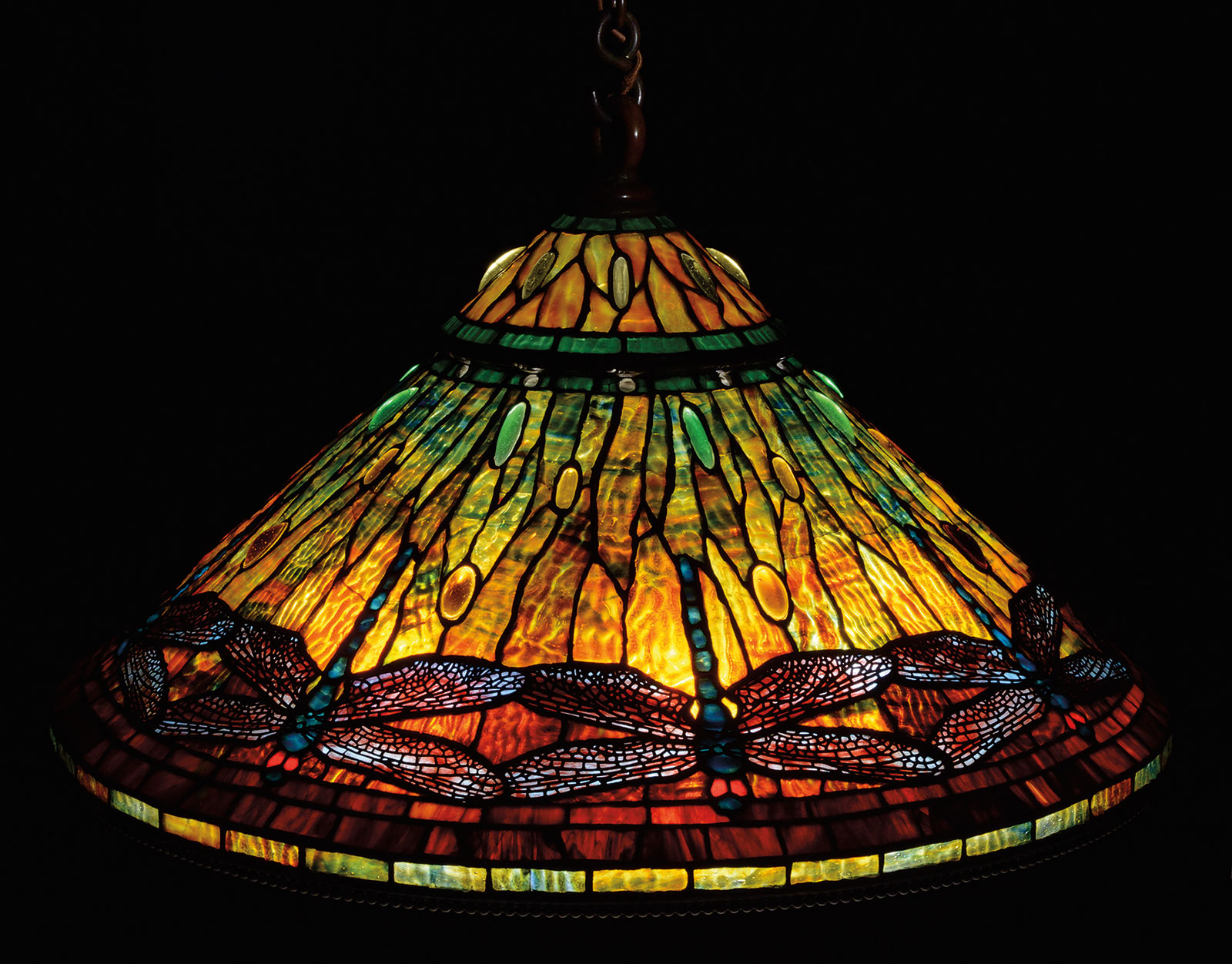
Another spectacular Tiffany highlight was lot 1099, a dichroic leaded chandelier with dragonflies surrounding the shade. The colors were just spectacular, each dragonfly having a blue body, red eyes, as well as red and blue striated wings. The dragonflies were set against a rich amber, blue and green background of heavily ripple-textured glass. Estimated at $100,000-150,000, this magnificent chandelier sold for an impressive $228,100.

Lot 1365 was a wonderful Tiffany Studios Wisteria leaded glass window with multi-colored purple and blue glass forming the overall wisteria patterns. Each blue wisteria panel is plated on the back side with various panels of confetti and striated glass forming individual petals of the wisteria flower, giving great depth of color. A large panel of striated amber glass is painted on the backside with a scenic design of a tree and pond, which is then plated over with a red panel creating great depth in the window. This window shattered its pre-auction estimate of $100,000-150,000 and sold for $257,850.

The Lotus design is one of the most complex geometric patterns that Tiffany Studios offered, and lot 1104 was an excellent example in mottled and striated green and cream panels. The shade rested on a Tiffany Studios bronze base complete with a 6-socket cluster and was finished in a rich, deep brown patina. This study in Tiffany craftsmanship exceeded its pre-auction estimate of $60,000-80,000 and went out at $84,700. Lot 1111, a Tiffany Studios leaded chandelier with all over clematis design, also exceeded its estimate of $40,000-60,000, selling for $76,625.

Private estates continue to do well at James D. Julia, and this auction was no exception. Two magnificent private estates were offered completely without reserves in this sale, and the market responded with a lot of pre-auction buzz that led to competitive bidding on every lot. One of these was an estate from a private collector in Texas who had amassed an impressive collection of Tiffany Studios leaded glass, art glass from Daum Nancy, Mt. Washington, Quezal and Stueben, as well as a fabulous collection of estate jewelry. The combined sale price for this estate was over $1.5 million, nearly doubling its low estimate $793,000.

The other unreserved private estate that James D. Julia was particularly honored to handle was the estate of Lynda Cunningham, a well-known Tiffany collector from upstate New York. The Lynda Cunningham Estate Collection included a treasure trove of Tiffany Studios metal work and achieved 100% sell through, with overall gross sales of $792,671 which more than doubled the low estimate of $354,200. One of the marvelous highlights from this estate had to be lot 1183, a Tiffany Glass & Decorating Company peacock mirror. Made with a cast bronze frame, the mirror had a peacock feather design enhancing the base and back, with blue iridescent favrile glass inlays making the eyes of each peacock feather in the base and appearing throughout the stylized floral border. This mirror, in like-new condition, was estimated at $2,500-3,500 and sold for $13,310. Another excellent example from the Cunningham Estate was lot 1252, a Tiffany Studios jeweled bronze candelabra with eight arms, each supporting a bulbous candle cup set with a band of iridescent glass cabochon jewels. The candelabra was finished in a rich brown patina and was complete with candle snuffer which stores within the center handle. Estimated at a modest $4,000-6,000, it doubled that and sold for $12,100.

The June 16th auction also included scarce cameo art glass from various well known makers, none scarcer than lot 1596, a Daum Nancy Cameo Snail Vase. Standing 13” tall, this vase had an acid cut grapevine pattern in bright vitrified colors against an internally decorated yellow, pink, orange and amethyst mottled background, and grape clusters with several applied discs to give them a three-dimensional appearance. What really made this piece special were the two applied and wheel-carved snails, which are very hard to find intact and undamaged as they were on this vase. Estimated at $17,500-22,500, the final sale price was $21,780.

Fine jewelry also performed quite well in this auction, with the combined total of jewelry lots sold exceeding the low estimate by 40%. The top grossing jewelry lot was lot 1020, a Cartier emerald and diamond ring centered by a 1.98ct emerald cut diamond that was flanked on either side with a natural Columbian emerald with deep, rich green color. This ring carried an estimate of $20,000-30,000 and sold for $20,570. Another jewelry highlight was lot 1033, a spectacular 18kt sapphire and diamond ring that was centered by a 7.08ct cushion cut natural blue sapphire flanked on either side trapezoid shaped diamonds with a total approximate weight of 1.30cttw. Estimated at $5,000-7,000, the ring topped out at $12,100.

“The response to the June Rare Lamp, Glass & Fine Jewelry auction was phenomenal, and I am very pleased with the results,” said department head Mike Fredericks. “With successes in every major category, Julia’s continues to provide great service with outstanding results to consignors and collectors alike. This is an exciting start to the year for our division, and I am very excited to see what the Fall 2017 sale will bring,” said Mr. Fredericks.

James D. Julia’s next auction will be Fine Art, Asian & Antiques on August 16, 17 & 18, 2017. The next Rare Lamps, Glass & Fine Jewelry auction will be in late November 2017.

About James D. Julia:
James D. Julia, Inc., one of the top ten antique auction houses in North America, is headquartered in Fairfield, Maine. The company also has an office in Boston, Massachusetts. In business for over 40 years, the company conducts high-end antique, collectible, and decorative arts auctions throughout the year. Julia’s routinely establishes new world records through its auctions. Julia’s has three divisions, including Rare Firearms and Militaria; Fine Art, Asian & Antiques; and Rare Lamps, Glass & Fine Jewelry. Each division is staffed by knowledgeable professionals and is internationally recognized and respected.

For more information on James D. Julia, Inc. and the company’s June 2017 Rare Lamps, Glass, and Fine Jewelry sale, please visit www.jamesdjulia.com.

Contact:
Mike Fredericks
Department Head, Rare Lamps, Glass, and Fine Jewelry
James D. Julia, Inc.
207-453-7125
lg@jamesdjulia.com

Image Description

Lot 1020. Cartier Emerald & Diamond Ring (Est. $20,000-30,000)

SOLD: $20,570


Lot 1099. Tiffany Studios Dragonfly Chandelier (Est. $100,000-150,000)

SOLD: $228,100


Lot 1104. Tiffany Studios Lotus Table Lamp (Est. $60,000-80,000)

SOLD: $84,700


Lot 1107. Tiffany Studios Turtleback Table Lamp (Est. $30,000-50,000)

SOLD: $72,600


Lot 1108. Tiffany Studios Dogwood Floor Lamp (Est. $100,000-150,000)

SOLD: $406,600


Lot 1111. Tiffany Studios Clematis Chandelier (Est. $40,000-60,000)

SOLD: $75,625


Lot 1183. Tiffany Glass & Decorating Co. Peacock Mirror (Est. $2,500-3,500)

SOLD: $13,310


Lot 1252. Tiffany Studios Jeweled Candelabra (Est. $4,000-6,000)

SOLD: $12,100


Lot 1365. Tiffany Studios Leaded Glass Wisteria Window (Est. $100,000-150,000)

SOLD: $257,850


Lot 1589. E. Michel Cameo Glass Bottle (Est. $15,000-20,000)

SOLD: $20,570


Lot 1596. Daum Nancy Cameo Snail Vase (Est. $17,500-22,500)

SOLD: $21,780


Lot 1685. Handel Reverse Painted Underwater Lamp (Est. $30,000-40,000)

SOLD: $36,300