Fairfield, Maine ~ November 7, 2014. As one west coast phone bidder put it, referring to Department Head Andrew Truman’s satisfaction with the auction thus far, “You can see that ear-to-ear grin all the way from California.” To almost punctuate that point, a previewer in attendance testing an antique cash register at that exact moment filled the hall with that emblematic (and apropos) “Cha-ching”. When the final hammer fell, Julia’s tallied over $1.4 Million, nearly a half million dollars over the total presale estimate of approximately $935,000.
The auction had all the makings for a blockbuster right from the start. Drawn fresh from three major collections, combined with select pieces from individuals from all over the United States, it was a nonstop parade of quality, condition, rarity, and diversity. With estimates that were realistic and conservative, bidders were treated to one spectacular piece after another.
Starting the show was the collection of the late Carol & Jerry Soling of Pound Ridge, New York. The Solings spent the better part of 40 years amassing an astounding collection of windup toys, still banks, advertising, and coin-op whose condition suggested the pieces hardly saw the light of day or hardly had a hand touch them. The family was represented by their daughter and her husband who watched the proceedings with great joy as they watched their parents’ objects find new homes. Highlights included a rare painted version Palace still bank with exceptional modeling and paint. It quickly surpassed its $4,500-6,500 estimate to land at a final price of $18,367. The collection continued with numerous house and building banks such as a rare painted Crown bank by J & E Stevens. This diminutive version of the footed bank with cupola and red trim was the object of much competition, selling for $5,806 against an estimate of $1,750-2,750. A Town Hall bank by Kyser & Rex painted in bright primary colors rather than the traditional japanned finish went out at $4,977 versus a $1,000-2,000 estimate. A large painted City Bank with more muted pastels was another stunner, hitting $4,740, tripling the low end of its $1,500-2,500 estimate. And a rare “Hold the Fort” still bank paid homage to a religious hymn of the same name with inserts picturing Moody & Sanky, two revivalists of the late 1800s. It filled the collection plates beyond its $2,500-3,500 estimate to $5,925.
From the same collection came a marvelous array of Lehmann tin windups, many of which retained their original boxes. Here too, condition was a strong concern of the Solings. Included were various rarities, the most significant of which was a “Walking Down Broadway” depicting a well heeled gentleman accompanied by his female counterpart walking their dog. Finding one at all is quite difficult, but finding one complete with its original box is almost unheard of. One determined bidder in attendance had decided before even making the trip to Julia’s that he was not going to leave without it. And he didn’t. Bids easily escalated past the $5,500-7,500 estimate, quickly leaving four digits behind. It finished up well into five, landing at $25,515 and setting a new World Auction Record in the process.
The auction continued with a great number of tin windup automotive vehicles and motorcycles. A most unusual clockwork limousine from the 1920s with its original box was a great find. Entitled “The Polite Chauffeur”, when activated, it would roll along the floor, stop, and the chauffeur would emerge from the vehicle to assist the female passenger in the rear of the limo. German engineering at its finest, it sold for $3,555 against an estimate of $1,000-1,500. An exceptional KiCo motorcycle with lithographed side panels and rider was more finely detailed than its contemporaries. It went to a bidder in attendance for $5,332, ignoring a $1,000-1,500 estimate. A rare Distler motorcycle and sidecar with rider and two female passengers was another hot ticket. With such unusual features as having the sidecar on the left side as opposed to the traditional right side and a windup mechanism in the rear, it hit a final price of $7,110 against an estimate of $1,500-2,500. And a lot of two desirable Indian motorcycle toys including a hand operated sparkler went out at $4,147, more than 20 times its $200-300 estimate.
Toys from other collections included a variety of pressed steel including several Buddy L pieces. Of particular note was a grouping of unusual vehicles similar to their flivver series. A couple different versions of their dump truck and a Huckster delivery van with that trademark front end construction and same black color saw strong action. The Huckster went out at $3,850 against expectations of $1,500-2,500. These were joined by other mainstays like a Buddy L stake body baggage truck sold just above its estimate for $1,896.
If heavier metals are more your thing, then a grouping of cast iron airplanes should be noted. These cast iron planes, modeled after the real thing of the 1930s, boasted great detail and surprisingly good condition given the vigorous use by boys of the period. Included was a scarce Hubley Lindy Lockheed Sirius with two riders in the dual open cockpits that sold above expectations of $1,750-2,750 for $3,555. Also bringing $3,555 was a vibrant yellow “Friendship” seaplane that brought within its $3,000-4,000 estimate. And a strong example of a large Hubley DO-X with six nickel plated engines atop its red ribbed wing landed at $3,851 against a $1,500-2,500 estimate.
Other toy highlights included a scarce Lutz/Marklin three-tiered tin fort that made for a wonderful display piece for one’s lead soldiers. Despite some condition issues, this rarity still saw active bidding, besting its $2,500-4,500 estimate to sell for $5,036. A lot of six O-gauge passenger cars made for Bassett Lowke had no such condition issues and sold well above its $1,000-1,500 estimate to sell for $2,488.
A selection of German Steiff fared well. A precious Apricot bear with charming facial features and retaining his original ear button sold for $2,607 against a $1,000-2,000 estimate. A 5-ways jointed white Steiff bear from 1907 in very good condition sold at the upper end of its $1,500-3,000 estimate for $2,844. Also bringing $2,844, beating out his $1,000-2,000 estimate was a handsome and very desirable Steiff “Bully” dog with his original bell, collar, and metal rimmed chest tag. And a duo of Steiff felt dolls, a charming uniformed soldier with black shoebutton eyes and a rare and lovely girl doll with her original box, “Jrmgard” chest tag, and ID bracelet sold for $1,422 and $1,185, respectively, each selling within estimate.
The auction also featured a varied grouping of quality antique advertising items that performed admirably including numerous pieces that seldom (if ever) hit the marketplace from the Richard J. Miller collection. Featured were large scale early movie posters, lithographed paper signs for soda, tobacco, early medicinal products, etc. Of the many highlights, interest ran high on his exceptional grouping of Buffalo Bill and 101 Ranch posters. Posters promoting this master showman with their highly detailed images and eye catching illustrations are exceedingly rare and highly sought after. One such example was the imposing three-sheet poster showing Buffalo Bill sitting calmly on the sidelines of his great spectacle, awaiting his cue to enter and save the day. Dripping with arrogance and charisma, this life size image of Cody was irresistible. The poster sold for $13,035, more than quadrupling its $3,000-6,000 estimate. An example picturing a young Chief Red Cloud scouting a prairie landscape below illustrative copy for Buffalo Bill’s Wild West and Congress of Rough Riders of the World show, too, was an impressive piece in every way. It finished up at $10,665, topping its $5,000-10,000 estimate. An action packed example detailing a dramatic scene of Buffalo Bill storming an Indian encampment with his band of Rough Riders in the nick of time to save two settlers sold for $7,110 against a $3,000-6,000 estimate. And a marvelous poster showing a violent train robbery of a Wells Fargo payroll car, complete with exploding dynamite, hauled in $5,214, besting a $2,500-4,500 estimate.
Imagery relating to the Wild West, Indians, and that era was an apparent theme within Miller’s collection, and is highly desirable by today’s collectors. One hanger advertising Warner’s Safe Yeast remedy, illustrating a young brave and his squaw navigating a raging river in their birch bark canoe finished up at $5,925 (est. $2,000-3,000). A vibrantly stone lithographed paper poster for Kickapoo Indian Remedies that featured a native princess amid eye catching ad copy was among the collector’s final purchases, having acquired it from a Julia auction just over two years ago. It found a buyer at $12,442, just above its $8,000-12,000 presale estimate. It was his carved cigar store Indian that topped them all though. This tobacconist figure from the late 1800s and attributed to master carver Samuel Robb was in exceptional condition with superb paint and patina. One of the finest examples to hit the market in recent years, it found a buyer at $29,625 against a conservative estimate of $6,000-8,000.
Another strong area in the Miller collection that saw much activity was in the beer category. Two curved glass corner beer signs, one advertising Illinois’ Bluff City Brewery and the other, Wisconsin’s Walter Beer, sold for $6,517 and $2,962, respectively, each surpassing a $1,200-1,600 estimate. A lot of here brewery signs including a rare paper litho factory scene for Lemp Brewery sold for $10,072 (est. $800-1,200).
The collection continued with a selection of rare movie and theater posters. Highlights included an exceedingly rare and bold poster for Arthur Conan Doyle’s
Sherlock Holmes tale “The Hound of the Baskervilles”. Among the most highly sought after of film posters, it found a buyer within its $10,000-20,000 for $18,960. A marvelous example advertising “The Blue Dahlia” went out at $2,962 against a $3,000-5,000 estimate. And a heart stopping and rare poster for “Moon Over Miami” featuring a sultry Vargas image of Betty Grable and her famous legs sold for $2,488t
Miller had been a man about town in New York City early on, often associating with actor types, and theater posters and the like seemed a logical extension. Some of the splendid examples he acquired during his lifetime included a large scale poster entitled “On the Bowery” picturing Steve Brodie leaping from the Brooklyn Bridge. Estimated for $1,000-1,500, it sold for a solid $10,072. A lot of two rare posters for magician Kellar the Great, consorting with and taking counsel from the devil found a buyer at $8,295 against expectations of $2,000-3,000.
Defying category were two unusual lighting items. A bronze based office lamp with a triangular shade inset with glass panels, each reading “Postal Telegraph” looked straight out of a noir film. It caught the eye of several bidders, but went to the one willing to go to $3,555, paying no attention to the $500-700 estimate. The following lot was a marvelous hanging cubical shade hand painted “Tourist Rooms” on four sides separated by a geometric pattern. It sold for $1,540 against a $300-600 estimate.
From other collections came a variety of other advertising including a selection of large scale hand painted tin signs by Ithaca Sign Works. One such example pictured a group of folks out for a Sunday drive in their open air Ford vehicle. Advertising Bierkamp’s sales and service garage in Durant, Iowa, this rare sign sold for $16,590, surpassing an estimate of $9,000-12,000.
Again, frontier and cowboy imagery proved to be a strong category. A scarce advertisement of a lovely cowgirl on horseback distancing herself from he pack in an informal race was a sleeper, selling for $5,036 against a $400-600 estimate. A selection of firearms posters and calendars included a 1909 poster for Winchester of two flushed grouse in a woodland setting that sold for $5,036 (est. $2,000-4,000) and a winter scene poster picturing Teddy Roosevelt riding horseback on a snow capped mountain trail that sold for $4,147 (est. $3,000-5,000).
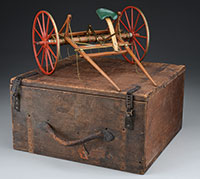
Salesman samples, always a popular advertising collectible that Julia’s specializes in included farming implements, household objects, furniture, machines, etc. Highlights included an exceptional Clinton hay rake with its original carrying case. Exceptional craftsmanship down to the smallest detail, its wood and brass construction is evidence of a quality full sized product. Well cared for due in part to being kept in its original wooden carrying case, it sold for $20,145, well exceeding its $2,500-3,500 estimate. It was joined by two salesman sample sickle bar mowers, one of which retained its original carrying case. It brought $7,702 against a $2,500-4,500 estimate. A salesman sample farm scale with exceptional detail went out at $4,147, outweighing its $1,000-1,500 estimate.
From a longtime customer and consignor of Julia’s who has begun the process of downsizing came a marvelous collection of salesman sample or scale model furniture. Several created by Sacks of Boston in the early 20th century, these store displays were truly breathtaking. Included was a beautiful federal mahogany bowfront sideboard with burl panel doors and drawers all on slender tapered inlaid legs. True to scale in every way, this gorgeous piece went out at $5,925 against pre-auction expectations of $2,500-3,500. An exquisite salesman sample triple pedestal dining room table with an inlaid satinwood border likewise sold for $5,925, surpassing a $2,000-3,000 estimate. An inlaid burl veneer step back two-part butler’s secretary with geometric panel windows sold for $4,147 against an estimate of $2,000-2,500.
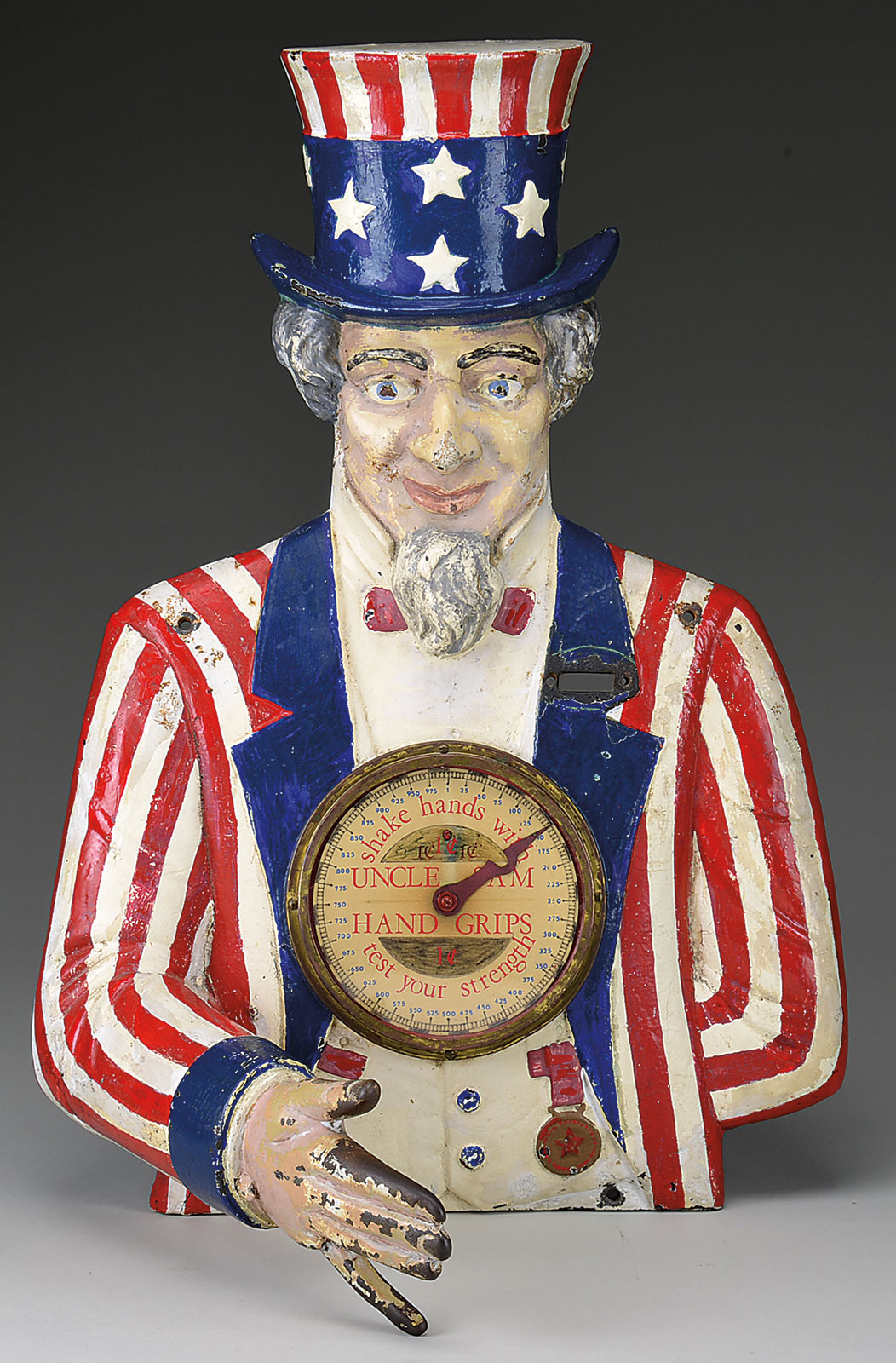
The sale continued with a variety of coin-op and music machines. Chief toy, doll & coin-op consultant Jay Lowe put it best when he said, “Once again, it is obvious to see that also in the field of toys, dolls, and coin-op machines over the past decade the pendulum has swung. Collectors consider condition to be king, and they are willing to pay record prices for choice condition pieces.” Case in point, from the Soling collection came a variety of penny gum machines including an Ad-Lee E-Z vendor in perhaps the best known original condition. Complete with its original marquee and bracket, its original box and an original box of gumballs, it exceeded an estimate of $1,250-1,750 to sell for $4,147. Compare this with a lot of two restored examples that went out at $1,777. Perhaps the big surprise in the coin-op section was the outstanding and rare Goo Goo penny gum vendor. This machine with a decorated front iron casting over a wooden case featured its original side panel decals of Brownie type characters. It is considered by many to be one of the most highly sought after machines around. The phones were quite active, and in the end it came down to a bidding war between a phone bidder and Jay Lowe, who was bidding on behalf of a client. Jay’s client was ultimately beat out, going to the phone bidder who brought the final price to $42,660, well beyond its $15,000-20,000 estimate. From the Miller collection came a top casting of Uncle Sam from the popular strength tester machines. Although reproduced over the years by several entities, this was an original version, missing a few mechanism pieces and its wooden base but retaining “park paint”. It was a strong performer at $13,035, well surpassing expectations of $600-1,200. Other highlights included a scarce Adams Pepsin Tutti Frutti gum vendor with wonderful porcelain panels and a nickel and glass Honey Breath mint dispenser. In very fine original condition, both neared their mid-estimates to sell for $5,925 apiece.
Music machine highlights included a massive Regina upright 27” disc playing music box. Housed in a regal oak case, it brought $13,035 against a $9,000-11,000 estimate. A Capital cuff playing music box in beautiful cherry wood sold for $2,370 against a $600-800 estimate. A duo of Edison opera phonographs likewise helped keep an upbeat tempo. One example coming from the family of the original purchasers retained its original wooden horn, rested on its original cabinet, and came with over 200 cylinders. It went out at $6,517 against a $3,000-4,000 estimate. And an Edison Model A, SM opera phonograph estimated for $1,200-1,800 sold for $3,555.
Julia’s also presented a vast selection of over 200 dolls. Running the gamut of genres and materials, bidders were treated to numerous fine bisque French and German examples that haven’t seen the marketplace for quite some time. True artists with a flare for the elaborate created some of the most captivating expressions one could hope to find. Featured in the sale were handpicked selections from the Madelyn Trotter Collection of Pacific Grove, California. This renowned and exacting dealer/collector focused on better quality dolls for over 40 years. Highlights included some exceptional French bebes and German character dolls. Perhaps central to the collection was an exceedingly rare 21” Kammer & Reinhardt 107 boy doll known as Karl. His painted blue eyes, generously proportioned ears, and full pouting lips gave him the most engrossing woeful expression. He changed hands at $23,700, within an estimate of $20,000-30,000.
French dolls included a charming Depose Jumeau E. 9 J. with brown paperweight eyes and nice modeling. Quality and beauty throughout, she sold for $3,910 against a $3,500-5,500 estimate. A slightly smaller Depose Jumeau E. 7 J. with an equally charming expression went out at $4,740, just above its $3,500-4,500 estimate. An early Jumeau 6 (over) E.J. with her original skin wig sold for $5,332. And a lovely Bru Brevete bebe with blue threaded paperweight eyes and delicate facial features changed hands at $8,887.
From other fine doll collections came such beautiful offerings as a diminutive cabinet size Bru Jne bebe with deep blue paperweight eyes and terrific presence. She beat out a $10,000-12,000 estimate to sell for $13,035. A Circle Dot Bru Bebe with amber paperweight eyes and mauve shadowing found a buyer at $7,702. A rare French fashion doll attributed to Barrois depicting a woman of color, which was not a common subject in the period. This rare and superb doll was dressed in a royal blue silk gown with long silk train. Approaching the upper end of her $5,000-8,000 estimate, she finished up at $7,110. And a beautiful towering 28” Jumeau fashion with piercing blue paperweight eyes and sublime expression neared the upper end of her $4,000-6,000 estimate to bring $5,925 while a pale bisque Jumeau fashion sold for $4,443 against expectations of $2,200-2,800.
Julia’s upcoming auctions include their winter antiques, fine art, and Chinese artifacts auction in February while a phenomenal firearms and military memorabilia auction will be held in March. Julia’s next toy & doll auction as well as their rare lamp & glass auction will follow in June. Julia’s is currently accepting consignments for these and other upcoming auctions. Call immediately for inclusion in these exciting sales. For more information or to place offers on unsold items, contact their offices at 207-453-7125. James D. Julia, Inc., P.O. Box 830, Dept. PR, Fairfield, ME 04937. E-mail: info@jamesdjulia.com.
| Image |
Description |

|
Music machine highlights included a massive Regina upright 27” disc playing music box. Housed in a regal oak case, it brought $13,035 against a $9,000-11,000 estimate. |

|
From the Madelyn Trotter Collection came some exceptional French bebes and German character dolls such as this exceedingly rare 21” Kammer & Reinhardt 107 boy doll known as Karl. His painted blue eyes, generously proportioned ears, and full pouting lips gave him the most engrossing woeful expression. He changed hands at $23,700, within an estimate of $20,000-30,000. |

|
From the Soling collection came a marvelous array of Lehmann tin windups including this “Walking Down Broadway” depicting a well heeled gentleman accompanied by his female counterpart walking their dog. Finding one at all is quite difficult, but finding one complete with its original box is almost unheard of. Bids easily escalated past the $5,500-7,500 estimate, landing at $25,515 and setting a new World Auction Record in the process. |

|
From the Soling collection came a rare painted version Palace still bank with exceptional modeling and paint. It quickly surpassed its $4,500-6,500 estimate to land at a final price of $18,367. |
|
This diminutive cabinet size Bru Jne bebe with deep blue paperweight eyes and terrific presence beat out a $10,000-12,000 estimate to sell for $13,035. |

|
One of the biggest surprises was the outstanding and rare Goo Goo penny gum vendor. This machine with a decorated front iron casting over a wooden case featured its original side panel decals of Brownie type characters. Considered by many to be one of the most highly sought after machines around, it went to a phone bidder for $42,660, well beyond its $15,000-20,000 estimate. |

|
A selection of rare movie and theater posters included an exceedingly rare and bold poster for Arthur Conan Doyle’s Sherlock Holmes tale “The Hound of the Baskervilles”. Among the most highly sought after of film posters, it found a buyer within its $10,000-20,000 for $18,960. |
|
This tobacconist figure from the late 1800s attributed to master carver Samuel Robb was in exceptional condition with superb paint and patina. One of the finest examples to hit the market in recent years, it found a buyer at $29,625 against a conservative estimate of $6,000-8,000. |

|
From the Miller collection came a top casting of Uncle Sam from the popular strength tester machines. This original version, missing a few mechanism pieces and its wooden base but retaining “park paint” was a strong performer at $13,035, well surpassing expectations of $600-1,200. |

|
Of the exceptional posters from the Miller collection, this imposing three-sheet poster showing Buffalo Bill sitting calmly on the sidelines of his great spectacle, awaiting his cue to enter and save the day sold for $13,035, more than quadrupling its $3,000-6,000 estimate. |
|
Salesman samples included an exceptional hay rake with its original carrying case. Exceptional craftsmanship down to the smallest detail, its wood and brass construction is evidence of a quality full sized product. Well cared for due in part to being kept in its original wooden carrying case, it sold for $20,145, well exceeding its $2,500-3,500 estimate. |

|
A selection of large scale hand painted tin signs by Ithaca Sign Works included this marvelous example of a group of folks out for a Sunday drive in their open air Ford vehicle. Advertising Bierkamp’s sales and service garage in Durant, Iowa, this rare sign sold for $16,590, surpassing an estimate of $9,000-12,000. |