Julia’s Kicks Off 2015 with 3-Day Antiques & Fine Art Auction

Fairfield, ME ~ February 4-6, 2015. Auction veterans of nearly 50 years, James D. Julia, Inc. has been on a steady trajectory showing significant growth for several years running. 2014 saw the firm reach another company best with over $54 Million in sales, a yearly gross that has been increasing with each consecutive year. They’re about to kick things off with an auction that will help pave the way for an exciting 2015. The Fine Art & Antiques team has once again assembled a stunning array of fine art, antiques, folk art, Asian artifacts, and historical items from various collections and estates from across North America including over 300 paintings and other artworks.
The ample array of art is augmented by two important works by renowned commercial artist Howard Terpning whose credits include Time, Newsweek, Field & Stream, and the movie industry doing the artwork for posters for “The Guns of Navarone” and “Dr. Zhivago”. Later known as an award winning Western painter, he became friends with noted gun expert and reference book author, Norm Flayderman, from whose estate the paintings were consigned. The first shows a rugged frontiersman traversing a picturesque mountain pass on horseback. The second depicts what appears to be the same man on a different expedition with his Indian guide on a snowy outcropping. The two works, inscribed with a dedication by the artist to his friend Norm Flayderman come estimated for $200,000-300,000 and $175,000-275,000, respectively.

Also featured are selections from a private Boston collector whose keen eye for quality Cape Ann school works brought him to some of the finest galleries in the Northeast to make his favored purchases. Included are such luminaries as Aldro Hibbard, William Lester Stevens, Thomas Nicholas, Emile Gruppe and others who take us through the distinct seasons for which New England is known. Gruppe’s “Autumn in Vermont” focuses on a lone tree overlooking a river valley, withering in anticipation of a long winter. It carries a presale estimate of $6,000-8,000. Nicholas’ “Valley Farm, Vermont” offers another view of the state’s rolling hills; this one depicting rural residents amid a blanket of snow. It, too, carries a $6,000-8,000 estimate. From the same collection, John Terelak’s impressionistic “Spring Trout Fishing” captures a tranquil moment on a wooded and sunlit stream. It is expected to bring $4,000-6,000. The auction continues with numerous works by these and other fine New England artists from other collections including Charles Woodbury’s “Playing in the Waves” that depicts several bathers in suits that leave everything to the imagination. It’s estimated for $10,000-15,000.

The diversity continues with numerous nautical works by such names as Louis Dodd, S.F.M. Badger, and of course Antonio Jacobsen. His depiction of the steamer “Guyandotte” cutting through the towering waves comes estimated for $8,000-12,000. Louis Dodd’s portrait of the “Roanoke” beneath the Brooklyn Bridge prior to her maiden voyage carries an estimate of $18,000-25,000. And Badger’s portrait of the “Sovereign of the Seas”, a massive three-mast schooner, is expected to bring $10,000-15,000.

A selection of illustration art includes several works by published artist Eric Pape. Pape, besides his prolific career in the arts, was instrumental in designing and circulating the petition to Congress to preserve the famous U.S.S. Constitution (Old Ironsides) from destruction in 1906. His artwork contained in this auction includes his oil on canvas work depicting actress Clara Syde in her role as Angel of the Vision scene in “Canterbury Pilgrims”, a play performed at an outdoor festival in Gloucester, Massachusetts honoring President Howard Taft. It comes estimated for $4,000-6,000. One of Pape’s contemporaries, and famous in his own right, Dean Cornwell is represented by a large scene of an opium den showing a dimly lit dingy room that appears to have seen its share of action. It carries an estimate of $15,000-25,000.

European art is highlighted in part by Jean Frederic Schall’s “La Petite Danseuse La Rose” of a lovely young ballerina in an elaborate gown. With provenance to a French countess, the piece comes estimated for $10,000-20,000. An oil on board study attributed to Spanish artist Joaquin Bastida depicting two men taking a dip off the bow of a skiff is estimated for $15,000-25,000.

The day continues with a selection of bronzes by such renowned artists as Ferdinand Pautrot, Pierre Tourgeuneff, John Terken, and others. Other visual art includes a rare offering of five select groupings of original photos by Richard Avedon. While the photographer’s name may not be recognizable to the uninformed, the iconic images herein are known the world over to every generation on the planet. Featured are images of all four Beatles at the height of the Psychedelic era as well as lots picturing folk idol Bob Dylan. These hallowed image lots come offered with estimates ranging from $2,000 to a high of $8,000.

The second day features a vast array of antiques, furnishings and folk art including over two dozen weathervanes chosen from private collections and acquisitions from across the country. Featured will be a large and well detailed hollow molded copper grasshopper weathervane. Attributed to L.W. Cushing and Sons of Waltham, Massachusetts, it displays a marvelous verdigris and gilt surface and realistic elements. It comes estimated for $60,000-80,000. A flattened copper example attributed to A.L. Jewell, also of Waltham depicts a formal gentleman atop a trotting steed, it carries a $12,000-18,000 estimate. A large “Nelson” running horse weathervane by Washburne or Mott of New York features a well modeled horse with cast zinc head and hollow copper body. It is expected to sell for $6,000-8,000. Other examples include a rare horse drawn sleigh, a quill, a copper galleon, and a variety of animals for whichever way the wind blows.

Other folk art includes a very rare set of 25 carved and painted shore birds by master decoy carver A. Elmer Crowell. From a private collection, consigned by the grandson of the original purchaser and accompanied by the original bill of sale the desirable set carries an estimate of $10,000-15,000.

The auction continues with various historical documents, books, and objects from the Judge George Greene Museum of Southern History ranging from archaic fossils to American Civil War relics. Greene was one of the longest serving judges in Alabama history with over 34 years of continuous dedicated service. He was also a passionate and avid collector and researcher of history and ultimately became highly regarded for his research and collection. Of particular note will be an effigy pot in the form of a dog circa 1300 A.D. found at the Neisler Indian Mounds in Taylor County Georgia in 1928. One of the most popular exhibits at Greene’s museum, this exceedingly rare funerary object comes estimated for $20,000-30,000. Equally fascinating is a trove of original sheet music, broadsides, and photographs relating to piano virtuoso “Blind Tom” Wiggins. Born blind and possibly autistic, he was a “throw-in” when his parents and two of his purported 19 siblings were purchased by a Columbus, Georgia lawyer. Essentially born into slavery, he was discovered at a very early age to be able to memorize and mimic the most sophisticated pieces of music ever written. He could sing in German, French, and English by the age of 10. He quickly became a “prized possession” for the family and eventually became famous, performing all over the world and making his owners royal sums of money. The grouping, which took almost an entire room in the museum to display, comes estimated for $10,000-20,000.

Other historical items of note include a collaborative oil on panel created by Lambert Sachs and Paul Weber picturing General Washington at prayer at Valley Forge. Accompanied by a rare lithograph by Peter Kramer based on this very painting, the lot carries an estimate of $70,000-80,000. Also up for bid will be two lots of Presidential porcelain dinnerware. Included will be a lot consisting of two demitasse cups and saucers as well as a plate from the Harrison administration. The following lot is a rare Canton footed open salt from the Thomas Jefferson dinner service. The lots carry estimates of $1,200-1,800 and $2,000-2,500, respectively.

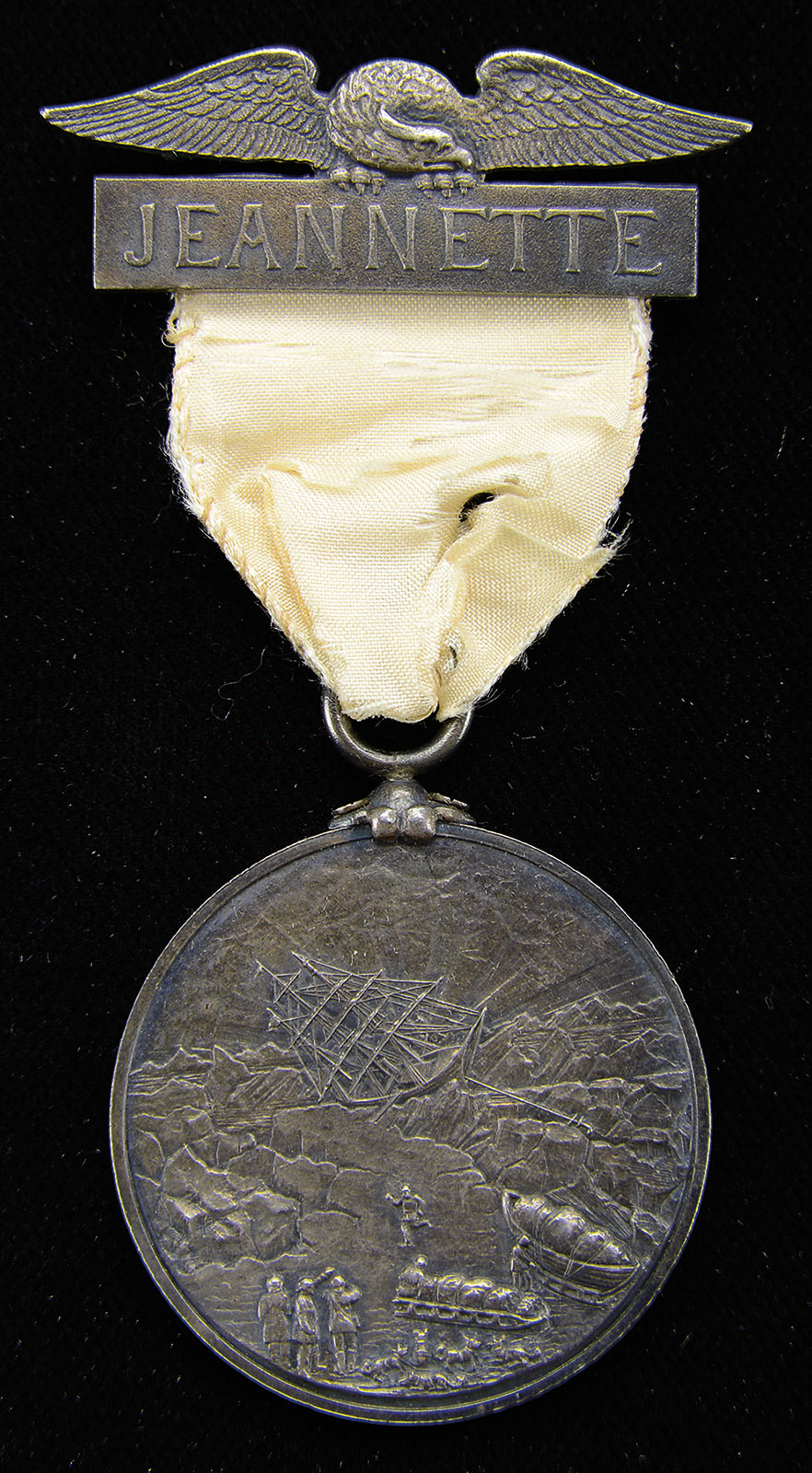
Also worthy of note will be a rare silk flag made by Sarah Wilson, the great granddaughter of Betsy Ross, the original creator of our stars and stripes. Patterned after Ross’ creation, it further cemented her legacy as a historical figure for all time. Ross pattern flags seldom come to public auction, so this represents a singular opportunity one may never see again. It comes estimated for $3,000-5,000. Another rare opportunity is an exceedingly rare silver Congressional Medal for Herbert Leach of the Jeannette Arctic expedition of 1879-1882. This ill fated mission soured shortly after departure, becoming trapped in an ice pack and drifting north toward the Pole for the next 21 months. Provisions dwindled and eventually the ship began to give way under the pressure of the ice and sank. Leach was one of the 25 survivors and was given this medal, which descended through the family until being consigned to Julia’s. It now comes offered with an estimate of $10,000-20,000. An important and historic Portland, Maine Civil War soldiers quilt, circa 1864, consists of a field of patchwork and appliqué red and blue stars around a central stars and stripes shield. Purported to have been created as a gift for Abraham Lincoln, it comes estimated for $8,000-12,000.

The sale is rounded out by a large selection of early American furniture from the mid-18th and mid-19th centuries. Highlights include dressers, secretaries, cabinets, tables, and much more. Day III will be dedicated to a wide selection of Asian antiques including a large offering of jade carvings, soapstone seals, porcelain export, bronzes (including Ming), scrolls and watercolors, table and floor screens, textiles, cloisonné, furniture, and much more. Of special note is a rare and finely carved rhinoceros horn figure of Budai from the Wanli Period (1573-1620). Typically depicted with a joyful expression and wearing loose fitting robes to reveal his plump stomach seated representing contentment and abundance, Budai is also associated with the protection of children and is often shown with small children playfully climbing on his belly or back. Figural carvings from rhinoceros horn are rare but the most common depictions include Manjusri and Budai. The current carving of Budai ranks among the most impressive and elaborate depictions of the subject matter. A very closely comparable carving of Budai formerly in the Ruth Dreyfus and Arthur M. Sackler collections is illustrated by Thomas Fok, Connoisseurship of Rhinoceros Horn Carving in China, and again by J. Chapman, The Art of Rhinoceros Horn Carving in China, and was sold at Christie’s New York in December 1994. Another related example formerly in the George and Mary Bloch collection illustrated by J. Chapman, The Art of Rhinoceros Horn Carving in China was sold at Sotheby’s Hong Kong in October 2005. This lot carries an estimate of $30,000-40,000.

More information on the Julia auction can be obtained by going to their website at www.jamesdjulia.com or calling 207-453-7125; contact Tony Greist; Department Head at tgreist@jamesdjulia.com. Free full-color brochures are available, or their lavish, full-color, detailed and illustrated catalogs are available for $40. Previews for the auctions will be Tuesday, February 3 from 9am-5pm, and Wednesday through Friday (February 4-6) from 8-10am and during the auction sessions. The auction commences at 10am on the days of the sale at Julia’s auction facilities on Rt. 201 in Fairfield, Maine.

Image Description

A rare opportunity is an exceedingly rare silver Congressional Medal for Herbert Leach of the Jeannette Arctic expedition of 1879-1882. This ill fated mission soured shortly after departure where many crewmembers perished. Leach was one of the 25 survivors and was given this medal, which descended through the family until being consigned to Julia’s. It now comes offered with an estimate of $10,000-20,000.

Dean Cornwell is represented by a large scene of an opium den showing a dimly lit dingy room that appears to have seen its share of action. It carries an estimate of $15,000-25,000.

A trove of original sheet music, broadsides, and photographs relating to piano virtuoso “Blind Tom” Wiggins, which took almost an entire room in the Judge George Greene Museum of Southern History comes estimated for $10,000-20,000.

An exceedingly rare effigy pot in the form of a dog circa 1300 A.D. found at the Neisler Indian Mounds in Taylor County Georgia in 1928 comes estimated for $20,000-30,000.

The ample array of art is augmented by two important works by renowned commercial artist Howard Terpning whose credits include Time, Newsweek, Field & Stream, and the movie industry doing the artwork for posters for “The Guns of Navarone” and “Dr. Zhivago”. This piece shows a rugged frontiersman traversing a picturesque mountain pass on horseback. It carries an estimate of $200,000-300,000.

The following lot by Terpning depicts what appears to be the same man on a different expedition with his Indian guide on a snowy outcropping. This one is estimated for and $175,000-275,000.

Nautical works include Louis Dodd’s portrait of the “Roanoke” beneath the Brooklyn Bridge prior to her maiden voyage. It carries an estimate of $18,000-25,000.

A rare and finely carved rhinoceros horn figure of Budai from the Wanli Period (1573-1620) and formerly in the Ruth Dreyfus and Arthur M. Sackler collections, it carries an estimate of $30,000-40,000.

A collaborative oil on panel by Lambert Sachs and Paul Weber picturing General Washington at prayer at Valley Forge carries an estimate of $70,000-80,000.

Other visual art includes a rare offering of five select groupings of original photos by Richard Avedon. While the photographer’s name may not be recognizable to the uninformed, the iconic images herein are known the world over to every generation on the planet. Featured are images of all four Beatles at the height of the Psychedelic era as well as lots picturing folk idol Bob Dylan. These hallowed image lots come offered with estimates ranging from $2,000 to a high of $8,000.

A very rare set of 25 carved and painted shore birds by master decoy carver A. Elmer Crowell and consigned by the grandson of the original purchaser, the desirable set carries an estimate of $10,000-15,000.

Selections from a private Boston collector whose keen eye for quality Cape Ann school works brought him to some of the finest galleries in the Northeast to make his favored purchases. Included are such works as Gruppe’s “Autumn in Vermont”, which focuses on a lone tree overlooking a river valley, withering in anticipation of a long winter. It carries a presale estimate of $6,000-8,000.

Folk art includes over two dozen weathervanes chosen from private collections and acquisitions from across the country. Featured will be a large and well detailed hollow molded copper grasshopper weathervane attributed to L.W. Cushing and Sons of Waltham, Massachusetts. It comes estimated for $60,000-80,000.

Mister Magnum – Elmer Keith by Wes Dillon

To most firearms aficionados, Elmer Keith needs little introduction. Keith’s iconic trademarks were his love for tobacco, his ten-gallon Stetson hat, right of center point of view, and practical expertise. Elmer became arguably the most famous and prolific gun writer in all of America over the span of his 60 year career. Even today his articles and books are widely reprinted with the content being as applicable, timely and entertaining as the day they were written.

Elmer Merrifield Keith was born March 8, 1899 in Hardin, Missouri, the heart of “Red Leg” guerrilla country during the Civil War. The Keith clan knew many of the legendary characters of the day and baby Elmer was fed tales of gunfighters, outlaws and cowboys while in the cradle, instead of Mother Goose and nursery rhymes every day. The age of the wild frontier was coming to a close and the new gilded age of progress and innovation was at the doorstep… at least in more urbanized America east of the Mississippi. Elmer’s father, growing restless from the relative hustle and bustle of borderline Missouri, set out for western Montana, to raise his family and earn his keep tending the mercantile in a more comfortable environ…Elmer was six and his boyhood role models were the old war heroes, gunfighters and vigilantes of the frontier. As a young boy he spent many Montana summers in the company of such characters which served to mold and shape Elmer’s unique outlook and shooting skills.


Fabulous Factory Engr S&W Pre-M29 .44 Mag,
Pres to EK by S&W boss Carl Helstrom
(Elmer Keith Estate Coll.)

As a young man, Elmer was primarily a ranch hand and big game wrangler/guide in Oregon and Idaho. His tools were of the trade were a horse and a gun. He had a keen understanding of what worked for him and why, and began modifying his guns and ammunition to suit his needs and insatiable curiosity. He began to share his ideas with some of the early gun writers of the day with bits of shared ideas appearing in print as a result of his observations in the field. The first published article was in the American Rifleman in 1924. His writing style was pure and wreaked of frontier Americana as this excerpt, describing his epiphany, a July 4th celebration with his Colt SAA .45LC; “When the gun rose from recoil of the first cartridge I unconsciously hooked my thumb over the hammer spur and thus cocked gun as it recovered from recoil. When I turned the next one loose I was almost deafened by the report and saw a little flash of flame. My hand automatically cocked gun and snapped again but no report. I stopped then knowing something was wrong.


The Last Word in Sixguns, ca 1927…
The famous Colt SAA Number Five
(Elmer Keith Estate Coll.)

The upper half of three chambers was gone. Also one cartridge and half of another case. Also the top strap over cylinder. My ears were ringing otherwise I was all O.K.” (American Rifleman, August 15, 1925). Little did he know at the time that this event would change his life forever. Elmer kept the blown up cylinder as a visual reminder to himself that using oversized rifle bullets in a Sixgun was a No-No and the importance of proper bullet sizing on performance. This innocent Independence Day accident opened the door to a new career and independence for Keith. It is amazing to realize how ignorant Keith and most of the shooting world was in 1925 and how much he subsequently learned and taught us all. If that old Colt had not blown its top strap and cylinder, Keith may have spent most of his life ranching on the North Fork of the Salmon River and shooting his old .45 LC at Johnnie rabbits, with no one ever knowing what he was all about.

During World War II, he served as a small arms inspector at the Ogden, UT Arsenal with his cartouche, a small rectangle with initials OGEK. Martial arms that bear this inspector’s mark are now considered quite collectable by devotees. Post-war, Keith subsequently devoted his full efforts towards the shooting sports (both hunting and target) and writing about the results. His works largely focused on the real world performance of the latest new gun offerings firing large, heavy bullets pushed to high velocities as well as his own “hot rod” hand-loaded creations. His field tests across North America and Africa provided a wealth of fresh material. During his career, he served on the editorial staff of The Outdoorsman, The American Rifleman, Western Sportsman, Guns Magazine, and Guns and Ammo. Elmer also wrote 10 books, beginning with Sixgun Cartridges and Loads in 1936 and ending with his autobiography, Hell, I was there!, from 1979. His works are considered required reading for neophytes and serve as refreshment for the seasoned gunny Aside from his recognized and published works, Keith penned tens of thousands of personal letters that were hand-written to an ever growing throng of followers and antagonists from all walks of life and from all points on the globe. One might believe that his gruff exterior and remote lifestyle would harbor a solitary persona, but Elmer was very approachable. He was comfortable passing time with the ordinary Joe on the street and his Salmon, ID home was always open to those who made the pilgrimage in search of the truth or an argument. Elmer was very opinionated on matters where his experiences dictated facts and yet was not afraid to admit when he simply did not know something… a rare trait for someone in the public eye.


Elmer’s Personal Carry Gun…
S&W M 29 .44 Mag w /4″ bbl
in Milt Sparks FBI holster

(Elmer Keith Estate Coll.)

Elmer was keen to discuss Sixguns as they were his tools of opportunity, both as a young rancher and later as an accomplished scholar. He liked big bullets with big powder charges. This magnum mentality made Keith famous. His first contribution, the .357 Magnum, was the result of handloading the .38 Spl cartridge well past the red line, taking full advantage of the greater frame and cylinder strength of the revolvers of the day. The longer cased .357 Magnum first became available in 1935 and quickly became a favorite among law enforcement and civilian users. The S&W “Registered Magnum” was an overnight sensation.

The .44 Magnum was developed in much the same way, and was released commercially in 1956. Keith had earlier determined that the thinner chamber walls of the .45 Colt would not comfortably withstand the pressures generated by his own heavy loads (remembering the 4th). He subsequently began experimenting with the .44 Spl revolver, and used the same formula for pushing heavy bullets at high velocities. The resulting “.44 Special Magnum” was a formidable cartridge for handgun hunting, firing a 250 grain bullet at 1,200 ft/s, generating sufficient downrange energy to anchor most North American big game. Elmer himself extolled the virtues of the cartridge by writing about his dispatching a rifle wounded deer at 600 yards with his personal S&W Model 29. Where many will raise their eyebrows at the practice, few will question Elmer’s execution of the task.

The .41 Mag, released in 1963, was an attempt to reach an efficient middle ground between the .357 and .44 magnums. However, while there was (and still is) a small community of shooters preferring the .41 Magnum, the round failed to achieve a similar high degree of popularity. Hunters generally preferred the more commonly available .44 Magnum, which could be used with full house factory loads, modest handloads, or .44 Spl loadings as needed.

Of course these higher horsepower cartridges would require projectiles designed to handle the increased workload. Keith was also responsible for a number of bullet designs still popular today, and collectively called “Keith style” bullets. These bullets were based on the lead semi-wadcutter design, but using a wider than normal front surface, and convex sides. These changes increased the volume of the bullet outside the case, thus allowing more room inside the case, needed for larger charges of slower burning powders. The side bearing surfaces were also enhanced for accuracy and the wide basal profile minimizes gas blow by. These more massive lead bullets remain popular for both target shooting and hunting even among today’s jacketed and geometrically engineered offerings.

Aside from his ballistic contributions Elmer Keith had his own ideas on Sixgun design. In 1927, Elmer Keith wrote an article titled “The Last Word” for the American Rifleman magazine. By default Elmer had a lot of practice with Colt Single Action Armies. He knew what worked well and what he liked. Elmer set out to create the ultimate Sixgun… this piece would be the culmination of his years of experience, using the noted gunsmithing talents of R.F. Sedgley, Neil Houchins, J.D. O’Meara, and Harold Croft to design and build “The Last Word” in single action revolvers. The team spared no detail in the creation of what has come to be known as Keith’s Number Five.

The Number Five started like as a Colt Single Action Army chambered in .44 Spl, of course. From there, everything that could be tweaked was tweaked. The top strap of the frame was welded up into a flattop target configuration, with an adjustable rear sight added. The front sight was changed on the 5 ½” barrel to a hi-visibility Patridge style. To eliminate the possibility of the base pin moving forward under recoil, an ingenious design was created that uses a swinging lever to retain the pin positively in its place. The head of the base pin is enlarged for an easy grasp to aid in removal. The hammer was modified with a Bisley-type target spur, and the trigger was curved and moved closer to the back of the trigger guard. The unique grip of the Number Five was created by marrying a modified Bisley backstrap to a Single Action Army trigger guard. Add contoured ivory grips and the resulting is probably the most comfortable-to-shoot revolver grip ever designed.

Whereas Sixguns were convenient, big bore rifles were a requirement when the job to be done involved extremes…such as weather, range or mass of target. Elmer Keith was no less proficient with a shoulder mounted firearm than he was with a handgun… perhaps even more so. Elmer’s first rifle was a brand new Winchester M94 in .25-35 given to him by his father in about 1914. He killed his first deer with that rifle, but it took four or five shots and a half-mile chase across a mountain to finish the job. That was enough .25 caliber action for Elmer. He moved right into the heavy artillery opting for a Springfield trapdoor carbine in .45-70 that had been given to Elmer by an old stager driver. The .500 grain bullet was a handful to shoot but it anchored game in their tracks. Bigger was definitely better, but Elmer wanted to be able to shoot further as well…. Out to 1000 yards! As a kid, Elmer had to earn a membership in the prestigious Helena, MT Gun Club by first qualifying as Expert on a full NRA course at their annual club match with a borrowed rifle… Elmer made Expert with three points to spare, which was no accident and the club was compelled to grant membership.

As a big game guide in Idaho and Oregon, long range opportunities on big animals were a fact of life and Elmer knew what it took to get the job done. His working rifles were much like his Sixguns, built for delivering big bullets on target at range. Whether it was an old fashioned .45 caliber Sharps Long Range Buffalo rifle or a newfangled Custom Rifle in a high octane Wildcat caliber, with which he was equally proficient, Elmer Keith was all about performance. It was Go Big or Go Home!

Keith was instrumental in the development of various engineered wildcat cartridges, a few of which were later adopted as factory rounds. The .333 OKH (“O’Neil-Keith-Hopkins”), was made from standard.30-06 brass necked up to take the .333” heavy bullets of the Jeffery family. The .338-378 Weatherby, introduced in 1998, was developed based on another one of Keith’s wildcats, the .338-378 KT (Keith-Thomson), which he developed in the 1960s. Even at a half mile or more, trophy Elk were in danger.

Of course, any big bore enthusiast would also be an admirer of the classic nitro-breathing British stopping rifles as well. Indeed Keith was and had numerous examples in his personal collection. He used two of these doubles, a fabulous droplock Westley Richards chambered in .476 Nitro and a .sidelock Jeffery in .500NE, to take dangerous game in Africa on two different safaris. Keith documented the first of these hunts in his 1968 tome, Safari. The most famous double rifle in his collection was one used extensively by British author and big game hunter, Jim Corbett, a best quality boxlock .450-400 by W.J. Jeffery & Co., with which he killed so many man-eating tigers for the Indian government, chronicling his adventures for in a series of widely read books.

Elmer Keith remained active into his eighties when a tragic stroke robbed him of his physical abilities, and eventually his life in 1984. Today, Elmer Keith lives through his timeless writings, priceless imagery, and his iconic personal collection of firearms accumulated over the span of his storied life. Until very recently, a selection of his personal firearms collection and memorabilia had been wonderfully displayed at the Elmer Keith Museum housed inside Cabela’s Boise, ID retail showroom. The Museum display has since closed and the collection reassembled by the Keith family in preparation for its proper disposition to the people that loved Elmer the most… His fellow shooters.

Special Note: An exciting opportunity, which affects all those passionate about Elmer Keith and firearms history, has come to fruition. The highly anticipated and diverse array of firearms and accessories from the Iconic Elmer Keith Estate Collection will be a featured component of James D. Julia’s March 15-17, 2015 firearms auction in Fairfield ME. The items being offered at Julia’s includes treasures from Keith’s battery of African stopping rifles, highlighted by the legendary “Corbett Tiger Rifle”; the famous Jeffery .450/400, once the principal weapon of famed Tiger hunter Edward James “Jim” Corbett. Classic Farquarsons and magazine rifles by Hoffman Arms and C-H, including his Wildcats, along with a host of specialized hunting and target Sixguns by Smith& Wesson, Ruger, and Colt… The prize being Elmer’s much publicized, tricked out, and engraved Colt “SAA No.5” in .44 Spl which Keith called The Last Word in fine Sixguns. The importance of the Elmer Keith Estate Collection cannot be overstated. This truly represents a once in a lifetime opportunity to own a piece of firearms history. The Poulin Auction Co. will also be offering an important selection of Elmer’s utility arms and ammunition from the Keith estate, the days preceding the Julia sale. All items in the collection have remained in the possession of the Keith family since Elmer’s passing. See the auction websites for more information. www.jamesdjulia.com and www.poulinantiques.com .

The Making of a Woodblock Print

The Japanese Woodblock Print is an art form, which highlights flowing, curved outlines, simplistic forms as well as the detailing of flat areas containing color. This form of art has not only existed for a long time in Asian history, but it has also deeply impacted artists in both Europe and North America throughout the 19th century.

Woodblock printing was first used in Japan in the 8th century to print religious texts. Buddhists traveling from China brought these texts, as well as the printing method itself, to Japan. These first prints were made in a single color using only Sumi ink. The world would have to wait nearly 900 years for the first colored prints to appear. Early color prints were made using a single block and black ink. The colors were hand painted by workers in the print shops. It was only when the popularity of these prints exceeded the production capacity of the workshops that the true woodblock print evolved.

To meet the rising demand, the printers employed master carvers to make individual blocks for each of the colors in the print. Many of the finer woodblock prints contained 15 or more colors, requiring 15 different expertly carved wooden print blocks. Each of these blocks had to be carved with great precision to ensure that the colored sections met perfectly. Earliest among these images were private calendars that were printed without first by Suzuku Hornbook (1725-1770), and later with other various artists. One of the most famous of Suzuku Hornbook’s print was the image “The Køya Jewel River”.

Beginning in the mid-1760s, the newly discovered color prints were sold commercially; their depictions included themes that were both classical as well as contemporary; these themes included literary scenes, the lives of celebrities, women of beauty, travel scenes, erotic scenes, as well as actors in their different dramatic roles. During the 19th century, some of the most exhibited and represented artists of Japanese Woodblock Prints are Utagawa Toyokuni I (1769-1825), Utagawa Kunisada (1786-1865), Utamaro Kitagawa (1750-1806), and Andø Hiroshige (1797-1858).

The techniques that were used were varied, but were absolutely critical to the final print. While working, the artist is required to keep a very specific goal in mind while creating the blocks. This mindset should be in line with the Japanese tradition of demonstrating the precise direction of the brush that would be painting the picture, so that the features of the original piece, as well as the written characters, are not in any way destroyed. So from the artist’s point of view, the direction of the knife should match identically the direction of the brush, which initially inscribed the picture. This being said, it is easy to understand that it takes an extremely skilled hand to replicate the unique and exact features captured in the originals, while simultaneously demonstrating the artist’s own skill and character.

For woodblock prints to be created, there had to be the artist, the block maker/carver, the printer, and of course, the paper maker. A Japanese artist would create the artwork using ink to draw a line symbolizing color. From there, the student within the school would take the design, copy it onto thin, translucent paper, after which the publisher would secure thick and seasoned blocks of cherry wood to the sides being used. As the copy of the artwork was placed onto the blocks, the lines would be cut out by the block maker.

Next, the block maker would eliminate the wood so he was only cutting around the lines. This way, a key-block effect was created in which the lines were high. The step following included rubbing ink onto the raised lines and then proofing paper applied on top. This paper would be rubbed by the block maker to produce a copy of the image. Also known, as “pulls”, the paper with the image could then be used to create other blocks using colored ink if so desired. From that point, the blocks would be carefully carved.

When these parts of the process were complete, the printer took the key-block, again rubbing ink on it, left alone so the outline would dry. Colors would then be mixed by the printer with all of the blocks being covered in paint and then color printed. As you can imagine, the process of wiping the color on to produce a gorgeous design was painstaking and key to the printer’s success. Keep in mind that to maintain colors and keep everything aligned, precision was required when passing between blocks. Finally, the registration marks were applied by the block maker.

Interestingly, most colors used for woodblock prints were derived from vegetable extracts until the latter part of the 19th century. While the colors were beautiful, consisting of blue, violet, and pink, if the dye were exposed to sunlight, they would fade to gray or ivory. To enhance the beauty of the blocks with a shinier surface, some printers would add small particles of metal dust or mica. Additionally, the number of print runs during the 18th century had to be limited to 200. Otherwise, the key-block lines would start to show significant wear and tear. In fact, over time the colors were so saturated that producing good results was near impossible.

With time came new options such as the one-sheet design now, being stretched out to two or even three sheets in the late 18th century. For this to be successful, the edges had to join yet at the same time, the artist and printmakers needed to keep each sheet as an individual piece of art. Again, it was common for prints to be done in series, some as many as 100 or more pages. Most often, people would store the multi-page prints in boxes or sometimes, mount them in albums.

Often times, sheets would be joined horizontally and rolled up similar to a scroll. In most cases, these sheets would show a gorgeous landscape or city scene. While some woodblock prints were merely the actual artwork, some publishers also allowed consumers to request additional work such as writing done in the form of poetry, a birth announcement, New Year’s greeting, and so on. Typically, these paintings were elaborate and the detailing incredible.

The wood that is used for Japanese Woodblock Prints is selected very carefully. The woods considered include only very specific types of trees, and only certain textures of wood within those different species. No matter what, the texture of the wood must be extremely fine and very hard.

The differences between old and modern methods of Japanese woodcutting are as follows: the method of cutting on wood – as the ancient woodcuts is deeper than the ones that are made today. However, though more shallow, the present day pieces allow for much greater detail.

The majority of the woodblock prints were produced in the cities of Osaka, Kyoto, and Tokyo (formerly Edo). Workshops in Kyoto still produce woodblock prints today.

Reference: Asian Art Mall

Happy Holidays!

I just want to take this time to thank all of our consignors and clients. It has been wonderful getting to know so many of you and learning about your business, collections and passions.

When the collections arrive at Julia’s it is almost like watching the kids on Christmas morning. Typically the FEDEX driver drops off the package at the receiving dock and Tom will open it up and inspect it. Soon afterward, Jim meanders back into the receiving area to check out what just came in. If it is glass or lamps, Julie or Mike are soon there to take a look.

When Wes or John start to unpack the latest firearm delivery, Fred or I are down there to check out what just came through the door. JR and Malcolm are there to share their opinion and insight into each one and help make us a bit wiser.

One thing that I frequently hear during our auctions is that a Julia’s auction is like no other. “Everyone is so nice” is a frequent comment. The energy, the fun and the atmosphere really set us apart. It wouldn’t happen without having the best auction staff in the business.

All of us at Julia’s want to wish you and your families Happy Holidays and a very joyous and prosperous New Year.

Mark Ford
Chief Executive Officer