James D. Julia, Inc.

Advertising, Toy & Doll Division
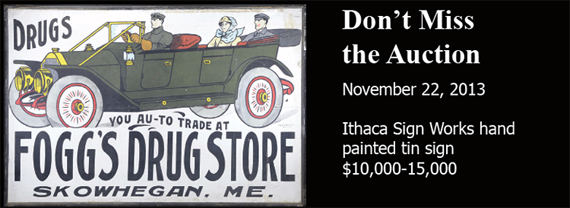
Don't miss the auction!
Spotlight
Spotlight
This rare Mettlach syrup dispenser for Hires root beer featuring the "Ugly Kid" sold above expectations of $22,500-25,000 for $39,675. Click to see more highlights.
  To Be Sold
To be sold.
Rare paper poster for Winchester Repeating Arms depicting a Chesapeake Bay retriever with a canvasback duck in its mouth, estimated at 2,500-3,000.

highlights
Julia's Plan in Place
Sonia MacNeil An innovative, proactive approach to secure the future of your fine antiques collection and your family. Our Plan in Place Agreement is like a will for your collection, combining your knowledge with our expertise to provide you and your loved ones with peace of mind. You've spent years building your unique collection, investing time, energy, passion and money. Why would you leave its future to chance?

Contact Sonia MacNeil at 207-453-7125 or smacneil@jamesdjulia.com to learn more about A Plan in Place and how we can craft one specifically for you.

Sonia MacNeil has been with Julia's for 3 years as the Estates & Collections Manager. She has four years of previous antique auction experience as well as public relations and marketing experience from her years in publishing and advertising.


What's It Worth
Two-sided die-cut flange sign for Heath and Milligan paints sold for $7,475 (est. $600-1,200). If you have a rare toy, doll or advertising item and want to know "What's it Worth," please take a picture and email it to us at atd@jamesdjulia.com. We are always looking for consignments of rare and valuable items, as well as collections for our auctions. What's it worth?
 
Antique Advertising Through History

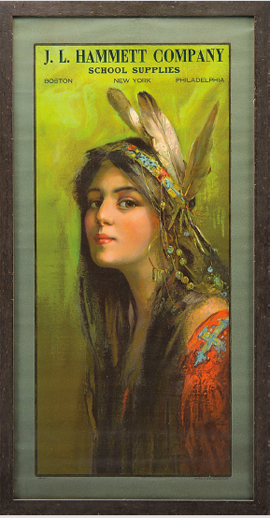
J.L. Hammett Indian Princess Poster

Antique advertising covers an extremely broad spectrum that would take literally volumes upon volumes to detail. Companies discovered unique and colorful ways in which to get their name in front of the general public to help

sell their product or service. In fact, centuries ago, before the days of widespread literacy, shop owners and the like could not rely on the printed word to attract customers. Instead they would craft figural signs in a form that would represent their particular enterprise and hang it above the entryway of their business. For instance, a dentist might have a large molar, a blacksmith might have a large iron horseshoe, a tavern owner might have a large mug of grog, and so forth.

As time marched on, and reading and writing became more commonplace, companies expanded, developed, and improved their methods. After the Civil War, companies that manufactured consumer products began to see branding their merchandise as a way to increase sales. Consumers gained confidence that product quality could be expected to remain consistent from one box to the next. With the completion of the transcontinental railroad, it opened the vast expanse of the United States for commerce, trade and travel between the East and West. So it became more important for companies to craft colorful signs, displays and objects in a variety of mediums like paper, cardboard, tin, wood, porcelain, etc. that would boast the company's product or service, and entice potential customers to use them.

The industrial revolution led to mass production, and by branding their products with easily identifiable trade-marks, they were able to set themselves apart from their competition. As demand increased for pre-packaged branded products, there was a corresponding boom in advertising companies generated to garner more market share.

Manufacturers began providing store merchants with posters, signs, thermometers, window displays, calendars, display cabinets, trays, etc. that carried their product name and logo.

However, these advertising pieces were never intended to be permanent fixtures. Little did they know that these "temporary" things would years later become wildly popular and collectable objects d'art. And survive they did. From advertising smalls and premiums to large scale displays and fixtures, these items became an inexpensive means of decorating one's home. That is, until popularity and supply and demand drove the prices up to an all-time high in the 1990s. One of the companies that embraced artistry in advertising was Coca-Cola. Since their inception in 1886 right up to the present day, they produced calendars, signs, displays, toys, store fixtures, and so forth that became the standard in collectable advertising. The successful formula that worked early on is still the most popular today and other companies followed suit, regularly utilizing attractive women (particularly partially clad women), strong graphics/colors, comical or fanciful images, and sports.

It was in the late 1990s that Julia's set the World Auction Record at the time for one Coca-Cola tin sign in particular that featured the early opera star Hilda Clark that we sold for $88,000. While prices have dropped off somewhat over the years, those quality objects in nice original condition that are fresh to the market and are reasonably priced are still performing admirably.


www.jamesdjulia.com | atd@jamesdjulia.com

At James D. Julia, Inc. we are always seeking high quality antiques of all types for our year-round auctions. We offer the best seller commission rates in the industry, as low as 0% for high value items and collections. Please contact us directly at 207-453-7125 (Maine office) or 781-460-6800 (Boston area office) to learn more or if you are considering consigning one item, an entire collection or an estate to auction. All inquiries are confidential and without obligation.