| Image | Lot | Price | Description |

|
2547
|
$14,950.00
|
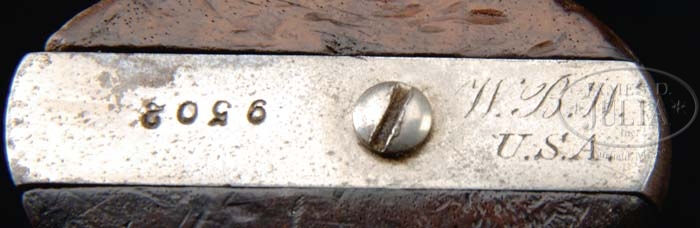
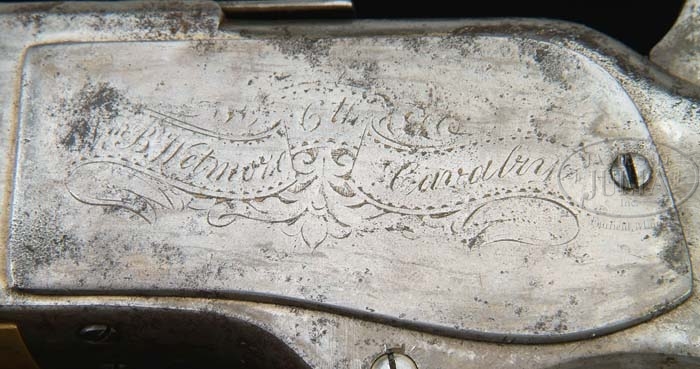
GROUPING OF FIREARMS & PHOTOGRAPH OF LT. WILLIAM B. WETMORE. Lt. Wetmore was born in 1849, apparently to a wealthy family. He was accepted as “an appointment at large” to the U.S. Military Academy at West Point, NY and graduated in June 1872. After being commissioned a 2nd Lieutenant he was posted to Fort Riley, Kansas as the Post Adjutant, Subsistence Officer & Assistant Quartermaster. He was subsequently assigned to Colorado and then to Fort Leavenworth, KS as the Aide de Camp to Maj. Gen. Pope. He rode on the expedition to Indian territory with Maj. Gen. Miles in Aug. 1874 and participated in the fight at Red River for which he was brevetted 1st Lieutenant and then Captain. In September 1875 he took a leave of absence until October of 1876 to make a tour of the world and resigned his commission December 1, 1876. Accompanying this lot is a 3-ring binder which contains an official copy of a West Point photograph of Cadet Wetmore. Also in the binder is a copy of the Sept. 13, 1873 Junction City newspaper with highlights of Lt. Wetmore shooting a rogue Capt. G.W. Graham formerly of the 10th cavalry. Graham & his men shot & killed a guard & wounded some of the passengers. Wetmore immediately shot the outlaw dead with this very Smith & Wesson revolver. Additionally included are copies of three pages from Firearms of the American West 1866-1894, Garavaglia & Worman, which on p. 78 has a reprint of Lt. Wetmore’s photograph that we have with this lot. Another page shows these two firearms in detail. Subsequent to resigning his commission Wetmore was involved in attempting to raise volunteers for the Spanish-American War but even though he was successful, the regiment he raised was not accepted to duty as that duty had fallen to the National Guard and his unit was disbanded. In the winter of 1894, with a party of Indians and sled dogs, he left the north edge of Lake Superior and discovered the headwater system of the Great Lakes. He was a member of a large variety of military & social organizations and clubs and died in New Jersey in 1919. The single incident for which he was most famous was when two bandits attempted to hold up the military paymaster at River Bend, Colorado on Sept. 10, 1873. One of them was a former Army Captain of the 10th Cavalry by the name of G.W. Graham. Several shots were fired and the paymaster was wounded. Wetmore fired his Smith & Wesson revolver and struck Graham just below the heart, from which wound he subsequently expired. Accompanying this lot is Wetmore’s Smith & Wesson 2nd Model American revolver, Cal. 44 Russian, SN 9502. It has 8” keyhole bbl with half moon front sight, nickel finish with 2-pc walnut grips, the right of which is numbered to the revolver, the left is a period of use replacement. The buttstrap is period engraved “W.B.W. / U.S.A.” This is undoubtedly the revolver that Lt. Wetmore used to shoot Graham. CONDITION: Fine, all matching except the replacement left grip. Overall retains 70-75% strong orig nickel with wear on sides of bbl, sharp edges & grip frame. Cyl retains about 90% orig nickel. The bbl latch spring is broken, otherwise mechanics are fine, bright shiny bore. Right grip has a smooth oiled patina. Also accompanying is a framed copy of an 11-3/4” x 14-3/4” photograph of Lt. Wetmore wearing a 6th Cavalry beret-style hat in 1880’s frontier clothing including mid-thigh boots, wearing a cartridge belt with two flap holsters, one of which is an American revolver with a plug in the buttstrap identical to the one described above. He is holding a Winchester ’66 saddle ring carbine inscribed with his name in a ribbon on left side. This photograph is reprinted along with a close-up of the’66 carbine on p. 96 of The Peacemakers, R.L. Wilson. Wilson states that the Winchester is engraved by Nimschke. In addition, the third item in this lot is a Winchester 1st Model 1873 Saddle Ring Carbine, Cal. 44 WCF (44-40), SN 2375. It is a standard carbine with 20” bbl, full magazine, uncheckered wood with straight stock and carbine buttplate with trap. The integral front sight was removed from front band and a dovetail was cut just behind the band which now contains a Rocky Mountain sight with German silver blade. Rear sight dovetail was moved about an inch forward and a rifle-style, short, 1873 semi-buckhorn rear sight was installed. It has the raised thumbprint mortised dust cover. Left sideplate is Nimschke engraved exactly as the 1866 carbine pictured in Wilson’s book. The inscription reads “Wm. B. Wetmore 6th Cavalry”, on a ribbon with some light flourishes of arabesque patterns. Poor to fair. No orig finish remains being a worn, heavy brown patina with some refinished blue around middle band. There is moderate to heavy pitting over most of metal which shows heavy wear. Wood is extremely worn and even may be old replacements. It shows heavy sanding with a crack in forend tip and is dark and oil stained. Mechanics are fine, strong bright bore with a ring about mid-point and a few spots of pitting. 4-38913 (14,000-16,000)
Auction: Firearms - Fall 2009 Please Note: All prices include the hammer price plus the buyer’s premium, which is paid by the buyer as part of the purchase price. The prices noted here after the auction are considered unofficial and do not become official until after the 46th day. |