| Image | Lot | Price | Description |




|
2504
|
$28,750.00
|
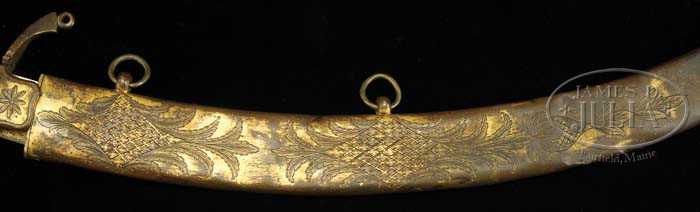
OFFICER’S DIRK OF WAR OF 1812 HERO LEWIS ARMISTEAD. This magnificent officer’s dirk or dagger is inscribed “Lewis Gustavus Adolphus Armistead”. Lewis Armistead is from a long line of prominent Virginia military officers. Lewis Armistead was killed at the Battle of Fort Erie is September of 1814. His nephew & namesake, Confederate General Lewis Armistead, was killed in Pickett’s Charge at Gettysburg July 3rd 1863. Lewis Armistead’s two year older brother, George Armistead, commissioned the making of the famous “Star Spangled Banner” that flew over Fort McHenry in Baltimore Harbor. The bombardment of Fort McHenry and the view of this famous flag from the shore inspired Francis Scott Key to write our National Anthem on September 14, just three days before Armistead’s death. George Armistead survived the war and commanded troops in Baltimore until his death in 1818. Lewis G. A. Armistead was a lieutenant under Col. John Gibson of the 4th US Rifles during the Battle of Fort Erie. He was killed along with his colonel on September 17, 1814 in the bloodiest battle ever fought on Canadian soil. The British were slow in developing their siege operations at Fort Erie. During the first week of August 1814 some American schooners moved freely between the fort and Buffalo, occasionally sailing down river to bombard the British camp. Finally the British moved some boats from below the Falls, and on 12 August captured two of the three American vessels. On 13 August Drummond’s four gun siege battery opened fire. The guns however were old and not very effective in breaching the fort’s wall. It was therefore surprising that Drummond decided on a three-pronged night assault only two days later. It was an ambitious plan, and given the nature of night operations, one that was certain to fail. The attacking columns were composed as follows: 1) Right Column: Lieutenant Colonel Victor Fisher of De Watteville’s regiment commanding 1300 men drawn from companies of his own regiment and the 8th (King’s) plus the light companies of the 89th and the 100th. Their objective was the American battery at Snake Hill. 2) Centre Column: Lieutenant Colonel William Drummond of the 104th commanding 250 men from the flank companies of the 41st and the 104th plus a number of seamen and marines. Their objective was the main fort. 3 ) Left Column: Lieutenant Colonel Hercules Scott of the 103rd commanding 650 men drawn from his own regiment.Their objective was the Douglass Battery located between the fort and the lake shore. Fisher’s column was the first to move out, leaving the British camp at 2:00 a.m.. The “forlorn hope”, led by Major Charles de Vilatte and Captain Thomas Powell, managed to penetrate the American defense line, some of them by wading through the waters of the lake to bypass the palisade. The main body, however, was noisy and this alerted the defenders. De Watteville’s regiment was in the lead and, to ensure surprise, had been instructed to remove the flints from their muskets. They were met by a withering fire from the American defenders. Unable to return fire, the Swiss panicked. In their haste to get away, they threw the companies of the 8th and 89th into disorder. It was not until daylight that the three regiments were able to reform, too late to renew the assault. The hapless advance guard were abandoned to their fate, most becoming prisoner-of-war. The remaining two columns waited, concealed in a ravine to the north of the fort, until 2:30 a.m.. The sound of the engagement of the right column was the signal to advance. Lieutenant Colonel Scott was killed early in the attack, and his men became disoriented and converged with the center column in their attack on the breach in the north-east demi-bastion. The combined force suffered heavily from small arms and artillery fire as they closed up to the breach. They launched three major assault and were repulsed each time. Finally, on the fourth attempt, the British infantrymen overcame the American gunners and broke into the bastion. They turned the guns on the defenders and started to clear the northern barracks but were driven back to the bastion. Here the British hung on tenaciously in the expectation that reserves would reinforce their effort. They made one more attempt to breakout soon after daylight on the morning of 16 August. During the fighting, an ammunition chest caught fire, causing the expense magazine under the gun platform of the bastion to explode. Men, masonry, timber and other assorted debris was hurtled skyward in a pillar of fire. The mangled British survivors surrendered. The waiting reserves outside the fort refused to advance, convinced that the fort was mined and that a similar fate awaited them. Having lost 366 killed or wounded and 539 missing, Sir Gordon Drummond stopped the attack. Among the killed was his nephew, Lieutenant Colonel William Drummond. The assault had been a disaster. While Sir Gordon Drummond accepted responsibility for the failure, he attempted to shift most of the blame to De Watteville’s Regiment. While the Swiss did break, the attack suffered generally from poor planning and inadequate siege artillery. Despite these shortcomings, the plan nearly succeeded. If the reserve troops had followed up the capture of the bastion, or the detonation of the magazine had not occurred the British may have been able to pull it off. Drummond continued to stand his ground, though the siege became an affair of small attacks and counter-attacks, all taking their toll of lives. On 17 September, the U.S. troops, once again under the command of Major General Jacob Brown, made a full-scale sortie, during which destroyed two of Drummond’s batteries and the British lost another lost another 600 men. This is the date that Lieut. Lewis G. A. Armistead lost his life along with his Colonel John Gibson. There were 41 casualties on this day in the 4th US Rifles in this assault on Fort Erie. Where Lewis Armistead got this fine weapon we can only guess. Could he have obtained it the previous month in earlier action at the fort where the British suffered such terrible losses? This weapon is quite rare, being made in the style of a Model 1803 British officer’s sword, we can only find a couple of other examples of this rare pattern dirk. The 16-1/2″ curved blade is decorated in blue and gold with a panoplies of arms and a “GR” cypher with king’s crown which represent King George III. The engraving of Armistead’s name on scabbard is no doubt contemporary to the War of 1812. Based on all the scabbard dents, dings and scratches; Armistead must have been wearing this when he was killed and his captured trophy sent home as a memorial to his sacrifice in this terrible battle. SIZE: 16-1/2″ blade; 21″ overall. CONDITION: Overall very good and in “as-found” condition. The engraved handle, hilt and scabbard retain 20-30% original gilt highlighted by rich chocolate brown patina. The blade is bright with most of the blue and gold decoration intact. Several nicks to cutting edge with scattered staining and soiling. Scabbard exhibits numerous small dents, dings and scratches and nicks along cutting edge (possible battle damage). 8-76265 JS55 (15,000-20,000)
Auction: Firearms - Spring 2010 Please Note: All prices include the hammer price plus the buyer’s premium, which is paid by the buyer as part of the purchase price. The prices noted here after the auction are considered unofficial and do not become official until after the 46th day. |