| Image | Lot | Price | Description |

|
2504
|
$45,000.00
|
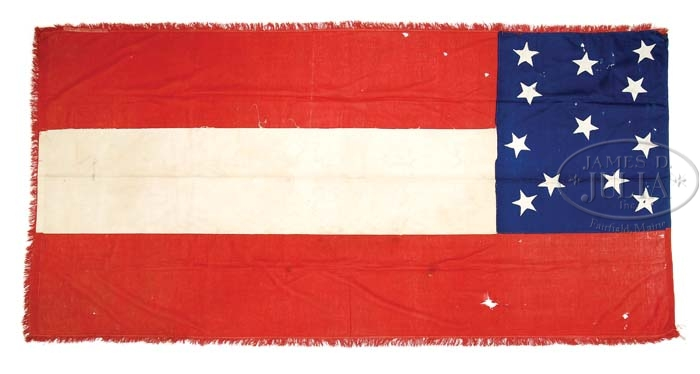
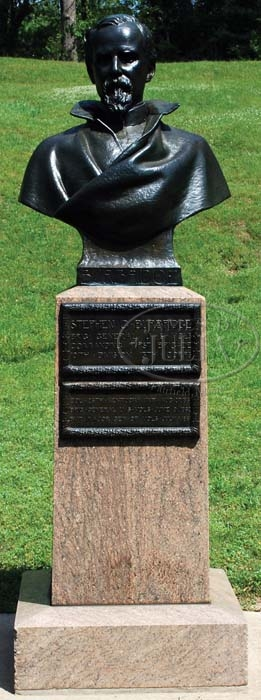
CONFEDERATE FLAG CAPTURED FROM GEN. JOHN HUNT MORGAN. You are bidding on the only known John Hunt Morgan flag known in private hands. This flag descended in the family of Union Brigadier General Stephen Burbridge, who was known as the Butcher of Kentucky and the man to finally drive Morgan from Kentucky. This fabulous 1st national flag, the General’s commissions, and a 1911 newspaper article covering his defeat of Morgan were found in the same box that they are in today. The family has retained Burbridge’s Brigadier General’s commission as well as a letter from General Sherman to Burbridge which a copy of accompanies this lot. General Burbridges’s family also retained a fine oil portrait of Burbridge, a photograph of which accompanies this lot. His Major General’s commission is being sold in the next lot. This lot also contains a letter from Burbridge’s descendant telling the story as well as a letter by noted flag historian Greg Biggs: Union Gen. Stephen Burbridge was one of the most vocal Unionists in Kentucky, a state divided in its loyalties. Given command of the state in 1864, he had two missions; countering the pro-Confederate guerrillas and recruiting blacks into the United States Colored Troops. His actions in both would serve to make him highly unpopular in Kentucky even causing a clash with the state’s governor of the time. Burbridge planned a raid on the Confederate salt works in Saltville, VA but Morgan’s raid upset those plans. Burbridge’s aggressiveness in going after Morgan in his June, 1864 Kentucky raid was the result of understanding of the effect on morale a successful Morgan raid would have on the population of his home state. Pro-Southern forces were still very active. Thus, he sought to smash Morgan once and for all hoping that such a victory would quell pro-Southern activity. After striking Morgan at Mt. Sterling, Burbridge remained on his trail until his final victory at Cynthiana. The defeat of Morgan earned Burbridge a brevet to Major General. Burbridge’s life in Kentucky after the war was very difficult, with periodic press reports excoriating him for his conduct in running the state during the war. He feared for his family’s safety and often found jobs difficult to obtain despite support from former commanders like Gen. William T. Sherman and even state political figures. Ultimately, he was forced to leave Kentucky in order to provide for his family. Burbridge died in New York City in 1894. The flag that Burbridge’s men captured at Cynthiana remained in his family for over 150 years. Along with his general officer’s commission and a Sherman letter of support, the flag came into the hands of a descendent of one of Burbridge’s children living in Michigan. Trimmed in red fringe and bearing noticeable bullet holes, the flag bears twelve stars. Included in the flag was a 1911 Detroit New Tribune newspaper article about John E. Taggart of the 9th Michigan Cavalry which added wonderful details of the fight at Cynthiana, KY. Taggart was returning to his regiment in Kentucky after a furlough when he was captured by some of Morgan’s scouts. Eventually escaping, Taggart made his way to Union lines and reported to Gen. Burbridge. He was reinstated with his regiment, which was with Burbridge at the time, and he brought information about Morgan’s whereabouts. This information led to Morgan’s defeat at Cynthiana. Taggart’s newspaper story is consistent with known historical information on the Cynthiana affair. The flag is made out of light weight polished cotton with 12 double applique stars with an interesting shape of 7 stars in a circle, 1 in the center, and 4 at the quadrangles. 12 star Confederate flags are quite scarce. Most confederate 1st National flags are 11 stars or less. The 12th confederate state was Missouri. The Missouri legislature approved secession in October 31, 1861, Kentucky the following month to become the 13th Confederate state. However both Missouri and Kentucky had strong Union sympathies also and large contingents of Union troops. Even though popular sentiment may have wanted these states to be part of the Confederacy, Union troops prevailed. We can probably assume this 12 star flag was made after October 31, 1861 and before November 20, 1861. The 12th star most probably commemorates Missouri as the 12th Confederate state. No wonder 12 star Confederate flags are rare and so few known, there was only a 20 day window when they were made. Flag has a 3/4″ folded over hoist which supported a cord for attachment to pole. Typical early 1861 production had a long ratio of 2:1 (fly: hoist) and this flag fits being 40″ hoist x 84″ fly. Another early feature of this flag is a delicate 1″ red silk fringe sewn along the edges. This flag is in remarkably fine condition with bright colors, as can be seen in photo. There are several stains (possible blood) and minor soiling. The holes are consistent with battle damage, the size of pistol or rifle shots. General John Hunt Morgan was one of the most colorful and famous Generals of the Civil War. Several books have been written about his life and death, he was killed in September 1864. Burbridge’s Major General’s commission, being sold in the next lot, states “for gallant and distinguished service in the repulse of John Morgan’s recent invasion of Kentucky.” This commission is dated July 4, 1864 in response to the victory by Burbridge over Morgan less than a month earlier at Cynthiana, Kentucky. According to Greg Bigg’s report most of Morgan’s command got out of Cynthiana safely and retreated to Virgina, however 250 prisoners and a battle flag was captured. Since so few existing flags can be found with a specific Morgan connection the fact that this flag exists, along with provenance, offers a unique and rare chance for the serious collector to own an important piece of history that involved the “Kentucky Thunderbolt” during one of the most well known episodes of his career. CONDITION: As stated above. 8-76259 JS30 (40,000-60,000)
Auction: Firearms - Fall 2009 Please Note: All prices include the hammer price plus the buyer’s premium, which is paid by the buyer as part of the purchase price. The prices noted here after the auction are considered unofficial and do not become official until after the 46th day. |