| Image | Lot | Price | Description |


|
2470
|
$24,500.00
|
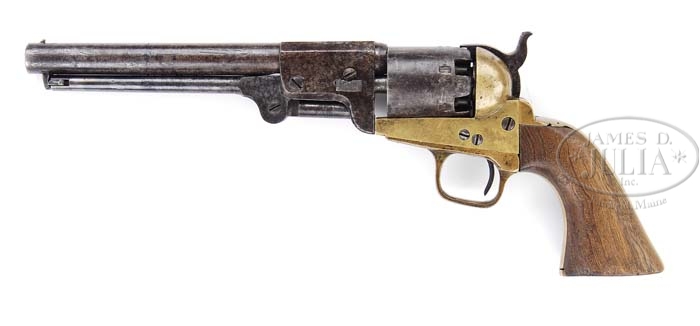
GRISWOLD REVOLVER. SN 3037. Cal. 36. Griswold #3037 was made in July of 1864. The gun shows many traces of its original blue finish as well as a mellow age patina to the brass. Upon close examination, most of the original tool marks from the manufacturing process are visible. The piece is in excellent original condition and has never been cleaned. Mr. Fred Edmonds might be the only person to have ever disassembled #3037. All parts normally serial numbered on this model are numbered. Serial number 3037 is found on frame, barrel and cylinder. The secondary number “8” is also found on frame, loading arm, wedge, triggerguard, backstrap, hammer and inside grip. Even the trigger ratchet arm are stamped with “8”. A cryptic “W” is found on bottom of barrel, on back of cylinder, on frame and triggerguard. Roman numeral “III” is also found on frame and triggerguard. Griswold serial number 3037 is 100% original in every respect, down to the last screw. It is in excellent condition, showing much original finish blending with an aged patina throughout the entire piece. No doubt this gun would rank among the best few. This gun would make a welcome addition to the finest Civil War collection. Sam Griswold was a Connecticut Yankee who moved to Clinton County, Georgia in 1822. Soon thereafter, he used his mechanical genius in developing a large and successful business in manufacturing cotton gins. He bought 4000 acres along the right-of-way of the Central Railroad of Georgia, nine miles east of Macon, where he became the founder of a small, nearly self-sufficient manufacturing community, with the necessary buildings attendant thereto. The community became known as Griswoldville, and was actually a small city. When the Civil War broke out, Griswold manufactured pikes in response to requests for the same by then- Governor Brown, of Georgia. Arvin N. Gunnison was a native of New Hampshire, who moved to Georgia, then to New Orleans, where he had begun making ‘Colt’s Navy’ revolvers, near the time of its fall to the Yankees. He escaped with his machinery and moved to Griswoldville, where he and Sam Griswold commenced the manufacture of the Griswold & Gunnison Revolver, with the help of trained slave labor. The Griswold operation became the most prolific producer of revolvers in the Confederacy, having produced some 3606 pieces. They were the most heavily used revolvers in the Confederacy, with the Confederate Government being the recipient of nearly all of the revolvers produced. After being in steady production, from July of 1862 on, the Griswoldville pistol factory was completely destroyed by Yankee cavalry in November of 1864. While there is no name stamping on any Griswold revolvers, excavations at the factory site over the years have produced many revolver castings and parts which are identical to various parts of collector-owned Griswolds. In fact, so many parts have been found that it has been possible for a few fortunate collectors to piece complete specimens together (except grips). There are many other markings on these revolvers which are just as significant in making a proper identification as a name stamping would be: in some instances, these other markings may be of more help in authentication. There are two models of Griswold revolvers. Both models have round barrels; however, First Models have rounded barrel housings, while Second Models have octagonal housings. Their serial numbers run consecutively, from #1 to #3606, the highest number known. First Models run from I to approximately 1500, while Second Models run up to 3606. They are all stamped with the same individual large dies, at several different places, seemingly without establishing a pattern for their location. Certain ‘cryptic’ Stampings and secondary numbers also appear in various locations on these pieces. All Griswolds have brass frames, back straps and trigger guards, and brass pin front sights. More often than not, most frames are a different shade of brass than the back straps and trigger guards, for the reason that they were cast at different times out of different batches of molten brass. The Griswold Company’s supply of brass came from many different sources (also, there was certainly no attempt at visual quality control by the Confederates). Much of the brass used in making the castings for these guns was from melted down church bells donated by Georgia’s patriotic churches. Christ Church in Macon stands out as one of the many donors, indicative of the religious support afforded The Cause. PROVENANCE: Fred Edmunds Collection. CONDITION: As noted above. 4-38127 JS38 (25,000-30,000)
Auction: Firearms - Fall 2009 Please Note: All prices include the hammer price plus the buyer’s premium, which is paid by the buyer as part of the purchase price. The prices noted here after the auction are considered unofficial and do not become official until after the 46th day. |