| Image | Lot | Price | Description |




|
2466
|
$0.00
|
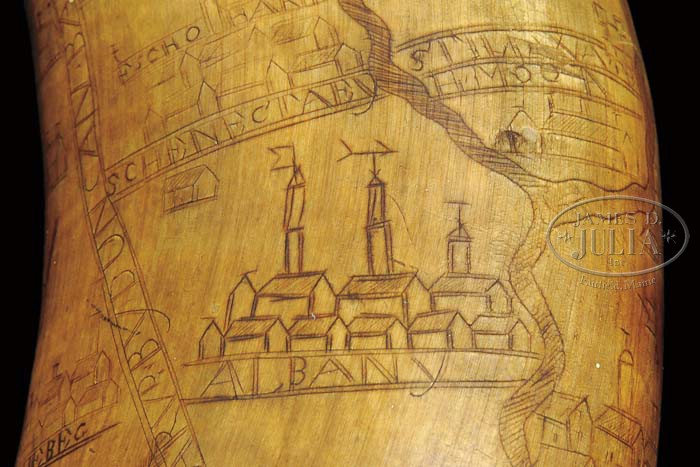
FINE 18TH CENTURY ENGR MAP HORN CARVED BY DUNCAN BAIN 1768. This excellent detailed map horn has a carved throat with 2 rare carved notched rings separated from the horn body by an engrailed edge. The upper portion of the horn, carved down and retaining to relief notched wings. The horn body, all over engraved with wonderfully artistic and detailed renditions of Towns, Forts, and rivers all identified. The outer curve of the horn features the royal British coat of arms surmounted by the initials GR. Below and to the left is a small banner dated 1768, and to the right half way around the horn is a vertical banner inscribed, “Carved by Duncan Bain” The largest Town depiction is for that of New York, which features a great number of houses, many of which have very tall spires. Some flying banners, some with weathervanes, etc. Surrounding, are fortifications directly below New York, at the base of the horn is a depiction of Long Island with a British Man of War in full sail. Other towns depicted include Quebec, Albany, Schenectady, Oswego, Onda, Lake-Halfway, Boston, Sorrell, Halifax, Montreal, and Ococknyego. Forts depicted include Ticonderoga, Ft. Scoharie, Hunter, Harriman, Niagra, Stawix, Bull, Gr Point Teow. Waterways include Bay of Funday, Lake Erie, St. Lau River, Gulf, Wood Creek, Lake George, South Bay, Champain, Isle Orleans Long Island, Isle Coudreand 3 rivers. The horn is very artistically rendered and a good example of an 18th century map horn. Accompanying the horn is an old letter written on a sheet of ledger paper and signed Sheldon L. Cooke. In the letter Mr. Cooke indicates that the horn was given to his Great Grandfather by the man who carved it. (Duncan Bain) The letter goes on to say this man was a prisoner in a war of that period, and that “this map was made on this horn by scratching with a nail while in prison”. The Indian wars had concluded around 1763, and the only 2 wars on the North American continent in 1768 included the rebellion of 1768, which was an unsuccessful attempt by the Creo and joining settlers around New Orleans, Lousiana to stop the hand over of the French-Louisiana Territory, as had been stipulated in a treaty in Fontainebleau in 1768. It is unlikely this is the war he refers to, More than likely he is referring to the War of Regulation, which took place from 1768 to 1771. In this war, the regulators rose up against the Government by refusing to pay taxes and by meddling with the courts. The rebels were defeated by the North Carolina Governor William Tryon on May 16, 1771 during the battle of Alamance Creek. (Regarding the war of Regulation, the following information was extracted from the Patriarch files as listed on the internet) No further information could be attained regarding this masterful horn carver. SIZE: Approx 15” on the outside curve. Diameter of butt, between 2-1/2 to 3 in. CONDITION: The horn shows has a nice, honey amber patina and show various signs of usage. The notch design on the sculpt have a few ancient chips. The overall surface of the horn has a few scattered stain marks. The horn retains its original wooden plum, which now sets freely within the base of the horn. There is a very old crack, approx 1 in long, extending from the base of the horn, and also another crack emanating from the sling hole near the base plug. 4-41956 JC-1 (8,000-12,000)
Auction: Firearms - Spring 2011 Please Note: All prices include the hammer price plus the buyer’s premium, which is paid by the buyer as part of the purchase price. The prices noted here after the auction are considered unofficial and do not become official until after the 46th day. |