| Image | Lot | Price | Description |



|
2443
|
$10,350.00
|
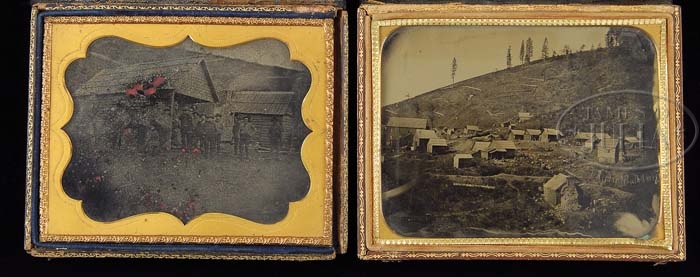
CALIFORNIA GOLD MINING GROUPING. You are bidding on a group from the great, great grandson of William Pitt who dug gold in California in the 1850’s. Including in this grouping is a fine 1/2 plate ambrotype of Diamond Springs, California. This photograph shows several houses, including William Pitt’s log cabin, and the gambling house that Pitt writes of to his future wife in a wonderful letter. This letter is in a small book form that is entitled “Miner’s Letter” which was sold by a stationery dealer listed in San Francisco and Sacramento. He states in this letter written, we think, in November 1852 “I am now at Diamond Springs to work in the mines 45 miles from Sacramento. I have been here almost two weeks and I have found some gold. I have made from $2 to $6 a day while I have been here. I have been here but there has been no water to wash with but I think we shall have water now for it rains now…I am sitting here in my log cabin & taking all the comfort in the world. There is one fellow with me so we take turns a cooking so you may know that we live first rate…I have got a little gold dust and I will send you a piece so can see how it looks and have something to remember me by til I come home. I hope that you won’t get tired of waiting for me. If you should I want you to let me know it but I hope you won’t….Suppose you would like to know what kind of a place this is here. I can tell you this is a hard place. There is a great many folks here that would be glad to go home if they could and they could after a while if they would save their money but there is a gambling house close by here and I have been in there and seen men lose the last cent they have and have seen some win $40 and $50 in a few minutes and then go off and get drunk and come back and lose it all again and some will work all day and spend it nights. That is the way with one half of the folks in California. I should never expect to get home at that rate.” It goes on to explain he would like to fill out the rest of this book and mail it but would have to walk 2 miles to the post office and signs it and sends it on “I still remain your affection, William Pitt”. In the back few pages of this book Sally, his future wife, makes note of receiving each letter from him year by year from 1852, which we believe this was the first letter November 1852, until the last letter listed March 22, 1857. According to Mr. Pitt’s great, great grandson, William Pitt and Sally were married September 21, 1857. William Pitt must have come home after working in the mines for over 4 years. In this letter William Pitt mentions he is sending a piece of gold dust home. In the wooden box that contains all these artifacts there is a 1 x 1-1/2″ piece of quartz with many visible flakes of gold throughout. This must have been the piece of gold dust he sent home to let Sally know what it looked like and to remember him by. Also in this 18″ x 8″ x 5″ wooden box is a Colt Pocket Model Revolver with 6” barrel, SN 74464, which is in well used but untouched condition with rust but a little finish left in the protected areas. Pitt must have bought this gun in California to carry with him in the gold field as it was made in 1853. There are two 1/6 plate daguerreotypes of William Pitt and his future bride, Sally Morrill. These photos were taken when both were young, probably prior to William’s excursion west. There is another 1/2 plate ambrotype showing a close-up of William Pitt’s log cabin with him standing with several other miners. Unfortunately this image is badly crazed and flaking, unlike the fine condition of the daguerreotypes or the other 1/2 plate ambrotype of Diamond Springs (most images have old ink tags). Also in wooden box are several lithographic scenes of mining life that measure about 8 x 11″. These sheets were probably used as stationery but these were never written on. These were all published by Britton & Rey, San Francisco. Two other large lithographic sheets, one being 16 x 10″; showing the Frazer River Gold Mine History, published in San Francisco in 1858 by Sterett & Butler, and the other sheet measuring about 8.5” x 11” shows California Indians and is dated 1854 by James Hutchins, Placerville, California. Several other photographs are in group, including a couple of Sally’s brother, Charles Morrill, one being a nice 1/4 plate ferrotype of him in Civil War uniform with two of his friends. There is another family album that includes more family members and several folded obituaries and a very rustic tin-type of William Pitt wearing homespun clothes like he may have worn when he was mining. Also in the box is a small pamphlet printed in 1825 that tells of medicinal uses of commonly found herbs. William Pitt may have had this while in the gold mines as doctors were scarce. There is also a bag of small sea shells possibly collected from the Pacific coast, a small brass tray and a brass candle holder typical of that era. Also a tarred linen bag with pewter top which could have held just about anything (gold nuggets?). There is one other really unusual object found in the box. It appears to be a vest worn by Mr. Pitt on his way home from the gold fields. Clearly handmade, from cloth and a body of doe skin, 6 pockets are found where family legend states gold coins were sewn in for his trip home. There is no doubt, as can be seen in photo, the stitching and staining where the $20 gold coins would have been held in this vest. What a wonderful relic of the gold rush. It is a shame there is no old paper tag telling the story attached to this vest, however William Pitt’s name is plainly inked on the back of this vest. CONDITION: As described above. 4-38111 JS79 (10,000-20,000)
Auction: Firearms - Fall 2009 Please Note: All prices include the hammer price plus the buyer’s premium, which is paid by the buyer as part of the purchase price. The prices noted here after the auction are considered unofficial and do not become official until after the 46th day. |