| Image | Lot | Price | Description |

|
2436
|
$0.00
|
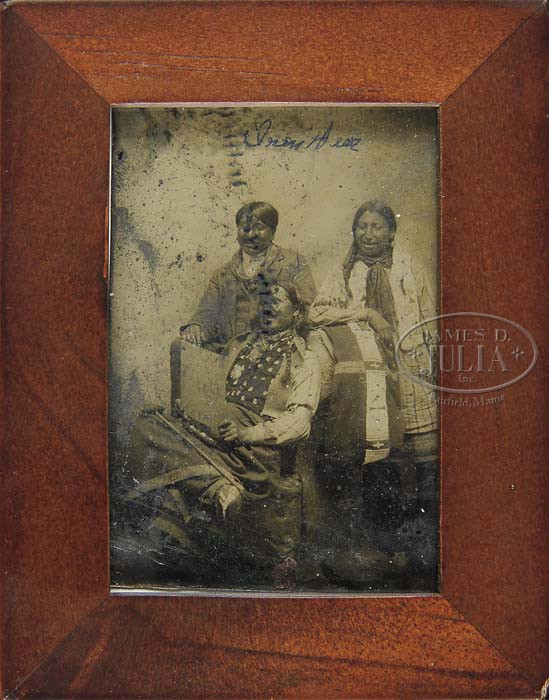
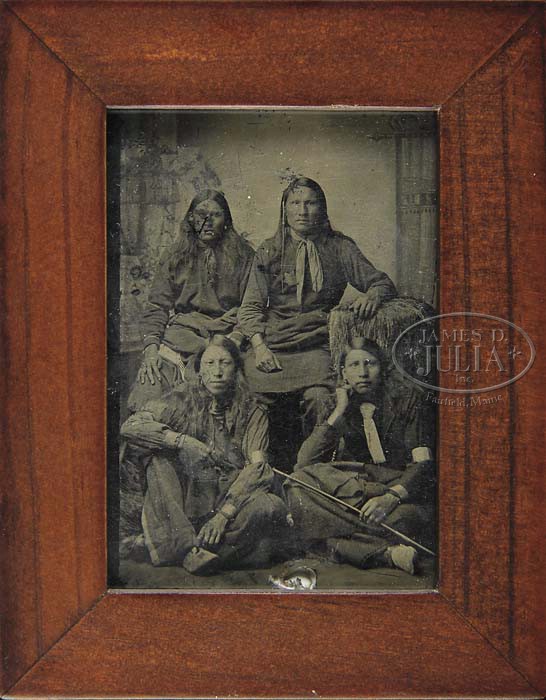
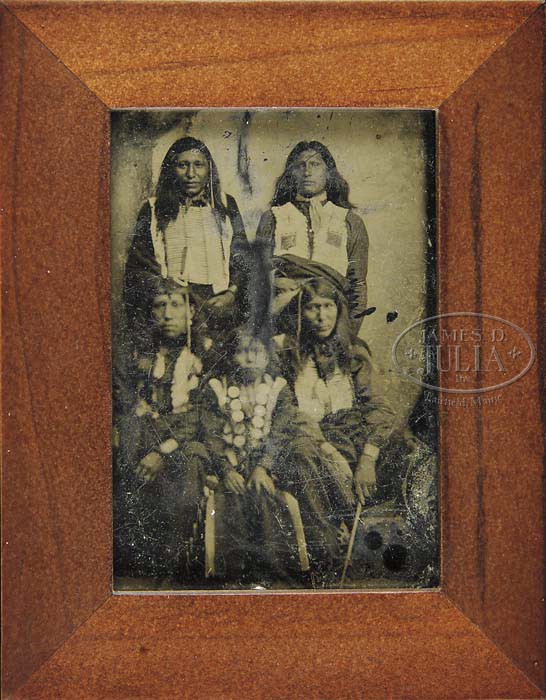
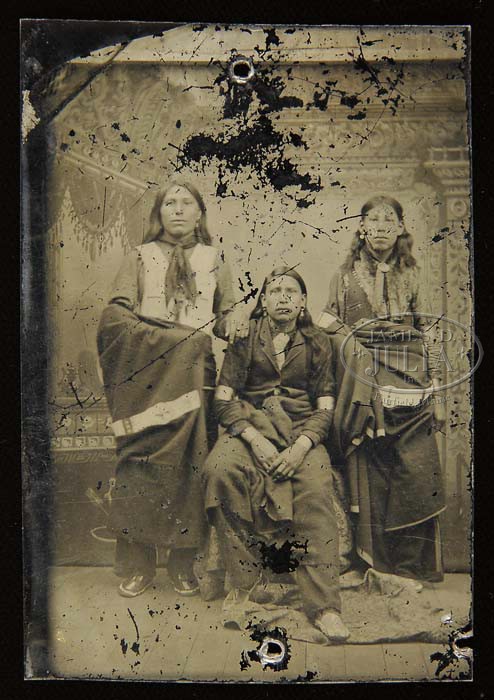
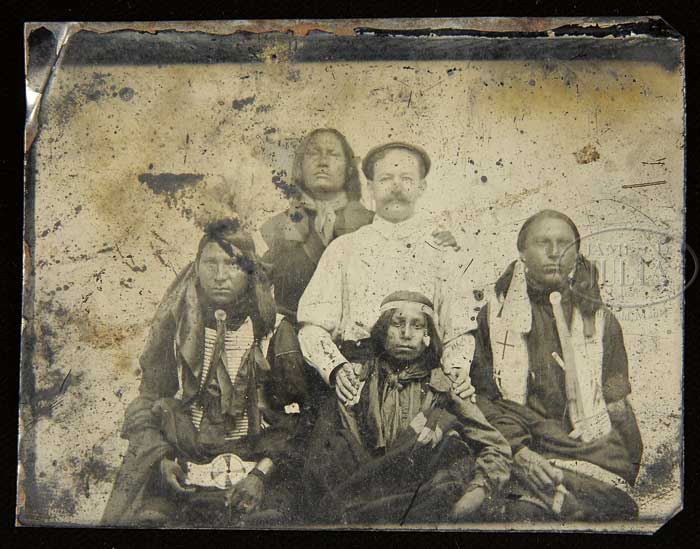
RARE AND UNPUBLISHED ANTIQUE LOT OF FIVE TINTYPE IMAGES OF PLAINS INDIANS. The tin-type process was generally antiquated by the albumen photo process but this type of photography was still in use (especially on the frontier) into the 1880s. In fact, the only known image of Billy the Kid is a tintype of similar size ca. 1879-1880. These photos date from the late 1860s to the 1880s. They are Plains Indians and, by their beadwork and dress, are probably Sioux and the images were obviously taken at a photographer’s studio or agency or at a fort with a photographer as two of them have typical painted photographers’ backdrops. There are five early tin types. 1) This tin type depicts four braves, two sitting on the floor, two sitting above. One is obviously an Indian policeman as he wears a six-point star. According to agency & fort policy, the Indians were allowed to keep the law among themselves policemen that were appointed by the commanding officer. This image is with a photographer’s backdrop. Each of the Indians are clad with government provided trousers and blouses, with some beaded ornamentation visible. 2) This image depicts three Indians. This image was obviously taken in a photographer’s studio or at a fort with a photographer’s backdrop set up. Two of the Indians are draped in blankets with what appears to be Sioux beadwork. One wears what appears to be trade bracelets on his arms. They are each wearing issued trousers and with scarves around their necks. 3) This interesting image depicts three figures, each wearing manufactured clothing. The Indian seated wears a shirt which appears to be decorated with Elk teeth, and he also wears a badge. He has a skull crusher resting on his knee and he holds a large sheet of paper which all three are looking upon and appear to be amused. Someone at one time scripted a title at the top which seems to read, “Iron Deer?” However, the Indian on the right who appears to be smiling, has a very close resemblance to Sioux chief Spotted Eagle. 4) Depicts five braves, one of which appears to be much younger than the rest. The braves wear trousers; two have bone breastplates; one with a beaded vest; and one with a large disc or conch-shell type necklace. A label, which at one time was affixed to the back of the tintype, lists a series of Indian names implying that they might be the names of the braves in the image. The list reads, “Top Row: Red Eagle, Goes to War, and Black Face. Bottom row: James Red Eagle, Joe American Horse, Assie Goes to War”. 5) This image depicts four Indian braves with a white man. The white man is unquestionably government or Indian agent or someone they are very familiar with. There is a famous photograph taken of the October, 1877 meeting depicting General Crook, various Indians and non-Indians. In this image the Caucasian who appears third to the right of General Crook looks very much like the exact person that appears in our tintype. He stands behind one Indian brave who is seated and both hands rest on either shoulder. An Indian standing behind him rests his hand on the Caucasian man’s shoulder. One Indian is dressed in a beaded vest; another with a bone breastplate and a beaded waistband. The Indians wear garments of trade cloth. This group of photographs was discovered together and as we indicated earlier, we believe them to be Sioux. In considering the fact that there is obviously a significant grouping of Indians, all of whom posed for their photo, and considering the approximate time period that the tintypes would indicate that these were made, it is speculated that these possibly could have been taken sometime after the Treaty of Fort Laramie in 1868. This treaty was an agreement between the United States and the Oglala, Miniconjou, and Brule bands of Lakota people, Yanktonai Dakota and Arapaho nation, which was signed in 1868. This treaty guarantee the Lakota ownership of the Black Hills and land and hunting rights in South Dakota, Wyoming and Montana. The Powder River was from that point forward supposed to be closed to all whites. The signing of the treaty in 1868 ended Red Cloud’s War, but the effect was short lived. By the 1870s the United States decided that it once again wanted the Black Hills, and in 1877 they seized the black hills back again. It is possible that these very same braves left the reservation to fight with Sitting Bull and Crazy Horse against the 7th Cavalry. This is a very rare offering on the public market. SIZE: These are each approximately 2-½” wide and 3-½” high. CONDITION: Three have nail holes; all have a fair amount of abrasion, scrapes and rubs over the surface of the images and show great age. 4-45608 (25,000-35,000)
Auction: Firearms - Spring 2012 Please Note: All prices include the hammer price plus the buyer’s premium, which is paid by the buyer as part of the purchase price. The prices noted here after the auction are considered unofficial and do not become official until after the 46th day. |