| Image | Lot | Price | Description |




|
2431
|
$0.00
|
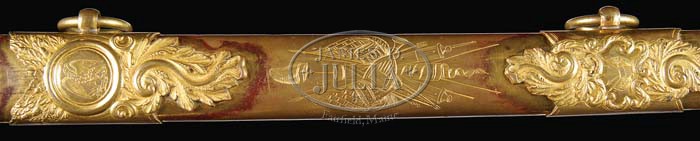
HISTORIC AND RARE MEXICAN WAR ASSOCIATED AMES INSCRIBED MODEL 1833 DRAGOON OFFICER’S SABER PRESENTED TO CAPTAIN GIDEON K. “LEGS” LEWIS, TEXAS MOUNTED VOLUNTEERS. One of a rare lot of known presentation grade U.S. Model 1833 Dragoon Sabers, this rare, historic and unique sword is identified to the Capt. of the Texas Mounted Volunteers during the Mexican War. “Legs” Lewis was one of Texas’ most colorful and well known newspaper reporters, Mexican War officers, ranchers and Texas Rangers. This presentation sword manufactured by N.P. Ames closely follows the regulation pattern for the U.S. Model 1833 Dragoon Saber except for the gilding and embellishments raising the profile of this sword to presentation grade. The sword’s overall length is 39-1/2” long with a 32-3/8” lightly curved, single edged quill back blade. The steel blade is etched with patriotic designs across 50% of the blade’s surface. The decorations include a standing Indian, American eagle, floral decorations and the maker’s name “N.P. Ames/Cabotville, Mass.” near the ricasso of the blade. The saber’s hilt follows the regulation having a three-branch, half-basket knuckle guard terminating at a stepped bird’s head pommel with backstrap. The quillion terminates in a knurl and has U.S. inspector’s initials stamped within. The cast brass hilt is gold-plated. The grip is of wood covered in fine sharkskin and wrapped with fancy twisted brass wire with a ferrule at base. The brass scabbard is gold-washed and engraved with floral accents above the top mount, a panoply of classical American arms including liberty cap, flags and an American shield between the top and middle mounts and fancy rococo scrollwork engraved below the middle mount. The applied brass and gilt drag also has floral engraving on the front side. The top mount is cast brass, gold-washed, with scrollwork and an engraved American eagle in a circular cartouche. The center mount is similar with an engraved quiver with arrows in the center. The scabbard furniture is plain on the reverse. Two important period inscriptions are seen on the reverse side of the scabbard between the top and middle mounts as follows: Presented to/Capt. G.K. Lewis/by his company of Texas Mounted Volunteers/called into the service of the State by his/Excellency Gov. P. Hansborough Bell. Curiously, Texas Governor P. Hansboroguh Bell, inscribed on the sword, must have fought side by side with Lewis, perhaps gaining his friendship during the Mexican War. Governor Bell joined the Texas Rangers under John C. (Jack) Hays in 1840 and held the rank of major in the Somervell expedition of 1842. In 1845 Bell was Capt. of a company of rangers but resigned that commission to enter the United States Army at the outbreak of the Mexican War. Under the command of Gen. Zachary Taylor, Bell won distinction at the battle of Buena Vista. As Lt. Col. he commanded the part of Hays’s regiment designated for service in Texas on the Rio Grande. Surely their paths crossed many times. Bell was elected governor of Texas in 1849 and, again in 1851. In 1853, Bell resigned to fill a vacant position in Congress and remained in the House of Representatives until 1857. Maker’s mark engraved on the reverse side of the scabbard above the top mount: H.S. Baldwin/& Co. by/ N.P. Ames/Cabotville/MASS. A published list of “Mexican War Presentation Swords Made by Ames; June 1846 through January 1851”, lists two swords delivered to H.E. Baldwin & Co., a prominent military goods dealer in New Orleans. These swords were shipped to Baldwin on behalf of Col. Belknap on January 16, 1847 and Lt. E.F. Nichols on September 1, 1847. Gideon K. “Legs” Lewis was born in Ohio in 1823, grew up in New Orleans, where he worked in a printer’s shop and at age 18 moved to Texas and worked as a newspaper reporter in Galveston until 1842 when Rafael Vasquez invaded Texas and he joined a company of volunteers executing a punitive raid into Mexico known as the Somervell Expedition. Ordered by Sam Houston on October 3, 1842, the Somervell Expedition was organized as a punitive measure following Mexican raids on San Antonio. After a general call, nearly 700 eager volunteers streamed into San Antonio to participate in the affair. The expedition departed San Antonio on November 25. It captured Laredo on December 8. They then headed south along the Rio Grande and soon afterward took the town of Guerreo. Houston’s instructions to Somervell were to continue the invasion only if circumstances assured a reasonable chance for success. Because almost one-third of the participants returned home soon after the capture of Laredo, Somervell determined that the remaining force was not strong enough nor did they have the supplies and equipment to successfully sustain further penetration into Mexico. He therefore ordered his men to disband and return to Texas. A large number of the Texans, however, felt betrayed by the order. They elected to ignore Somervell and continue the raid into Mexico. Thus, over 300 of the men elected to continue the raids in what came to be known as the Mier Expedition. Lewis was captured during this later action. Perhaps it was on the long march into Mexico that Lewis gained his nickname of ‘Legs’. The Mier captives were taken to Perote Castle, on the road to Vera Cruz, and locked in a dungeon. Santa Ana wanted to execute all the Mier prisoners, but U.S. diplomats argued for their release. Santa Ana decided that only one in 10 would be shot. The men were made to draw beans from a clay jar that held 159 white beans and 17 black ones. A white bean meant life, a black bean meant death. Lewis drew a white bean. After he was freed, he returned to Galveston and worked again as a reporter until 1846. With the war raging with Mexico, Lewis took off for the Rio Grande and joined Samuel Bangs, who had been editor of the Corpus Christi Gazette, and started a newspaper called “The Reveille”. Lewis soon left for more adventurous work and joined the Texas Mounted Volunteer Rangers assigned to Zachary Taylor’s army. He fought in Mexico for the next two years and was cited for bravery in carrying dispatches through enemy lines. ‘Legs’ Lewis stayed with the Texas Rangers after the war, chasing bandits along the Rio Grande. By 1852, Lewis was in Corpus Christi, helping H.L. Kinney plan the Lone Star Fair. He selected the prizes given at the fair. He bought two waterfront lots and Kinney’s interest in the newspaper ‘Nueces Valley’. That September, Lewis went back to service with the Texas Rangers and was commissioned Capt. of a Ranger company stationed in Corpus Christi. Lewis met a steamboat Capt. named Richard King at the Lone Star Fair. Befriending each other quickly, Lewis and King became partners in a ranching operation on the Santa Gertrudis Creek in 1852. King needed Lewis and his Rangers for protection. Lewis had little money to bring to the enterprise; he gave King $2,000 for a half interest in the ranch, although King would spend much more than that before he began to make money. Lewis apparently ran the ranching operation while King was operating his steamboat business. Lewis mad an unsuccessful attempt to run for Congress during the election of 1852. Following his defeat, his partnership with King broke up. Lewis had a reputation as a handsome, pleasure-loving, ladies’ man. In 1855, he was accused of having an affair with the wife of Dr. J. T. Yarrington of Corpus Christi. The doctor found love letters between Lewis and his wife and the couple separated. Lewis was making his second run for Congress and he wanted the incriminating letters back. He showed up in Yarrington’s office and demanded them. Yarrington refused and warned Lewis not to come back. But Lewis returned and on April 14, 1855, the doctor fatally shot him with a double-barreled shotgun. The slaying of ‘Legs’ was reported in all the major papers. Although the ranching partnership had split, his death complicated King’s affairs. Lewis left no heirs; his undivided half-interest in the ranch was put up in auction where King had to buy it to maintain all the ranch land. A rare opportunity to obtain a scarce Model 1833 Officer’s Saber presented to a Texas Ranger, Mexican War hero and a colorful Texas personality well known in the annals of the State’s history. SIZE: 39.5″ overall. PROVENANCE: Direct family descent. CONDITION: Very good. The blade has now darkened from age with light surface pitting here and there. The etched decorations remain visible and strong. The hilt is excellent with much of the orig gold-wash still present. The grip is excellent. The brass, gold washed scabbard shows only minor dings and dents here and there from handling and use. The gold wash is mostly worn away, however, it shines with its orig brightness around the perimeter of the scabbard mounts. Scabbard throat shows restoration. 8-76232 CW4 (85,000-125,000)
Auction: Firearms - Fall 2008 Please Note: All prices include the hammer price plus the buyer’s premium, which is paid by the buyer as part of the purchase price. The prices noted here after the auction are considered unofficial and do not become official until after the 46th day. |