| Image | Lot | Price | Description |




|
2430
|
$24,150.00
|
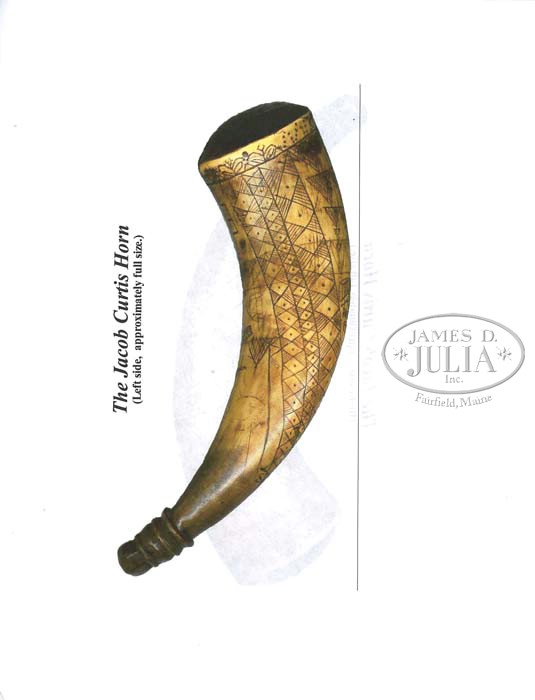
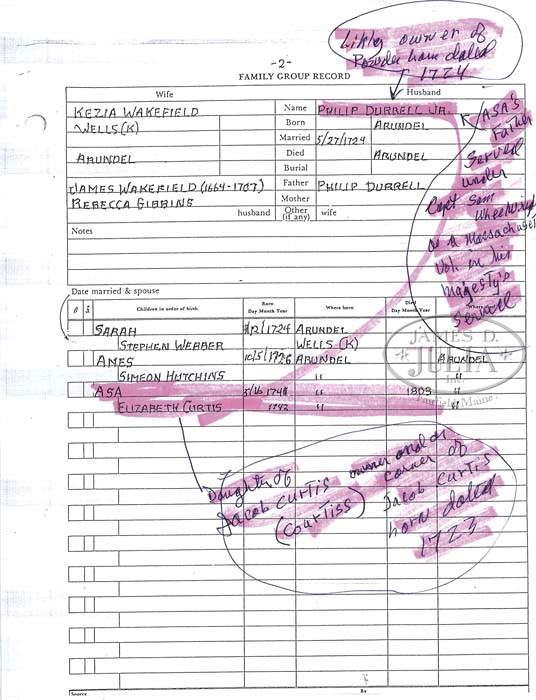
RARE EARLY 18TH CENTURY SCRIMSHAW POWDER HORN DATED 1724. This rare, early American, scrimshaw powder horn represents one of only a handful of horns that are known to exist that were produced during this time period, or before. American scrimshaw horns would eventually evolve into a form of sophisticated Folk Art and some of the later 18th and early 19th Century horns are truly works of art. This outstanding horn is noted not only for its very early date, but also its fanciful work and its potential historic connections. The horn body is all over inscribed with various designs, most notable is the repeating wampum design which covers nearly 50% of the horn, the remainder decorated with a fanciful stylized bird, flowers, diamond, heart and inscribed IN 1724. It also features a deep, old period brand P.D.. The upper portion of the body has an engrailed, or recessed edge, each point decorated with a dot and the base marked with a geometric design replicating the design. The entire foot of the horn is carved with repeating ribs and the spout also carved with the same design. The buttplug consists of an old, half-round, pine club fixture on four wood pegs. This horn is very similar to another documented early horn dated 1723. The reference horn carries the name Jacob Curtis and is dated 1723. It is not known whether Curtis was the maker or owner of the horn, however there is a great similarity in the carved decorative designs and utilized motifs of the two horns. The Jacob Curtis horn has a multiple, ribbed throat and also fitted with a half-round butt and has the repeating wampum design. The Curtis horn is of Maine origin, and there is no doubt as to the Maine origins of this 1724 horn. We believe that the maker of the Curtis horn is also the maker of the 1724 horn we are offering. It is known that Jacob Curtis lived in Southern Maine (at that time Massachusetts) in the town of York and a volunteer in His Majesty’s Service from the year 1722 to 1725 in Col. John Wheelwright’s command. Wheelwright’s command is well known as the very command that in 1724 proceeded on the expedition up the Kennebec River to Norridgewock and came upon a village of Abenaki headed by Jesuit missionary Father Rasle. In the engagement, Father Rasle, as well as most of the villagers were massacred. It is likely that Curtis may have accompanied this expedition as he was in Wheelwright’s company from 1722 to 1725. It is believed that same carver of this horn is the same as that of the Curtis horn and as already noted, there is a deep brand of the initials on the horn offered here P.D.. The initials most likely represent the owner of the horn. It was discovered in research of the military records from the time period that another member of Wheelwright’s command was a Phillip Durrell Jr. Durrell was not only under Wheelwright’s command during the same period of time as Curtis, but a member of the Durrell family eventually married into the Curtis family and they both lived, at one time in the same village, or very nearby each other. Since both were in Wheelwright’s command around the time of the 3rd Expedition of Governor Shute’s War it is possible that both Curtis and Durrell were part of the military contingent that attacked the Abenaki at Norridgewock and if so, this horn could have been, most certainly, carried by Durrell at the time. Further research will certainly shed more light on the exciting and interesting historical possibilities. The fact remains that the horn is a wonderful example of one of the earliest known scrimshawed American powder horns, and most definitely of Maine and Northern New England origin. SIZE: Approx. 11” on the curve. CONDITION: Horn is generally good condition with an overall dark, amber patina that has developed over the past few hundred years. The ribbed design on the horn shows small, old chips and the spout plug is missing. 4-40049 JJ666 (4,000-8,000)
Auction: Firearms - Fall 2010 Please Note: All prices include the hammer price plus the buyer’s premium, which is paid by the buyer as part of the purchase price. The prices noted here after the auction are considered unofficial and do not become official until after the 46th day. |