| Image | Lot | Price | Description |








|
2430
|
$143,750.00
|
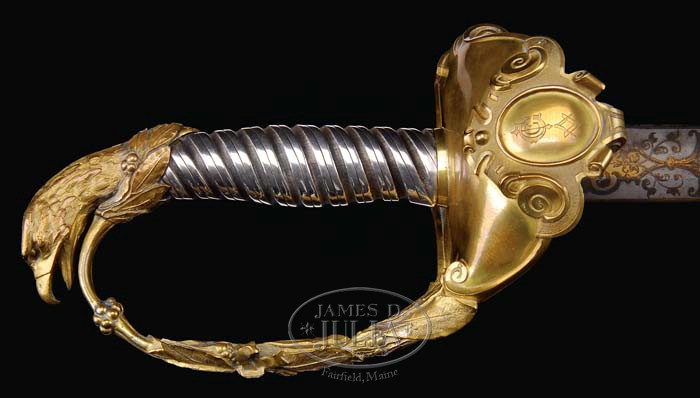
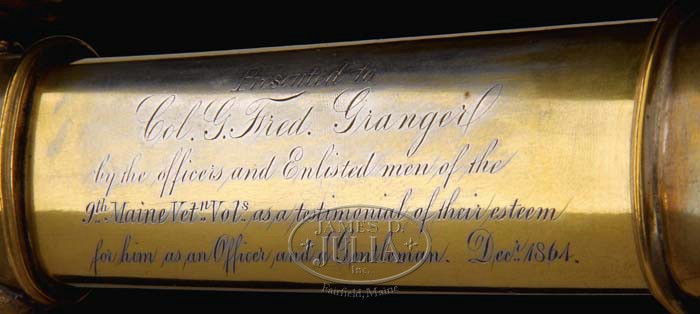
MAGNIFICENT AND HISTORIC CIVIL WAR CASED AND INSCRIBED TIFFANY & COMPANY PRESENTATION SWORD COMPLETE WITH ACCESSORIES, SASH, SPURS, REGIMENTAL AND RANK INSIGNIA OF BREVET BRIGADIER GENERAL GEORGE FREDERICK GRANGER, 9TH MAINE INFANTRY. In the world of cased, presentation swords it is both rare and unique to have such a complete casing from Tiffany & Company that is accompanied by many personal uniform effects of a gallant and renowned Civil War officer. This offering is a marvelous opportunity to acquire a beautiful cased presentation with such wonderful personal connections and objects. The fine walnut case presentation case measures 43.5” long x 5.5” deep x 8.25” wide. The case is fashioned of black walnut with brass furniture and the interior of form-fitted compartments are lined in vivid, royal blue velvet. The quality of this casing and its contents are surely only the work of Tiffany & Co., New York. Containing Granger’s rare & unique presentation sword and scabbard, the case also includes a pair of Tiffany & Co. marked, Gen. Off. spurs, his red silk and bullion sash, gilt bullion sword knot, and a marvelous high grade officer’s sword belt and plate. Accompanying this cased sword and accouterments are Granger’s rank and regimental insignia from Capt. through Bvt. Brig. Gen. The sword is a rare, high grade, staff and field officer’s sword with a unique eagle head pommel that measures 41 ½” overall. The lightly curved, single edged blade, measuring 31 5/8” long, is highly decorated with etching and gold wash. Depicted on the blade are two standing Union soldiers with flags, “U.S.”, classical Roman arms and beautiful rococo scrolls all embellished with the addition of gold wash. On the ricasso is stamped the blade maker’s mark “Collins & Co./Hartford/Conn/1862”. Immediately below is etched “Tiffany & Co./New York”. The blade measures 1 1/8” wide at the hilt. The hilt itself is finely crafted of gilded cast brass in a “D” guard form with a turned down counter guard shaped of solid Victorian scrollwork having a vertical oval cartouche showing a fancy wreath with the initial “G” inside surmounting a Masonic symbol. The “D” shaped knucklebow is in the formed of a sheaf of leaves that terminates at the base of a highly crafted, detailed eagle-head pommel with a swath of laurel leaves. The grip is of fine cast-silver finished bright and dark with an upward spiral motif. The scabbard is fashioned of silver-plated steel with gold wash and fancy mounts. The top and middle ring mounts made of cast-brass form a garland of laurel leaves, tied in a bow and terminating with an American shield. The applied drag mimics the ring mounts with a swag of laurel leaves terminating in a finial. On the reverse side of the scabbard’s top mount is the maker’s mark in a ribband “Tiffany & Co.” surmounting an Olde English “M” (the designer Edward Moore) in an oval cartouche. On the obverse of the scabbard is the period engraved inscription: Presented to Col. G. Fred. Granger/by the officers and Enlisted men of the/9th Maine Vetn. Vols. as a testimonial of their esteem for him as an Officer and a Gentleman Dec’r. 1864. Contained within the case is a pair of Tiffany & Co. marked officer’s spurs. The spurs, complete with their orig leather straps a of regulation style, gold-plated with engraved scrollwork and blued rowels. Also accompanying the sword is Granger’s fine red silk waist sash. Of unusually high quality, this sash incorporates fine gilt wire bullion knots and fringe intertwined with the red silk, rarely seen. Granger’s fine black Russian leather sword belt plate is present. Made of very high quality leather with fancy stitched decorations overall, the belt has a cast officer’s brass and gilt Model 1851 eagle belt plate with silver washed wreath. The brass snap hooks on the sword straps are engraved and the hook at the waist is a finely cast serpent. Finally, in the last compartment of the sword case, is a regulation gilt wire and bullion regulation sword knot. Along with this magnificent cased set come some of Granger’s personal uniform items that are representative of his career during the Civil War. A pair of triple bordered, bullion extra rich rank shoulder straps for Capt. of Inf. with light blue velvet backgrounds; two pair of dbl bordered, bullion rank shoulder straps for the ranks of Maj. and Lt. Col. of Inf. with deep blue velvet backgrounds, a pair of single bordered bullion Col. of Inf. straps with light blue backgrounds and a pair of single bordered bullion Brig. Gen. shoulder straps with black velvet backgrounds all represent his Civil War career and rise through the rank and file. The last two items, a die stamped brass “9” for his dress epaulets and a bullion embroidered Infantry bugle headgear insignia with the numeral “9” in the center represent his affiliation with the 9th Maine Infantry. George Frederick Granger, a lawyer born in Calais, Maine assisted in raising three companies for the 9th ME. Regt. Inf. in the spring and summer of 1861. He was, thereafter, elected 1st Lt. and then Capt. of Company A. Soon after the regiment was organized in Sept. of 1861, it began drilling in preparation to join Gen. Thomas West Sherman’s Expeditionary Corps and within two months it had participated in the capture of Forts Walker and Beauregard in SC. The men of the 9th were among the first to bring the United States flag back to the state of SC. In Feb. of the following year Capt. Granger with his company and regiment embarked on a secret expedition, which was later learned to have been an aborted plan to take Savannah. Fernandina, FL. was substituted in its place and here the regiment stayed doing fatigue duty until the end of August 1862. During the summer of 1863 the regiment was involved in the plan to take Charleston Harbor. In addition to bravery on the battlefield, many men of the 9th were forced to confront their individual social and prejudicial stances as they witnessed the 54th Mass. Colored Troops take the honorable lead position in the July 18 attack on Battery Wagner. The day proved to be a disaster for the Union with many casualties, including Brig. Gen. George C. Strong who was carried from the field by two men of the 9th. The regiment lost 189 men (killed, missing, and wounded) during the siege of Fort Wagner. On August 1, 1863, Maj. Granger returned to his regiment to assume command of the 9th ME. Inf. due to the absence of Col. Emery and Lt. Col. Robinson due to wounds and sickness. Granger was now the ranking officer in the regiment. By 1864, as the war intensified under Gen. Grant’s leadership, the 9th, then a part of the Army of the James, commanded by Gen. Benjamin F. Butler, began its march toward Petersburg where their many engagements included Drury’s Bluff, Cold Harbor, and the Battle of the Crater in Petersburg. Losses during this campaign were severe and by the fall of 1864, the regiment was so small, (about 300), that there was talk of combining the 8th and 9th ME, but one soldier, (Aaron H. Chase), later boasted that “the Genl. would not here [sic] of the 9th leaving its organisation [sic], the Regt was small but they done as much fighting as the larger Regts”. During the Battle of Drury’s Bluff, Maj. Granger suffered a severe wound to the knee when a mini ball, shot from the enemy, passed through it. Out of commission until Sept. 1st he returned to his regiment, still unable to walk on his own, in the trenches before Petersburg. On Sept. 25, 1864, Granger was promoted to Lt. Col. and then Col. of the Regiment. Col. Granger, still suffering from his wounds, commanded his regiment from a litter and was transported with them in a field ambulance. From his ambulance, he commanded the regiment through the campaigns of Fort Gilmer, Darbytown Road and Atler’s Farm. In December 1864, Granger was assigned command of a provisional division in the Army of the James attached to the 3rd Division, 24th Army Corps. After the Petersburg and Richmond campaign, the 9th was sent to North Carolina where it participated in the pursuit of Conf. Gen. Joseph E. Johnston and was present for Gen. Johnston’s surrender on April 26, 1865 in Goldsboro, North Carolina. On June 13, 1865, Granger was appointed Bvt. Brig. Gen. of Vols. and was the senior officer of the 2nd Div, 10th Army Corps. Granger originated the first branch of the Freedman’s Bureau while in command at Raleigh, NC. He was mustered out of service on August 5, 1865. Granger, a fine and well fought officer, certainly left behind one of the finest Tiffany cased swords and accoutrement sets known in private hands. In addition, the other personal uniform memorabilia that accompanies the cased sword is a testament to his service in the 9th Maine Inf. and his rise through the ranks as an officer. This sword is pictured on pg. 521 of “Civil War Army Swords” by John Tillman CONDITION: The sword is in excellent condition with strong etching and gilt decoration on the blade showing some age spotting here and there. The gilt finish on the hilt is nearly 90% but areas of wear have worn away some of the gold finish on the scabbard. The sash and sword belt and plate are both excellent, the spurs appear unused and the sword knot quite nice. The black walnut case shows only minor wear due to handling. Granger’s rank and regimental insignia all show use with light wear and some fraying to the bullion. Generally speaking, this entire group is in fine condition overall. 8-76234 CW2 (125,000-150,000)
Auction: Firearms - Fall 2008 Please Note: All prices include the hammer price plus the buyer’s premium, which is paid by the buyer as part of the purchase price. The prices noted here after the auction are considered unofficial and do not become official until after the 46th day. |