| Image | Lot | Price | Description |





|
2429
|
$92,000.00
|
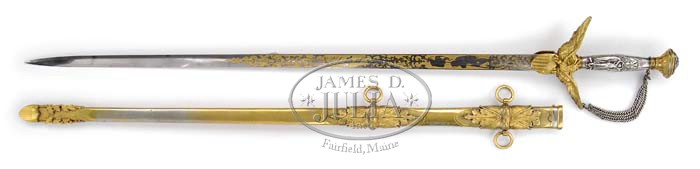
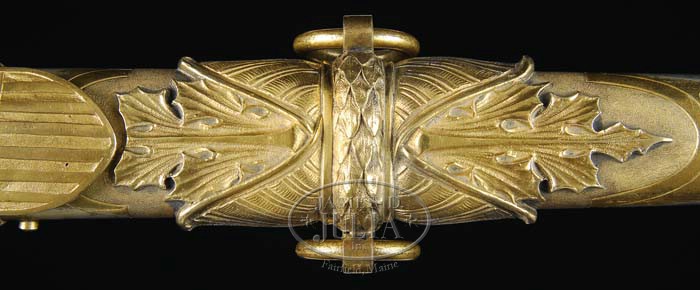
MAGNIFICENT HIGH GRADE TIFFANY & CO. PRESENTATION SWORD, SCABBARD, EPAULETS AND CASE INSCRIBED TO U.S. CAVALRY OFFICER BREVET BRIGADIER GENERAL (LATER MAJOR GENERAL) JAMES W. FORSYTH OF OHIO WHO PARTICIPATED IN MAJOR CAMPAIGNS DURING THE CIVIL AND INDIAN WARS INCLUDING COMMANDING TROOPS AT WOUNDED KNEE UNDER COMMANDER OF THE FAMED 7TH US CAVALRY. A wonderful, rare and unusual high grade presentation inscribed General officer’s sword and scabbard accompanied by photographs and a pair of Maj. Gen.’s epaulets with their wonderful Japanned and decorated case rarely ever seen. The sword is inscribed to Bvt. Brig. Gen. James W. Forsyth, a heroic and well fought Regular Army officer in the American Civil War who went on to finish his career in the U.S. Army as a Maj. Gen. This beautiful sword was manufactured by the famed Tiffany & Company of New York and is a shining example of their extremely high quality design and craftsmanship. The sword measures 41-1/2” overall with a 33” elliptical blade measuring 1” across at the ricasso and heavily decorated with etched patriotic designs including a standing Union soldier, a panoply of arms, a standing 17th C. warrior with banner, “U.S.” and wonderful rococo scrollwork. All of this is overlaid by gold wash creating a beautiful contrasting finish overall. The etched designs are present over 70% of the blade’s surface. The makers mark “Tiffany & Co.” is etched near the ricasso of the blade. The distinctive, high grade hilt is truly magnificent having a cast sterling silver grip with bas relief decorations of a Roman warrior’s head with helmet in an oval cartouche surrounded by a stand of arms on one side of the grip. On the opposite side there is a cast relief depiction of an angel with up-stretched arms grasping a wreath. The angel, with long flowing wings, is standing on a trumpet with another long trumpet above her head. This decoration is a marvelous allegorical depiction of war and peace. The cross guard is formed on both sides by a large American eagle with outstretched wings. The wings are spanned upwards forming a wide “V” and the eagle’s talons are firmly perched upon an American shield that forms two languets on either side of the hilt; all washed in bright gilt. The gilded brass pommel is urn shaped with alternating arrows pointing upward. The capstan or pommel cap is a sterling silver inset of a classical Medusa head cast in high relief. Finally the hilt is finished off with a double silver chain that is attached at the top to the base of the pommel and terminates at the eagle’s wing tip below. The sword is accompanied by its orig highly decorated scabbard of silvered and gilt steel. The body of the scabbard is fashioned of steel, silver-plated and gold-washed with three decorative mounts. The top and center mounts depict a leafy spray emanating from an open pod, with the ring mounts overlaid with a laurel leaf decoration. The top and center mounts are applied over an oval engraved and stippled cartouche on the body of the scabbard. The scabbard’s drag consists of two upward projecting oak leaf sprays that terminate at the base in a gilded American shield. On the top mount of the scabbard is an applied ribband with the maker’s name “Tiffany & Co.” embossed surmounting an Olde English “M” that represents Tiffany’s silversmith Edward C. Moore. Edward C. Moore was a leading silversmith of the period who worked for Tiffany as a designer and silversmith during the Civil War. In 1868 Tiffany & Co. (established in 1837) acquired Moore’s firm, retaining him as one of its directors. Between the top and center mounts of the scabbard appears a period engraved inscription that reads as follows: Bvt. Brig. Gen. J.W. Forsyth/U.S.A./from his sincere friend/L. Dexter Bradford/Oct. 16th, 1867”. Gen. Forsyth is most certainly no stranger to students of the American Civil War, Indian Wars and the Massacre at Wounded Knee. Along with much copied historical and biographical information on Forsyth, accompanying the sword is a framed Carte de Visite of Forsyth as Brig. Gen. with a “T. Lilienthal, New Orleans” backmark. A copy of an oft published photograph of Sheridan and his staff is included as well. This group photo, taken in 1865, shows Generals Sheridan, Forsyth, Devin, Merritt and Custer all gathered around a table. In addition, Forsyth’s cased epaulets as Maj. Gen. are retained with this group. The full dress epaulets are of gilt cloth, with gilded brass crescent ends and thick gold wire fringe. On the top surface are applied two silver embroidered stars for the rank of major general. The undersides are of red silk with brass attaching hardware. These epaulets are housed in a Japanned case with unique hand painted decoration of a quality that I have seen nowhere else. The top of the oval case has a gold and painted American eagle and shield within a wreath and having the Olde English letter “F” painted at the bottom. On the front side of the case are crossed swords and a garland of laurel leaves and on the reverse, a hand painted State Seal of Ohio within the garland. Forsyth was born on August 8, 1834 in Maumee, OH. He attended West Point graduating 28th in the class of 1856. He was assigned as a 2nd Lt. at Fort Bellingham on Washington Territory’s Puget Sound where he remained until the American Civil War commenced. On March 15, 1861 he was promoted to 1st Lt. in the 9th US Reg. Inf. Shortly after the war erupted, on May 14, 1861, Forsyth was assigned as a Lt. in the 18th US Reg. Inf. and served as an assistant instructor of recruits in Mansfield, OH. He was promoted to Capt. on Oct. 24, 1861 and for the first few months of 1862 commanded a brigade in the Army of the Ohio. On March 15th he was appointed to the staff of Maj. Gen. George B. McClellan. Under McClellan Forsyth served as Provost Marshal of the Army of the Potomac. In that role he participated in significant actions including the Peninsula Campaign, Seven Days Battle, and he fought against Lee’s invasion of Maryland. Following the Battle of Antietam he was sent to the Western Theater where he joined the staff of Philip H. Sheridan as an Assis. Adj. Gen. Forsyth remained on Sheridan’s staff for the remainder of the war. He was Brevetted Maj. for his gallant service at Chickamauga. When Sheridan was called east to command the cavalry of the Army of the Potomac, Forsyth accompanied him. He took part in the Overland campaign, was promoted to Bvt. Lt. Col. then rode with Sheridan down the Shenandoah Valley. Forsyth was present at Appomattox for Lee’s surrender. Forsyth was brevetted Brig. Gen. of Vols. on Oct. 19, 1864 for his service during the Valley campaign. His action at Winchester, Fisher’s Hill, Cedar Creek, and Five Forks earned him this honor for bravery and gallant service. Again he was presented with a rare honor of Bvt. Brig. Gen. in the United States Reg. Army on April 9, 1865. He was mustered out of the volunteer service on 15 Jan., 1866. Returning to his former rank of Lt. Col. following the Civil War, Forsyth remained in the regular army. He commanded a brigade of cavalry until 1867 ( the same year he was presented this sword) when he was again assigned to Sheridan’s staff, first as Assis. Insp. Gen. of the Dept. of the Gulf and then as an aide and military secretary to Sheridan. Forsyth accompanied Sheridan to Europe to observe field operations during the Franco-Prussian War. From 1878 Forsyth performed frontier duty in Washington Territory with the 1st United States Cav. In 1886 he was promoted to Col. and given command of the famed 7th United States Cav. From 1887 until 1890 he worked to organize a cavalry and field artillery school at Fort Riley, Kansas (which existed until World War II). In 1890 he was sent to force a band of about 350 Sioux led by Chief Big Foot to return to their reservation. The Sioux had left their reservation following the teachings of Wovoka, a Paiute medicine man, who claimed by performing the Ghost Dance, the buffalo and Indian life would return to how it was before the arrival of the white man. Forsyth and his 3000 strong 7th Cav. caught up to the Sioux near Wounded Knee, South Dakota on 29 December, 1890 where over 150 Sioux, including woman and children, were massacred. Nelson Miles, the Commander of field operations, called the incident an “unjustifiable massacre”. He convened a court of inquiry and relieved Forsyth of his command. The Secretary of War, Redfield Proctor, disagreed with Miles and exonerated Forsyth restoring him to command. In 1894 Forsyth was promoted to Brigadier General in the United States Regular Army. He was promoted to Maj. Gen. in 1897 and retired that same year. He died October 24, 1906 in Columbus, Ohio. This lot represents one of the finest Tiffany presentation swords in existence, enhanced by its presentation to a gallant Civil War and Indian War officer who was prominently involved in the historic incident at Wounded Knee. This sword is shown on pgs 518 & 519 of John Tillman’s Civil War Army Swords and pgs 446, 447 & 448 of Civil War Artillery Sabers. The exact same pattern sword is also shown as fig. 9 in the original Tiffany catalogue. Photos from this very rare catalogue have been generously shared with us by Norm Flayderman. SIZE: 41 ½” overal1 PROVENANCE: Sword inscribed, epaulets; accompanied by notarized letter attesting to their provenance and ownership by Forsyth. Ex-collection of Richard Johnson CONDITION: The sword and scabbard is in fine condition overall retaining nearly 80% of its factory finish and gold wash with only minor losses to the finish on a few high spots. The blade is quite nice with only a little age spotting here and there. The scabbard is excellent with no dents. The epaulets are fine as well showing only little wear and a tiny bit of fraying. The Japanned tin epaulet case is excellent retaining 80-85% of its exterior hand-painted finish with just a few minor nicks and loss of paint here and there. 8-76235 CW1 (125,000-150,000)
Auction: Firearms - Fall 2008 Please Note: All prices include the hammer price plus the buyer’s premium, which is paid by the buyer as part of the purchase price. The prices noted here after the auction are considered unofficial and do not become official until after the 46th day. |