| Image | Lot | Price | Description |




|
2380
|
$0.00
|
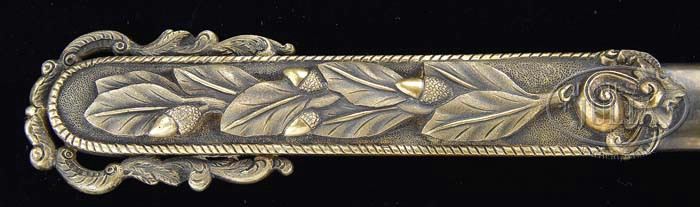
MAGNIFICENT AND RARE STATE OF DELAWARE PRESENTATION SWORD FOR MEXICAN WAR GALLANTRY. You are bidding on an extremely high grade Mexican war presentation sword in wonderful condition given to a hero from the State of Delaware. This elegant silver hilted and silver scabbarded sword is highlighted in gilt on the pommel, hilt, clamshell guard and scabbard mounts. The knucklebow is decorated in oak leaves and the pommel terminates in an acorn. The quillon terminates in a stylized eagle head. Scabbard mounts are raised relief with floral and patriotic motifs. The presentation which is found on the scabbard between top mounts is surrounded by an oak leaf frame and reads as follows: “Presented Feb. 20th 1849 to Brevet Captain CP Evans 11th Regt U.S. Infantry/by the Legislature of the State of Deleware for his Gallant and/Meritorious conduct in the War with Mexico”. According to The History of Delaware by Thomas Scharf, this sword is one of only two “one hundred dollar swords” presented by the Legislature of the State of Delaware to its heroes of the Mexican War. This sword was presented to Lieutenant (Brevet Captain) Columbus P. Evans of Wilmington, Delaware. An account of the presentation states that On February 20, 1849, the General Assembly of the State of Delaware appropriated one hundred dollars for a sword with suitable inscription for Brevet-Captain C. P. Evans, for his service in Mexico. In the Mexican War (1846-1847), the Federal Government would not accept volunteer companies but the Delaware volunteers were not content to stay home. After much debate in the State legislature, a statewide composite unit was formed that went off to war. Most of the men from Delaware entered service in the newly created 11th Regiment, U.S. Infantry. On February 11, 1847, the Federal Government authorized the formation of new 1 year regiments to help supplant those forces already on campaign. Lt. Evans went off to war with the The 11th Regiment and fought with distinction at Vera Cruz and in the battles of Contreras, Cherubusco, Molino del Ray and Chapultepec. The Eleventh Regiment of United States Infantry was the only complete company from the State of Delaware that went to the Mexican War. The bravery of its men, in common with the entire Eleventh Regiment, was highly praised in all of the published reports. Many of the Wilmington boys became sick soon after their arrival in Mexico; some of them died in the service, while numbers of them were killed or wounded in battle displaying the highest level of valor on the field. The Battle of Vera Cruz was a 20-day siege of the key Mexican seaport of Veracruz, during the Mexican-American War. Lasting from March 9 to March 29, 1847, it began with the first large-scale amphibious assault conducted by United States military forces, and ended with the surrender and occupation of the city. U.S. forces then marched inland to Mexico City. The 11th Regiment fought bravely at Contreras and Cherubusco according to Winfield Scott’s official report on the two conflicts filed at Tacubaya, at the gates of Mexico, on August 28, 1847. The Battle of Molino del Rey was one of the bloodiest engagements of the Mexican-American War. The list of casualties for the 11th Regiment alone for this single battle encompasses more than 45 men and Col. Graham, their heroic and much-loved commander, fell dead, pierced by twelve balls in the battle. At Chapultepec, nearing the end of War, the 11th Regiment once again distinguished itself on the field of battle. The unit lost so many men in these actions it became known as “The Bloody 11th.” After the treaty of peace was signed the Eleventh Regiment was sent to Fort Hamilton, New York, where the officers and men were mustered out of service. At a public meeting held in the City Hall, at Wilmington, April 12, 1847, where Dr. James W. Thomson was president and J. W. Duncan, secretary, congratulatory resolutions were adopted in recognition of the brilliant victories of General Taylor at Buena Vista and General Scott at Vera Cruz. On April 15th there was a grand demonstration in the city in honor of those victories. One hundred guns were fired at corner of Fourth and Washington Streets by Artillery Company A. There was a parade of local military organizations in the afternoon. In the evening the words “Honor” and “Fame” were reflected upon canvas in front of the City Hall and there was a fine display of fireworks. The streets were brilliantly illuminated. Over a year later, a spontaneous meeting of citizens occurred at De Haven’s Indian King Hotel, between Front and Second Streets, on Market, in Wilmington, Delaware. On July 29,1848, it was decided to give the returning soldiers from the city an enthusiastic welcome. The reception committee was composed of twenty-eight citizens, with Mayor Alexander Porter chairman and William R. Sellars secretary. “The gallant men returned crowned with laurels from the field of glory” They were tendered a banquet in the City Hall, and were received in a speech on behalf of citizens by Hon. John Wales. They were, Lieutenant Columbus P. Evans, Sergeants Benjamin F. Handy and Abijah Jackson and J. L. Patterson; Privates, Joseph S. Wheeler, Samuel Paul, John Bailey, William Hassam, Levin Stevens, Matthew Gosling, Paul H. Carter. Isaac Hill, Samuel Taylor, Alexander Henderson, George McMullen and John Crew of Chaytor’s Company F, 11th Regiment. A few others returned a day or two later, but the entire number that came back was but a handful of those who went sixteen months before. On February 20, 1849, the General Assembly appropriated one hundred dollars for a sword with suitable inscription for Brevet-Captain C. P. Evans, for service in Mexico. Brevet Capt. Columbus P. Evans served as editor of the Delaware Republican following the war and was elected as Mayor, city of Wilmington from 1851 – 1852. An obituary in the New York Times dated March 3, 1854 states: “DIED: Capt. C.P. Evans, associate editor of the Delaware Republican, dies at Westchester on Sunday last.” This magnificent sword, one of only two presented by the Legislature of Delaware, represents one of the great opportunities to acquire a Mexican War presentation sword with important provenance and heritage. PROVENANCE: Ex-Norm Flayderman Collection. Pictured on pg. 104-105 in “Steel Canvas” by R. L. Wilson, 1995. CONDITION: Blade retains most of its original luster with scattered areas of black staining and pin prick pitting as can be seen in photos. Silver grip is fine with no discernible defects. Silver has patinaed to a luminous black and gray. Silver shield on cross guard with Delaware state seal is gray/bright with scattered black staining. Engraving is fine showing only minor wear at highest points. Decorated hilt, cross guard, pommel and scabbard mounts show black staining in deep areas where the gilted silver surfaces have oxidized giving a beautiful effect to the gilted features. Pommel top and pedestal retain much of their gilt. Scabbard body is toned nicely over most of its silver body. 4-37750 CW1 (40,000-60,000)
Auction: Firearms - Spring 2009 Please Note: All prices include the hammer price plus the buyer’s premium, which is paid by the buyer as part of the purchase price. The prices noted here after the auction are considered unofficial and do not become official until after the 46th day. |