| Image | Lot | Price | Description |

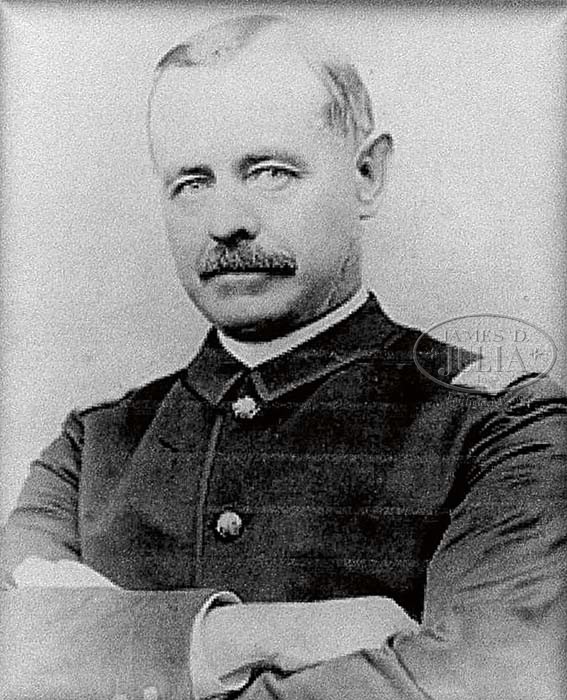
|
2357
|
$4,600.00
|
WHITNEY NAVY PERCUSSION REVOLVER 2ND MODEL 2ND TYPE, THE PROPERTY OF BRIGADIER GENERAL JOHN LAPHAM BULLIS. SN M10491. Cal. 36. Usual configuration with 7-5/8″ oct bbl, brass pin front sight and 2-line address. Mounted with 2-pc smooth walnut grips, matching numbered to this revolver. Accompanied by a signed notarized letter address to Fred B. McDonald dated Aug. 23, 1986 over the signature of Paul A. Schaffer. Mr. Schaffer states that this revolver, identified by SN, belonged to and was used by Lt. John L. Bullis during the Civil War. He further states “My grandmother, Herminia (Durand) Lujan, acknowledges that it was his gun. John L. Bullis was married to my grandmother’s great-great aunt, Alice Rodriguez.” Another revolver, a Colt Model 1860 Army, being sold elsewhere in this auction, descended from the same family and had been used by Texas Ranger, Augustus Durand, who was married to Alice Rodriguez’ sister. John Lapham Bullis (1841-1911) was born in New York April 17, 1841. He enlisted as a Corporal in the 126th New York Volunteer Infantry in August 1862 and thereafter, with his unit, participated in numerous important battles throughout the Civil War. At the Battle of Harpers Ferry in Sept. 1862 he was wounded & captured but was exchanged and rejoined his unit. He was again wounded & captured at Gettysburg, spending 10 months in the notorious Libby Prison and was again exchanged in the Spring of 1864. He was promoted to the rank of Captain and assigned to the 118th U.S. Colored Infantry where he remained to the end of the war, being mustered out in Feb. 1866. He re-enlisted in the regular Army as a 2nd Lieutenant in Sept. 1867 and was assigned to coastal Texas in garrison duty. In Nov. 1869 he requested to be and was transferred to the “new” 24th Colored Infantry. He remained with the 24th Infantry and participated in a number of Indian operations against raiding parties and cattle rustlers. In 1873 he received command of a special troop of black Seminole scouts. The Seminole Indians were the only tribe to never sign a treaty or surrender agreement with many of them emigrating to Northern Mexico. Luring the Seminole scouts into enlisting in the Army was extremely fortuitous for the border area of Texas. The scouts were the single most preeminent trackers & fighters to ever wear the uniform. They were promised permanent military enlistment with food for themselves and their families and a piece of land of their own for this service. From 1873 to 1882 Bullis commanded the black Seminole scouts on some of the most effective raids & fights against Comanches, Kiowas, Southern Cheyennes, Kickapoos & Lipans, frequently crossing the border into Mexico to punish & kill the raiders and recover stolen property. Bullis lived and fought with his Seminole scouts, becoming one of them, leading them into battle, not directing them. His scouts referred to him as “The Whirlwind” and the Indians he was fighting called him “Thunderbolt”. Bullis & his scouts were so effective in punishing the raiders that by 1882 the raids had just about stopped. In 1882 Bullis was transferred to new duties in Indian territory and the people of Kinney County, Texas presented him with two ceremonial swords, one silver & one gold, in appreciation of his protecting the border. The swords are currently in the Witte Museum in San Antonio, Texas. At the same time the Texas State Legislature passed a special resolution in his honor. From 1882 to 1888 Bullis served at Camp Supply in Indian territory and then rejoined his old regiment in Arizona and served as Indian Agent for the San Carlos Apache Reservation. In 1893 he was transferred to Santa Fe and became agent for the Pueblo & Jicarilla Apache Indians. In 1897, having been promoted to Major, he was appointed paymaster at Fort Sam Houston near San Antonio. During the Spanish American War he saw service in Cuba and the Philippines and in 1904 was promoted to Brig. General, retiring the next day. Gen. Bullis, during his tenure in Texas purchased numerous tracts of land and entered into a partnership with William R. Shafter and John W.Spencer to open the Shafter Silver Mines in Presidio County, Texas. He became wealthy out of these investments, enterprises which helped promote the settlement of West Texas. In 1872 he married Alice Rodriguez of San Antonio who died in 1887. He remarried and subsequently had three daughters with his second wife and he died in San Antonio on May 26, 1911. Just at the beginning of WWI the new military training base near San Antonio was named Camp Bullis. That this man was a true American hero is indisputable. PROVENANCE: Fred B. McDonald Estate Collection. CONDITION: About very good, all matching including grips. Bbl, cyl & rammer retain most of an old reblue. Frame is a gray/brown patina. Grips show heavy wear with chipped toes and retain most of an applied varnish. Mechanics are fine, strong bore with moderate pitting. 4-42088 JR282 (3,000-5,000)
Auction: Firearms - Spring 2011 Please Note: All prices include the hammer price plus the buyer’s premium, which is paid by the buyer as part of the purchase price. The prices noted here after the auction are considered unofficial and do not become official until after the 46th day. |