| Image | Lot | Price | Description |








|
2322
|
$74,750.00
|
Revised: 9/27/2011
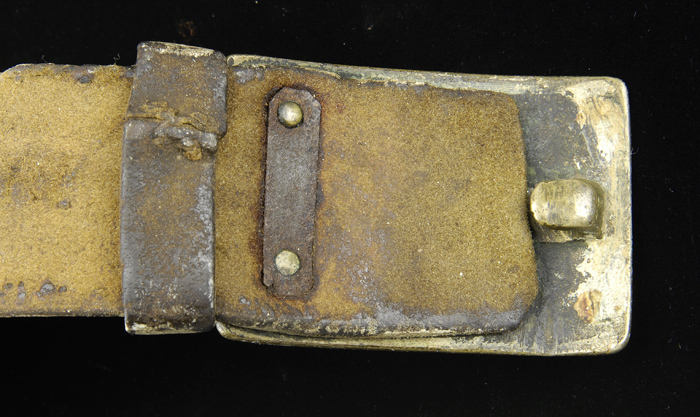
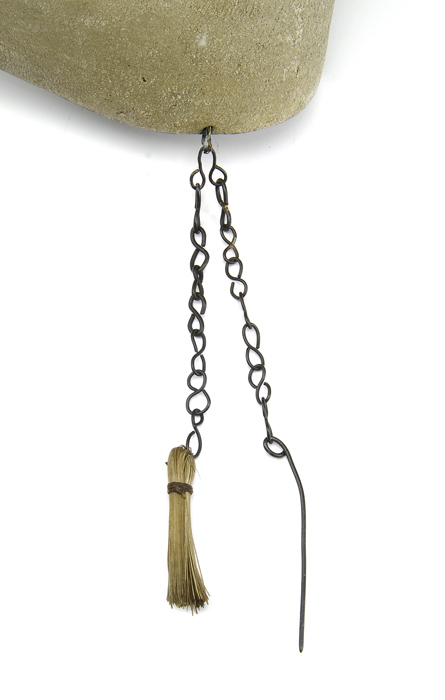
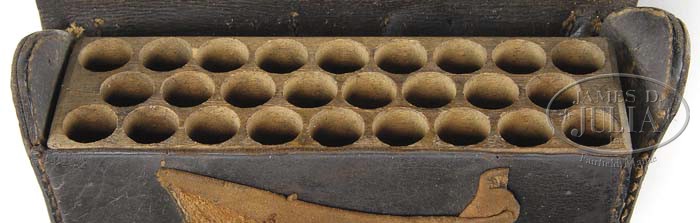
Additional important information regarding the historic cartridge box and bayonet rig of a British soldier of the 38th Regiment of Foot. A scholar and researcher regarding Revolutionary War material recently contacted us with some updated information and corrections which we wish to note. We also want to take the opportunity to share some additional information regarding this important lot. a. Our cataloger stated the accoutrements are those of a British light infantry man. The scholar who contacted us states, “more than likely the pouch, strap, and waist belt were worn by a “grenadier” of the 38th Regiment, not a “light infantry” who wore different accoutrements.” We are grateful for this information and would like to add some additional perspective. History notes that a number of British “light infantry” companies and “grenadier” companies both were involved in the actions on April 19th. Also, please see additional photographs we have posted on the web with close ups of all of the accoutrements, so that you can make your own opinion as to “light infantry” or “grenadier”. Of course, whether it is “light infantry” or “grenadier”, does not depreciate the value and historic significance of this spectacular lot. b. “This belt frog was obviously altered very crudely at a later date to only carry a bayonet. The scabbard for the bayonet is also not original to its form and was added after its capture.” Indeed this is absolutely correct; the bayonet and scabbard were added later. Our cataloger overlooked this in the cataloging and we apologize. The alteration is certainly very, very old and likely early 19th century. This type of alteration on captured accoutrements is normal and almost expected of a frugal New England farmer/soldier who sometimes needed to alter, adopt or resize captured accoutrements to meet his size or needs. c. In preparing the description, our cataloger discovered in the collections of the Concord Free Public Library, a map surveyed by Henry David Thoreau in 1857 which showed a farm near the North Bridge as being property of the Hosmer family and in preparing the description, mentioned this exact information implying the possibility it could have been this farm in whose field the British soldier finally died. The scholar has shared with us that while all of this is true, “the Hosmer family did not buy this specific farm until well after 1775”, an additional fact we did not know and are now grateful to have. All we know from the early 20th century newspaper article is that William H. Hosmer specifically states he “got the musket from his grandfather who was plowing in the field in the time of the battle of Concord”. And indeed, in regards to this, there are some important facts that must be considered: 1) Since William H. Hosmer does not say where his grandfather’s farm was, we do not know for certain if it’s in Concord or somewhere on the return to Boston. 2) Only a few British regulars were killed at the North Bridge but yet 100 to 200 were either killed or wounded before they got back to Boston. Indeed some wounded in and around Concord succumbed later and some were shot by sniper fire as they retreated to Boston. Whether this soldier was wounded somewhere in the area of Concord or shot on the retreat, we do not know. The newspaper states only that the British soldier was found at the farm of Mr. William H. Hosmer’s grandfather. And in fact, that newspaper article speculates that the owner of these accoutrements was one of the British retreating from Concord. 3) Hosmer was not an uncommon name in the village of Concord and there were various Hosmers that lived in Concord and we do not know which Hosmer, William H. Hosmer was referring to, or even if he was referring to a Hosmer. 4) What we have to remember is that William H. Hosmer had a grandfather on his father’s side which would have been named Hosmer and he also had a grandfather on his mother’s side who would have had some other last name. d. Our cataloger made reference in his description that William H. Hosmer was a linear descendant of Joseph Hosmer, the “Concord Adjutant” who participated in the Battle at Concord. Our cataloger did a general investigation on the internet site “Roots Web” and a preliminary study showed later descendants named William H. Hosmer or William Hosmer. Perhaps a more accurate term would be a lateral descendant, rather than lineal descendant as lineal descendant might imply that W H. Hosmer was a direct descendant of Joseph Hosmer and that is not what we meant to imply. We did not do a full genealogy on this which would take a considerable length of time (which might eventually prove to be exceedingly interesting). William H. Hosmer of course was actually born a few generations after Joseph. e. Our cataloger referred to Joseph Hosmer the “Concord Adjutant” who served in the Massachusetts militia “minutemen under Colonel Barrett”. We are told that Hosmer was part of a minute company which is part of a minute regiment, not a militia minuteman. We also want to reiterate what we specifically stated in our catalog description that the “dead soldier was obviously not one killed at or near the North Bridge. Those dead are identified by markers near the bridge.” All we know from the newspaper article that accompanies this lot, is that the dead soldier was found on the edge of William H. Hosmer’s grandfather’s farm and unceremoniously buried there. Thus, where this specific soldier was during the various activities in Concord on April 19th, 1775, where he was wounded originally or in fact the exact spot at which we died cannot be determined form the newspaper article, only that the soldier was part of the 38th Regiment that set out at General Gage’s orders, to Lexington and Concord to discover and destroy militia arms and stores. He was one of the many British regulars that were eventually killed that day. It is known that the British had lost between 150 and 200 soldiers, either wounded or killed. Also at the end of the day, over twenty of them were missing and obviously these accoutrements came from one of those missing British soldiers. This is truly an exciting, rare and genuine Revolutionary War set of British accoutrements and the facts known to us clearly indicate that these were carried during the engagement of April 19th, 1775; unquestionably one of the most historic engagements of the revolutionary War. We are grateful for the additional information that’s been supplied to us by one who so carefully researched and investigated these accoutrements and we appreciate his sharing these interesting facts and details with us. The clarification, we feel enhances these rare objects and their important history. IMPORTANT AND HISTORIC BRITISH LIGHT INFANTRY CARTRIDGE BOX, BAYONET AND BELT TAKEN FROM A DEAD BRITISH SOLDIER OF THE 38TH REGT. FOOT NEAR CONCORD, MASS APRIL 19, 1775. SN NSN. The first time this most historic piece of history has ever reached the public market. Associated with one of American history’s most seminal moments and just after “The Shot Heard ‘Round the World” is this Revolutionary War British light infantryman’s 26-rnd cartridge box, shoulder sling, waist belt with bayonet, frog and black leather scabbard accompanied by its orig rectangular cast brass waist belt plate engraved with the designation for the British 38th Regiment of Foot. Family provenance states that this set of accouterments along with a British Brown Bess musket (the whereabouts of which are now unknown) were taken from a dead British soldier from the 38th Regiment of Foot who was killed in the action at or near Concord on April 19, 1775. This set of accouterments was first taken from the deceased British Soldier by the Grandfather of William H. Hosmer, who was plowing in his field at the time of the Concord battle. After the British had retreated, according to family legend, Mr. Hosmer’s Grandfather either walked or plowed his way to the edge of the field and saw the soldier laying there. Mr. Hosmer gave the soldier a Christian burial and kept the musket and accouterments which were passed down through his family and finally to a Mr. Eldredge A. Mack who sold them to consignor. The British 38th Regiment of Foot came to America arriving in Boston in 1774. On the 19th of April 1775 one flank company of the 38th Regiment, under Major Pitcairn, participated at Concord in one of the world’s most famous moments in military history. The descent of this set of British accouterments is documented in an early (but undated) newspaper article. At the time of the article the accouterments (along with a Brown Bess musket previously mentioned) were in the possession of Eldridge A. Mack, a member of Company E, Massachusetts National Guard. Mr. Mack had acquired the set from Mr. William H. Hosmer of Concord. William H. Hosmer was a lineal descendant of Joseph Hosmer the “Concord Adjutant” who served in the Massachusetts Militia “Minutemen” under Col. Barrett on that fateful day. The article further states that Mr. Hosmer’s grandfather who was plowing a field at the time of the battle, discovered the dead British soldier and gave him “…a Christian burial but kept his musket, belt and bullet box.” A map surveyed by Henry David Thoreau in 1857 (in the collections of the Concord Free Public Library) shows land holdings and the Hosmer’s farm in close proximity to the Old North Bridge. The dead soldier was obviously not one killed at or near the North Bridge. Those dead are identified by markers near the bridge. This soldier was shot during the retreat and is so noted in the news article. The article goes on to describe the accouterment set exactly as it appears here as follows: “In excellent condition with the whole leather of the belt still pliable, and the initials of the soldier and Roman numerals still plainly visible…” clearly the article describes and defines the same set offered here. The components of the accoutrement set are as follows: A black bridle leather British light infantry cartridge box having a wooden cartridge insert with twenty six holes. A brown leather implement pouch is sewn to the front inside body of the box. Two iron rivets through the front flap of the box secure an “L” shaped hook the flap which connects to a brass triangular shaped latch affixed to the bottom. Overall measurements of the cartridge box are 9-1/2”long x 5” high. Also mounted on the bottom of the box are two square buckles for securing the shoulder belt. Affixed to these is the wide, white painted shoulder belt orig to the box. Secured to the shoulder belt is a musket brush and pick suspended by an iron chain. Carved initials are present cut into the leather on the bottom of the box. Somewhat illegible they appear to read “RP 2” and “B+P”. A wide white painted leather waist belt accompanies this set with a permanently affixed bayonet frog, scabbard and waist belt plate. The waist belt measures 1-5/8” wide with a leather loop keeper just behind the brass plate. Sewn to the waist belt is a white painted leather bayonet frog suspending a black bridle leather bayonet scabbard. The very bottom portion of the bayonet scabbard has been lost. The rectangular waist belt plate measures 3-1/4” long x 2-1/4” high” is made of cast brass in convex form having a narrow tongue on the reverse. The waist belt is secured to the leather waist belt with two small round studs on the reverse with a thin iron plate spanning the two studs. The brass belt plate keeper is missing from the opposite end of the waist belt. The face of the cast brass belt plate is engraved with a crown surmounting King George III’s Royal Cypher “GR” in fancy script and, on either side is engraved the regimental designation “XXXVIII” and “Reg t” indicating the British 38th Regiment of Foot. Finally the set is accompanied by its orig .75 cal. British Brown Bess socket bayonet with triangular blade and socket locking clip. The bayonet is marked in fractional style “D” over “26” on the socket of the triangular bladed bayonet. An amazing find, this British accoutrement set witnessed the very action that ignited the beginning of the American Revolution and was preserved as a souvenir and memento of the first armed conflict preceding the War. Provenance relating this accoutrement set to the Hosmer family punctuates its importance. Joseph Hosmer, the “Concord Adjutant” is quoted in nearly all sources as rallying his Minuteman force with the charge “Will you let them burn the town down?” as he stood amongst the Militia gathered at Concord’s North Bridge. History books recount that fateful day when as dawn broke on April 19, 1775, some seventy Lexington Minutemen, who were outnumbered almost ten to one, faced British Major Pitcairn’s regiments, including a portion of the 38th Regiment of Foot on Lexington’s town green. The militia, ordered by Pitcairn to disperse stood their ground and triggered a battle. Eight Minutemen were dead, and the British troops went on a rampage marching in the direction of Concord. In Concord, more Minutemen, now numbering about 400, retreated across the North Bridge to Punkatasset Hill in the face of the superior British force. As the British at Concord pursued their mission, they discovered and burned some wooden gun carriages. The fire spread to the meetinghouse, and the smoke rising from the town, easily visible from Punkatasset Hill, convinced the Minutemen that the British were burning their homes. “Will you let them burn the town down?” Is the famous rallying cry uttered by Adjutant Joseph Hosmer. The Shot Heard ‘Round the World was fired from the Minutemen’s muskets at Concord’s Old North Bridge, where this band of citizen farmers held off professional soldiers from His Majesty’s Army. The battle lasted only a few minutes, but when the musket smoke cleared, half of the British officers were wounded, and a dozen of their troops were dead or wounded. It was from one of these British soldiers who eventually died at the end of that fateful day that this set of miraculously preserved accouterments was obtained. PROVENANCE: Joseph Hosmer family; William H. Hosmer: Eldredge A. Mack. CONDITION: Very good. Cartridge box is in excellent well preserved condition with some stitch separation on the right end panel of the leather box. Outer flap and leather is very strong with some age cracking but little or no looses to the surface. Both the shoulder strap and the waist belt retain much of its orig white painted surface showing appropriate period wear at the edges. Waist belt keeper is missing and a small portion of the bottom of the black leather bayonet scabbard is missing as well. Brass waist belt plate is in very good condition showing surface scratching consistent with its age and use in the field. Triangular bayonet is in excellent condition now aged to a smooth brown patina. Overall this entire set is in very well preserved condition. 4-40317 JPC (30,000-50,000)
Auction: Firearms - Fall 2011 Please Note: All prices include the hammer price plus the buyer’s premium, which is paid by the buyer as part of the purchase price. The prices noted here after the auction are considered unofficial and do not become official until after the 46th day. |