| Image | Lot | Price | Description |


|
2319
|
$0.00
|
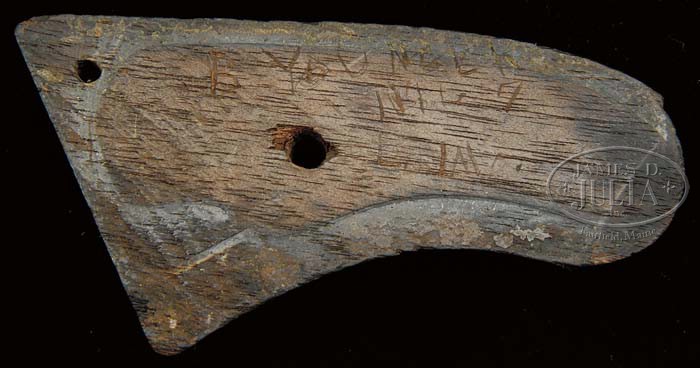
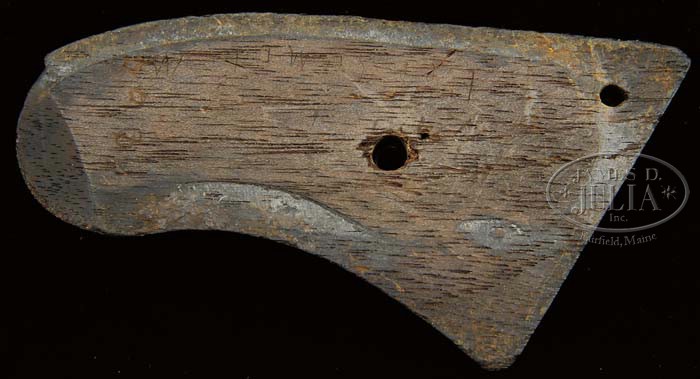
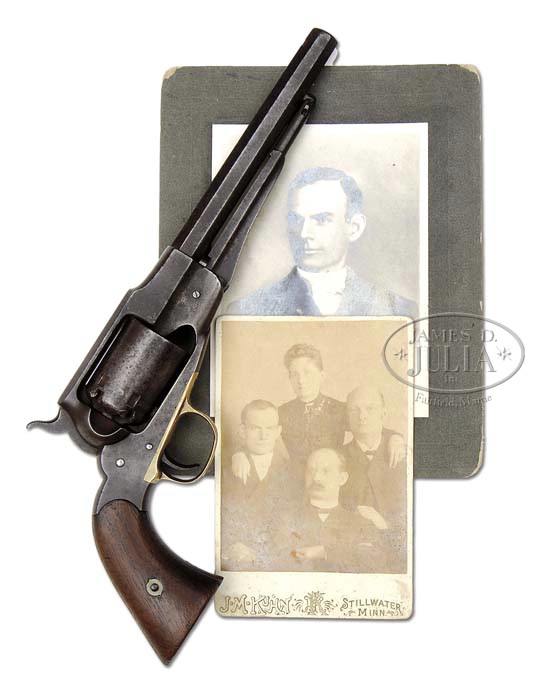
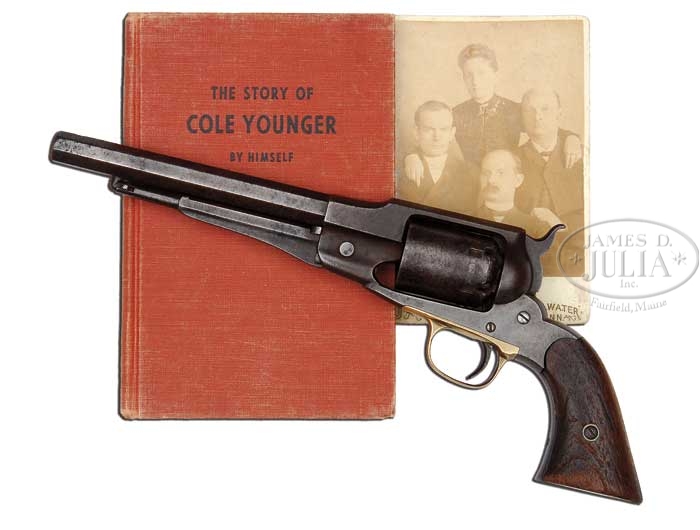
EXTREMELY RARE REMINGTON MODEL 1861(ELIOT”S PATENT) NAVY PERCUSSION REVOLVER WITH HISTORY TO BOB YOUNGER & POSSIBLY HIS BROTHER COLE “BUD” YOUNGER OF JAMES-YOUNGER GANG FAME. SN 15395. Cal. 36. Usual configuration with 7-3/8″ oct bbl, German silver cone front sight which was mounted on a dovetailed base mortised into the barrel, the cone is now gone or was removed by a former owner and the ends of the base have been filed down to be made flush with the barrel flats. We presume this was done to prevent the sight from catching on clothing or belt. There is a report of an incident in the Civil War in which Cole Younger drew his gun from his belt during a battle and quickly fired at a union soldier, the ball hit the man’s heart killing him instantly at a measured distance of 70 yards. The barrel also bears the correct 2-line Beals Patent address. The trigger guard is brass and is mounted with 2-pc walnut grips. The cyl pin of this particular model is unusual for a Remington percussion revolver in that it is not retained by the loading lever but instead is allowed to slide in a groove between loading lever and bbl. Remington was noted for employing various inventors and this cylinder pin was invented by Wm. H. Eliot. This particular model was also known as the “Old Model Navy” and was also made in .44 cal. known as the “Old Model Army”. Eliot’s thinking was that with this method of mounting the pin the shooter could very rapidly exchange an empty cyl for a loaded one. However, in practical use, after the revolver was used and “broke-in” the recoil of the revolver would cause the cyl pin to slide forward and bind the cyl. Remington almost immediately was notified by the Government to not supply any more of this model, only the previously supplied Beal’s model. To correct the problem, Remington simply installed a small filister screw into the top groove of the loading lever of any of the returned revolvers as well as any in stock, which modification prevented the cyl pin from sliding forward. This revolver has not had that alteration, instead has a very large headed screw installed through the pivot which effectively squeezes the frame slightly, which binds the cyl pin and prevents it from easily sliding forward. This is the type of field repair that was effected by a local gunsmith and could be the result of the “repair” ordered by Cole Younger as referenced further on in this description. This small nuance supports the historical perspective of this revolver, indicating that very early on in the Civil War it was removed from Union control. The inside of the grips are lightly & crudely scratched inside the left grip “B YOUNGER / 1867 / L.S. Mo.”. Inside right grip is lightly & crudely scratched with the date “1867” near the top and “Lee Sumit Mo”. The “o” in “Mo” is partially obscuring the “7” in the “1867” date. It should be noted that the name “Sumit”as scratched in the grip is wrongly spelled, a simple error for a 13 year old boy and also the Town had only been incorporated for a year or so. Accompanying this lot is is a signed and dated hand-written note from Antique & Modern Firearms Inc. of Lexington, KY over the signature of well-known dealer Charles B. Layson and dated Jan. 13, 1997, wherein he states that this revolver, identified by SN, “That I recently sold to Ted Bell, was purchased by me from an individual that came to our store with several family guns to sell, on about July 15, 1996. Not until our gunsmith removed the grips while cleaning the gun, did he see the marking, ‘BOB YOUNGER 1867.‘. The seller had not mentioned this marking, and apparently had no knowledge of its existence.” This cataloger is personally acquainted with Mr. Layson and will attest to his honesty and truthfulness. Mr. Bell had an analysis of the grips (COPY INCLUDED) in which a faint red material found in the scratched inscription. This analysis was performed by McCrone Associates Inc. of Westmont, IL, a well-known and respected analytical laboratory. In a report from this laboratory, dated 19 June, 2000, to Mr. Bell, over the signature of Richard E. Bisbing, Vice-President, Director of Research, wherein he states “We inspected the grips microscopically and analyzed some of the residue material that filled the scratch crevices. The only information that seemed to suggest the authenticity of the grips and how long ago they had been scratched was the fact that a filler had spread from the outside under the grip where it meets the frame. It had partially covered and filled in the crevices of the scratch marks. That is, the filler was applied after the scratches were made…We analyzed the material, and it was found to contain clay and silica with small amounts of iron oxide pigments (reddish-brown). Polarized light microscopy indicated the presence of finely divided quartz. Figure 1 is the elemental profile of the filler material using energy dispersive spectrometry (EDS); Figure 2 is the infrared (IR) absorption spectrum. Both analyses indicate the presence of clay and silica. The elemental profile also indicates a reasonable amount of iron from the pigment. I did not see any indication of Linseed oil in the IR spectrum, so apparently the oil in the filler is a hydrocarbon oil…These materials were used in the 19th Century, but they do not suggest a date because they were also available from earlier times and are probably still used today. Robert “Bob” Younger was born in Dec. 1853 in Harrisonville, MO and had three brothers, John, James & Cole Younger and a sister Henrietta. His brothers James & Cole, as teenagers joined in the Civil War in the Confederate Army and rode with the infamous William Quantrill raiders throughout Missouri & Kansas killing innumerable civilians opposed to the Confederacy and many Union troops. After the war James & Cole combined with the James Brothers, Jessie & Frank, and became the James-Younger Gang robbing just about anything that had money, banks, trains & stagecoaches throughout West Virginia, Alabama, Arkansas, Iowa, Kansas, Missouri & Minnesota. Bob Younger apparently considered too young to ride with the outlaw gang finally was allowed to ride with them on some of their later raids. Then on 7 September 1876 the gang attempted to rob The First National Bank in Northfield, Minnesota where three members of the gang were killed, Bill Chadwell, Clell Miller & Charlie Pitts. Cole Younger was wounded several times in this raid with some reports saying as many as eleven times. James was shot in the mouth and carried the bullet in his jaw for some time and even after it was removed, was troubled by this wound. Bob’s right elbow was shattered in the shoot out and although the wound healed his right arm was useless for the rest of his life. The James Boys escaped to a later fate but the three wounded Younger Brothers were all captured, tried and convicted and sentenced to life in prison. Bob died in prison on 16 September, 1889. Accompanied by an orig cabinet photo with vertical image 5-3/8″ x 4″, mounted on a cabinet card with the image of the three Younger Brothers and a young woman, Henrietta Younger, the sister of the Brothers. This photograph was taken at Stillwater Prison in 1889 six days before Bob Younger died. Another separate photograph of Bob Younger, was taken at the same time, a copy of which also accompanies this lot. Bottom of the cardboard backing of the group photo is marked on the front “J.M. KUHN, STILLWATER MINN.” Back of the photograph of the four Younger siblings is stamped in blue ink, “COPYRIGHTED 1889, BY / HENRIETTA YOUNGER”. The right side of the back is hand written “Bob Younger”, the left side is hand written “Cole Younger” and the bottom “Jim Younger”. Given that Bob Younger was born in 1853 and the date inside the grips of the revolver is 1867, would have made him about 14-15 years old when the inscription was made. It was shortly before that age that he, his mother and brother John had gone into Independence, Missouri to mill grain and other errands, one of which was to get one of Cole’s “pistols fixed”. As they were leaving town they were accosted by another boy who hit John with a piece of mackerel. According to Cole Younger’s autobiography on p. 66, Bob shouted “Why don’t you shoot him?”. The boy went away but returned shortly and John got out “the pistol” and shot him dead. In about 1872 Cole sent Bob to school at William & Mary College while Cole went to Lake City, Florida. Bob apparently had no intention of staying in school so with the money provided by Cole traveled a little and eventually joined Cole in Florida. By the Fall of 1872 Bob & Cole left Florida riding as far as Nashville where they sold their horses and went on from there by train to St. Louis, but a botched robbery by one of Cole’s old Confederate companions led authorities to suspect Cole & Bob were involved and were searching for them when the train arrived in East St. Louis. They managed to avoid detection and escaped back to Missouri. It was apparently at about this time that they began planning the Northfield, Minnesota bank holdup which included Bob & John and, as the saying goes, the rest is history. Additionally accompanied by a copy of a 2-page letter to his aunt dated Jan. 25, 1883 (while he was in Stillwater Prison). Letter is difficult to read with some areas illegible. Five books including have been used for references in this summary the first of which is included in the lot: The Story of Cole Younger, Himself(Autobiography of Cole Younger). The other four books used for reference are: Cole Younger Last of the Great Outlaws, Homer Croy; The Last Hurrah of the James-Younger Gang, Robert B. Smith; Outlaws, The Illustrated History of the James Younger Gang, Marley Brant; Remington Army and Navy Revolvers 1861-1888, Don Ware. Consignor reports that in the book The Outlaw Youngers by Marley Brant, p. 31, states that Cole Younger was also known as “Bud”. Page 51 says “Bob and Jim armed with handguns to defend their home”, that this was in September 1863 and is proof that they knew how to use firearms at a very early age (Bob was only 10 years old at that time); Author states that in January 1866, Cole had asked Bob to pick up a gun he had left with a gunsmith in Independence, MO; page 67 states “January 1866 gun was picked up from gunsmith”. This is possibly the “repair” to install the large headed screw which squeezes the frame to bind the cylinder pin, as noted above. The author of the referenced publication states that during the Northfield bank robbery when Bob was shot in the right elbow it is reported that he threw the gun into his left hand and continued firing, proving he was ambidextrous. PROVENANCE: E.J. “Ted” Bell Collection. CONDITION: Good. No orig finish remains being an overall medium to dark brown patina with moderate pitting on the bbl. Trigger guard is a light mustard patina. Grips are sound with the left side showing very heavy wear and the right side a heavy hand-worn patina. Wear on left grip is consistent with wearing the revolver in a belt with body moisture having caused severe surface damage and shrinkage. Mechanics are fine although a little worn. Strong bore with moderate pitting. The 1889 photograph has two or three small scratches on Jim Younger’s face, otherwise is extremely fine with good image, slightly yellowed with some minor foxing on the card. Bob Younger photograph is fine. Book is fine. 4-41716 JR265 (75,000-100,000)
Auction: Firearms - Spring 2011 Please Note: All prices include the hammer price plus the buyer’s premium, which is paid by the buyer as part of the purchase price. The prices noted here after the auction are considered unofficial and do not become official until after the 46th day. |