| Image | Lot | Price | Description |




|
2235
|
$69,000.00
|
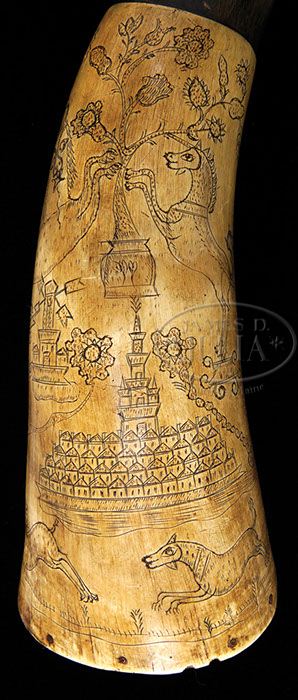
FABULOUS GROUP OF THIRTEEN 18TH CENTURY ENGRAVED POWDER HORNS BY ONE ARTIST. This group of horns represents 13 of the 27 known powder horns carved by same artist known as the “Folky Artist”. There are different schools of carving known on French and Indian War era horns and Revolutionary War era horns which is the period these horns date. This period between 1750 and 1790 was a time when every American military man carried a powder horn with his rifle. This is also the era of the greatest carvers of powder horns, few of which are known by name as they rarely signed their horns, but most are just known by their distinctive styles. There are groups of horns carved by the “Pointed Tree” carver, the “Memento Mori” carver and the subject carver the “Folky Artist”. These artists typically were paid by powder horn owner to be decorated and often named such that one man’s distinctive horn could not be mistook for another. Artistry skills and styles vary greatly among these 18th Century pieces of art. The Folky Artist is thought possibly to be a southern artist as southern characteristics such as palmetto trees, long leaf pine sprouts, scenes of dogs running deer, manatees, an alligator and what appears to be a Spanish mission are among the subjects engraved on his horns. There also appears on one horn to be the Hessian symbol of a double headed eagle. The only Hessian settlement in the south was at that time the Salzburger colony on Saint Simons Island just off the coast of Savannah, Georgia. Of these 13 powder horns collected; 3 had southern provenance. One horn known by this artist is identified to Aaron Lott of Charlestown, South Carolina and is dated 1777. There are recurring themes on many of this unknown artist’s horns. The most unusual of these is a hunter with bag, horn and flintlock rifle. He is dressed in Colonial attire; knee britches, frock coat, complete with tri-corn hat. Many times he is with his dogs running an almost comical bug-eyed deer. At least twice he is found portraying “Adam” with his hat in one hand and accepting an apple from an 18th Century clad “Eve” in the other. Often circle designs are found with two or three smaller spheres inside with “sun, moon and stars” or other personified faces carved within them. Another unique feature of this carver is a moth-like bug and/or a floral type vine with a bloom resembling a thistle blossom. Other recurring devices are found as can be seen in photographs. Mel Hankla who originally put this collection together and studied most of the other known “Folky Artist” horns in various institutional collections, states in his pamphlet produced on the “Folky Artist” the reason there are northern and southern scenes with dates ranging from 1759 to 1777. “My personal opinion, at this particular time, is that Folky Artist was on campaign. He was a soldier that was quite probably as far north as the Canadian border…but I also think he was at least as far south as Savannah, Georgia. Almost all of these powder horns have been engraved with an empty cartouche. Thus…I do not think that he was taking orders or making horns for particular individuals. Several have owner’s initials or a date scratched in, but most all seem to be from a different hand than that of the maker. I feel he was producing these horns for money or for trade. Perhaps he was producing these horns for someone that was actually dealing and selling these horns as a middleman; a merchant or a “drummer” as they would have been called in the day. Although his work is not what we would usually consider as professional, I think he was somewhat of a professional Horner. I believe he was influenced by what was around him; where he was, the people, where they were from and the norm of the accoutrements that they used. From looking at the whole spectrum of horns made by Folky Artist during the French and Indian War to his horns made well into the American Revolution, my personal opinion is that most were made in the field under a vast range of conditions producing much variety in the quality of workmanship. I feel some were produced under very good conditions and thus were very well wrought. And at the other end of the scale, one horn looks like it was perhaps an early attempt or maybe one of his last while laying on his deathbed!” The horns in this collection have each been assigned a name and individual details are available for each. This is a wonderful and probably the largest grouping that will ever be assembled by one French & Indian and Revolutionary War powder horn artist. SIZE: Horns vary in size from 9″ to 14″, average horns are 11-12″. PROVENANCE: Ex-Mel Hankla collection. The Gun Report, Vol. 50, #12, May, 2005 where 4 of these horns are pictured on the cover and 9 of the horns are pictured in the article on pgs. 24 thru 31. Pictured in article, pgs. 6-7 of the Dec. 2010 issue of The Horn Book. CONDITION: Overall condition on most horns is very good to fine. Several of the horns have seen use later then their time of manufacture. Three of the horns have additional names and dates carved such as on the 1775 horn which has an added date of 1837; as can be seen in photographs. All horns have original wood plugs, though a couple appear replaced but contemporaneous to their time of use. There is minor insect damage, if any to most horns. The 1759 horn exhibits most insect damage and only has 4 or 5 holes adjacent to plug; the largest being 1″ x 1/2″ as can be seen in photos. Surfaces of horns are mostly smooth with good patina with exception. “The Coat of Arms” horn with the Hessian eagle which has eroded areas about 2″ into horn from base that makes engraving difficult to see in those areas. But this horn which is 14″ overall and has 11″ of carved design which is only partially affected. 4-46280 JS122 (60,000-90,000)
Auction: Firearms - Fall 2012 Please Note: All prices include the hammer price plus the buyer’s premium, which is paid by the buyer as part of the purchase price. The prices noted here after the auction are considered unofficial and do not become official until after the 46th day. |