| Image | Lot | Price | Description |



|
2218
|
$13,800.00
|
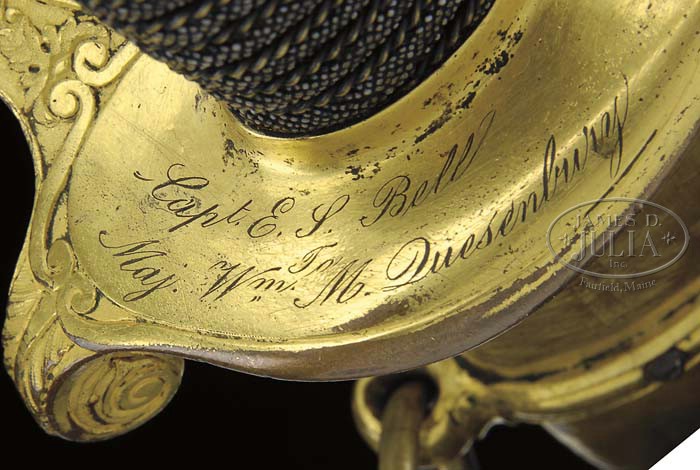
CIVIL WAR AMES STAFF AND FIELD OFFICERS SWORD, DATED AND INSPECTED, HISTORICALLY INSCRIBED AND PRESENTED TO FAMED ARKANSAS NATIVE MAJOR WILLIAM S. QUESENBURY. A Confederate presented Union Sword, presented by one Confederate Officer to another! Extremely Rare and Early Variation of the Model 1850 Ames Staff and Field Officers Sword with extra-wide blade and wide blued scabbard. Early style of etching with large, bold address. The blade is dated 1851 and inspected. Quesenbury was born in 1822 in Arkansas and attended the first school in Fort Smith. In 1838, he went to St. Joseph’s College, a Catholic institution in Bardstown, Kentucky. He later wrote for several newspapers. In the late summer of 1845, he joined a scouting party of Cherokee interested in settling in Texas. The outbreak of the Mexican War in 1846 prompted Quesenbury to join the Arkansas regiment. He wrote a detailed account of the Battle of Buena Vista and, in an extended poem, castigated his friend, Albert Pike. Quesenbury’s personal courage in this battle was noted in the dispatches. After the war and ensuing excitement further west, Quesenbury joined the gold rush to California in 1850. He did not prosper as a miner, but he did find work writing first for New Orleans’s California True Delta and then for the new Sacramento Daily Union. His art work included “View of Sutter’s Fort” and pictorial letter sheets showing a view of the Tehama block in Sacramento. In 1851, he returned from California in the company of J. Wesley Jones, whose plans to use daguerreotypes (reportedly 1,500) as the basis for a vast representation of the West called the Pantoscope included signing up Quesenbury as his staff artist. Quesenbury sketched a variety of scenes along the route back through Salt Lake City, Utah, and east into Nebraska. A printed narrative and his two sketchbooks survive. In 1853, he started the South-West Independent newspaper. In 1859, he assisted Superintendent of Indian Affairs Elias Rector in removing some of the Seminole from Florida to Indian Territory. Quesenbury opposed secession, but once the Civil War began, he joined Brigadier General Albert Pike in the Indian Territory, serving as major in the commissary department. Pike’s career there was turbulent, and Quesenbury was one of the major players in the first clashes between Pike and Major General Thomas C. Hindman over lines of authority. Pike was commissioned as a Brigadier General on November 22, 1861, and given a command in the Indian Territories. With Gen. Ben McCulloch and Pike, Quisenberry helped train three Confederate Regiments of Indian Cavalry, most of whom belonged to the “civilized tribes”, whose loyalty to the Confederacy was variable. Although initially victorious at the Battle of Pea Ridge (Elkhorn Tavern) in March, Pike’s unit was defeated later in a counterattack, after falling into disarray.After Pea Ridge, Pike was faced with charges that his troops had scalped soldiers in the field. Quisenberry’s poor health returned, and in 1864, now in Texas, he tendered his resignation. Captain E. S. Bell, the presenter, was a Captain from Alabama on Confederate Staff. More research needs to be done on the military career of Major Quesenberry, Bell and this sword. CONDITION: Fine for this early and rare variation of an Ames Staff & Field. Hilt, with beautiful inscription on its reverse, retains 95% gold gilt with a bit lesser percentage on the mounts. Grip is excellent. The blade etching is crisp showing age and weathering with the end of the blade showing wear and slight roughness. The scabbard is fine with most of its original blue finish and but a single slight dent. 4-44174 JS186 (5,000-10,000)
Auction: Firearms - Fall 2011 Please Note: All prices include the hammer price plus the buyer’s premium, which is paid by the buyer as part of the purchase price. The prices noted here after the auction are considered unofficial and do not become official until after the 46th day. |