| Image | Lot | Price | Description |






|
2147
|
$0.00
|
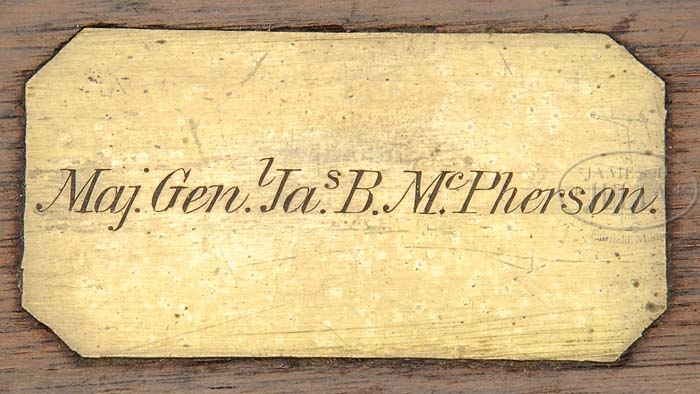
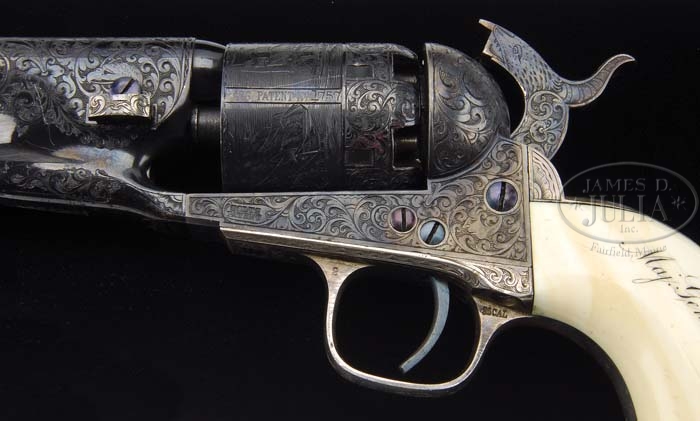
EXTRAORDINARILY RARE & UNDOUBTEDLY THE FINEST DOUBLE CASED PAIR OF ENGRAVED PRESENTATION COLT MODEL 1861 PERCUSSION NAVY REVOLVERS EXTANT, PRESENTED TO MAJ. GEN. JAMES B MCPHERSON. SN 11756 & 11757. Cal. 36. Phenomenal pair of revolvers with 7-1/2″ rnd bbls, German silver front sights and 1-line addresses with dashes. Left sides of frames are marked “COLTS PATENT” and the silver plated brass trigger guards & backstraps contain spectacular, smooth, 1-pc ivory grips. The serial numbers on the bottom of the frames, bbl lugs & trigger guards are all accompanied by a small “I” which indicates factory ivory grips. Left rear webs of the trigger guards have caliber markings. Revolvers are blue & color case hardened with Colt Master Engraver Gustave Young’s extraordinary deluxe engraving consisting of extra coverage, very fine foliate arabesque patterns, full coverage on the frames & recoil shields with patterns that extend over the bbl lugs terminating on top in front of the bbl addresses, with matching patterns around the front sights. Rammer pivots are engraved to match. Cylinders have hand-engraved Ormsby Naval battle scenes over front two thirds with the rear one third, most unusually finished with full coverage foliate arabesque patterns. Hammers are deluxe engraved with wolf’s heads on each side of the hammer noses and full coverage foliate arabesque patterns down the sides, with sides of the spurs also engraved. Spurs also have hand cut checkering. Tops of the backstraps are engraved with Mr. Young’s typical fan pattern and foliate arabesque patterns near the tops, at the heels, on the buttstraps and on the trigger guards. Wedges are engraved to match. While this pair is unquestionably engraved by Gustave Young himself, at the same time, for this presentation, they are not identically engraved. Number “11756” has a bird’s head incorporated into the scrolls on the left side of the frame. Number “11757” has a man’s face in the same position. Number “11756” has a bird’s head and a dog’s head on the left side of the bbl lug while “11757 has a bird’s head facing in the opposite direction with a flower blossom in the other position. The right sides of the frames are engraved in mirror images of each other. Right side of the bbl lug of #11756 incorporates a dog’s head & bird’s head in the scroll work while #11757 incorporates a bird’s head facing the opposite direction and a flower blossom. They also have slightly dissimilar patterns in several places. Left side of the ivory grips are engraved in period script “Maj. Gen. Jas. B. McPherson / 17th Army Corps.”. Backstraps are engraved “From his Friends / O.N. Cutler, W.C. Wagley”. All screws are fire-blued. Set is accompanied by their spectacular orig Colt mahogany dbl casing with a gold-washed, cut-corner plate in center of the lid engraved “Maj. Gen. Jas. B. McPherson”. Front of the case has a mortised brass lock with brass escutcheon. Interior is lined in burgundy velvet, French fitted in the bottom for the two revolvers, two blued 2-cavity molds with “COLTS PATENT” sprue cutters marked on right sides “36P”. There are also two L-shaped nipple wrenches, a small Dixon bag flask and two 250-count, sealed, paper wrapped tins of Eley Bros. caps. Covered compartment in the left rear contains spare screws, a spare trigger and a spare lockbolt/trigger return spring along with four nipples. Right front compartment is empty. Historical background: Clearly the finest cased set of engraved Colt Navy Revolvers to come to market in decades, these revolvers are enhances by their presentation to one of the Civil War’s most capable generals, killed in action near Atlanta in 1864. A centerpiece of the William M. Locke Collection for decades, this cased presentation has a long history of admiration into the 21st century. While this cataloger has been unable to turn up any definitive personal biographical data on the presenters; O.N. Cutler and W.C. Wagley, obviously deep personal friends of General McPherson, the general’s distinguished military career and his brave death while riding to his troops in battle is legendary. James Birdseye McPherson was born November 14, 1828 near Clyde, Ohio and entered the U.S. Military Academy at West Point in 1849. He graduated in 1853 first in his class along with his roommate, John Bell Hood, who later would take command of the Confederate forces McPherson was opposing five days before the time of this death. McPherson was stationed in San Francisco at the outbreak of the war. He requested and received an appointment in the Corps of Engineers. He left San Francisco on August 1, 1861, bound for Washington. Arriving in New York he was notified to report to Boston with a commission as Captain. In November of 1861, he wrote General Henry Halleck in St. Louis requesting a transfer to his command. McPherson then joined his staff as aide-de-camp and assistant chief engineer. McPherson’s career rise in the Union Army was due to his excellent skills and fine reputation as an officer. When reporting for duty in St. Louis, he was immediately promoted to Lt. Colonel. He was assigned as the Chief Engineer to General U.S. Grant and was responsible for selecting the deployment positions for Grant’s troops for their attaches on Fort Donelson and Fort Henry. Following the Battle of Shiloh, in May of 1862 he was appointed Brigadier General of Volunteers. On the 8th of October, 1862 he was, once again, promoted to Major General of Volunteers. In December 1862, the Army of the Tennessee was divided into five corps; 13th Corps under McClernand, 14th Corps under Thomas, the 15th Corps under Sherman, the 16th Corps under Hurlburt,and the 17th Corps was to be commanded by McPherson. On March 12, 1864, he was given the command of the Army of the Tennessee replacing General William Tecumseh Sherman as its commander. On May 5, 1864, Sherman began his march to Atlanta with McPherson’s Army of the Tennessee as the right wing of his army. McPherson, from his engineering studies of the area, knew that North Georgia was rough terrain and difficult ground for the movement of troops. Bare, perpendicular surfaces, such as Rocky Face Ridge, and other mountain sides were steeply sloping, with dense woods and undergrowth. Artillery and supply wagons would be able to move only through passes and gaps in the mountains. General Thomas, with his Army of the Cumberland, and Schofield with his Army of the Ohio were to advance to Dalton, Georgia and McPherson was to proceed to Resaca via Snake Creek Gap. Sherman’s plan was to force Confederate General Joseph Johnston out of his stronghold at Dalton while McPherson was to move south on his west flank and attack the railroad in Johnston’s rear. Johnston then would move south to avoid this danger and thus be caught between McPherson’s forces in the south, and Thomas and Schofield’s forces to the north. Thomas knew McPherson’s 24,000 men were too few for him to successfully carry out Sherman’s plan and asked to advance them on Resaca to give McPherson a larger force, but permission to do so was denied. At Resaca, McPherson learned that Johnston had cut a road through the woods and was marching his 60,000 troops down upon McPherson’s 24,000 men. McPherson knew that the speed with which his movements could be made was his only hope of success. He ordered the 15th Army Corps to attach Resaca at once. Troop movements were extremely slow and it was reported that the enemy had more troops outside of their defensive works than he had in his division. For this failure to trap Johnston, Sherman blamed McPherson for being too cautious. It is more likely, however, that Sherman’s laborious strategy against Johnston was to blame. As the confederate forces moved southward, McPherson’s troops followed vigorously, attacking them at Calhoun and repeatedly attacking them until they reached Kingston, where he was forced to halt due to lack of supplies. He resumed his march up on being re-supplied, and attacked the enemy again. Sherman sent order for McPherson to attack the enemy at Dallas, but by the time the courier arrived with this order, McPherson had already driven the Confederates through Dallas and a mile beyond. Every time Sherman moved, Joe Johnston met him with checking movements, Johnston faced Sherman step by step until they confronted each other at Kennesaw Mountain. The battle there lasted for nearly a month with disastrous results for the Union Army. On the 27th of June, Sherman made a massive attack on Kennesaw with all his army. McPherson’s troops went directly up the mountain and were met with tremendous fire from the Rebel breastworks. The assault failed. On July 2nd, McPherson tried a flanking movement on Johnston’s right, but Johnston discovered the movement and fell back, allowing McPherson to occupy Marietta. From the beginning of the campaign, Johnston and McPherson had anticipated each others movements and craftily circumventing them, each playing the part of a cunning adversary. On the 17th of July, Confederate President Jefferson Davis replaced General Johnston with McPherson’s old West Point roommate, John Bell Hood. Hood’s first engagement against Union troops as commander was north of Atlanta at Peachtree Creek. On the twentieth, Hood was defeated and moved his forces into Atlanta. Meanwhile, McPherson advanced from Decatur meeting little opposition and captured the outer earthworks guarding Atlanta and held the high ground on Bald Hill overlooking the city. That night, Hood sent General Hardee with four divisions south to circumvent McPherson’s forces. On the 22 of July, Sherman felt due to the lack of enemy in front of him, the Hood had evacuated Atlanta, and ordered an advance, but McPherson knew his old roommate and knew he wouldn’t give up Atlanta without a strong fight. If Atlanta was absent a large concentrations of enemy troops, McPherson believed, and rightly so, that Hood planned to attach the Union rear and side. McPherson was discussing his strategy with Sherman at his headquarters, when, suddenly they heard a large concentration of gunfire from the direction of Decatur. Hardee had, apparently, begun his attach. McPherson jumped on his horse and sped towards his troops where he found General Grenville Dodge’s Corps struggling against a fierce assault. After giving orders to Dodge, he followed a line of the 16th Corps towards the 17th Corps, traveling only with his orderly. Entering the wood that separated the two corps, he had traveled only about one hundred fifty yards when a cry of “Halt!” rang out. He stopped for an instant and saw a line of gray skirmishers, wheeled his horse, raised his hat, and made a quick dash to his right. The skirmishers let go with a volley. McPherson staggered in the saddle for a short distance and then fell mortally wounded to the ground. McPherson was loved by his troops, his commander, and by those who knew him. He was planning to get married to his fiancee Emily Hoffman when he could get a furlough. Confederate General John Bell Hood wrote: I will record the death of my classmate and boyhood friend, General James B. McPherson, the announcement of which caused me sincere sorrow. Since we had graduated in 1853, and had each been ordered off on duty in different directions, it has not been our fortune to meet. Neither the years nor the difference of sentiment that had led us to range ourselves on opposite sides in the war has lessened my friendship; indeed the attachment formed in early youth was strengthened by my admiration and gratitude for his conduct toward out people in the vicinity of Vickburg. His considerate and kind treatment of them stood in bright contract to the course pursued by many Federal officers. Sherman in his official report of the death of McPherson, said in part: The country generally will realize that we have lost not only an able military leader, but a man who had he survived, was qualified to heal the national strife which has been raised by designing and ambitious men.” Accompanied by a reprint of a studio photograph of Maj. Gen. McPherson along with his orig signature and an orig small hand written letter signed by Maj. Gen. McPherson. These three items are beautifully framed with blue matting that has gold lining in an extraordinary antique deep walnut frame with gold & black accents. Also accompanied by two CDV’s of Maj. Gen. McPherson with small Plexiglas stands. In addition there are two small medals, one being a gold McPherson Medal of Honor presented to Col. F.A. Starring on July 4, 1863 at the siege of Vicksburg. The other medal is a small 5-pointed gold star suspended from a red ribbon with a gold ribbon pinback at the top. The gold ribbon is engraved “1ST BRIG” on the left end and “1st DIV.” on the right end with a small ribbon in the center engraved “ELLSWORTH’S”. The star is engraved “US / ZOUAVE / CADET” on the points with a shield in the center inscribed on the top “CHAMPION” with a lion’s head in the center with “17” stamped into its forehead. Obverse of this star is engraved “PRESENTED TO COL. F.A. STARRING BY CAPT. D. BRAND / CHICAGO ZOUAVES”. This medal is attached to a small buff colored envelope with the inscription in period ink script “Ellsworths own badge, 1st Chicago Zouaves – worn by him, presented me by his successor Capt. Brand, and worn by me as Div Badge 17th Corps at Vicksburg and many fights.” No immediate connection between Col. Ellsworth and Col. Starring could immediately be learned. Also included is a small oxidized silver pin, porbably a Corps badge of some sort. Additionally accompanying are two copies of the Aug. 13, 1864 Harper’s Weekly with an illustration captioned “THE LATE MAJOR-GENERAL JAMES B. MCPHERSON”. On pp. 517-518 of this broadside is a brief narrative of Gen. McPherson’s career and relates his close ties to Gen. Grant. Also accompanying are a large bronze Colt Collectors Association Best of Show Award which is the rampant Colt trademark and an NRA Silver Medal #17 in its presentation case. Colt bronze is approx. 12 ” high x 10″ wide on an 8″ round walnut base. Finally accompanying is a modern reproduction 31-star American flag. As regards the Ellsworth Medal, it apparently relates to Col. Elmer E. Ellsworth who at age 22 in 1859 formed the Corps of United States Zouave Cadets which later became the Chicago Zouaves. He was born in 1837 and was killed May 24, 1861 in Alexandria, VA, two days after Virginia had seceded, becoming the first conspicuous casualty of the war. The June 8, 1861 edition of Harper’s Weekly carried an illustration of “The Late Col. Ellsworth”, from a photograph by Brady along with a narrative of his demise. These revolvers are pictured in color on pp. 18-19 with caption on pp. 33 & 147 in THE WM M. LOCKE COLLECTION, by Sellers. In Mr. Locke’s caption for these revolvers he states that “the W.C. Wagley who presented these guns was purchasing agent for McPherson’s Army.” Given Mr. Locke’s color photography and lengthy caption for this set indicates the high regard in which he held them. These revolvers are pictured in conjunction with an identically cased pair of Colt Model 1862 Police revolvers that are also pictured later in the book, also with a lengthy caption. The last two sentences of that caption for the Model 1862 revolvers reads “This casing and engraving is identical to that found on the McPHerson Navies. Originally in the McMurdo Silver Collection and follow the same line of acquisition: F. Theodore Dexter to Leaonard A. Busby to William Locke”. This set is also pictured in full color on pp. 58-60 of Fine Colts The Dr. Joseph A. Murphy Collection, Wilson. PROVENANCE: Dr. Joseph A. Murphy Collection; William M. Locke Collection; F. Theodore Dexter; Leonard A. Busby. CONDITION: Revolvers are extraordinarily fine, remaining new & unfired and retaining virtually all of their orig factory finish with glossy bright blue and brilliant case colors. Both revolvers have slight worn spots on their backstraps and slight wear at the heels, probably from the case. Screws retain all of their bright fire blue. Grips have a few age lines and retain a wonderful mellow ivory color. Accessories are equally new. Case has a repaired crack at back edge of lid with usual storage & handling marks in the varnish and a few light gouges in lid and retains most of its orig varnish. Interior is moderately to heavily faded with a large rectangle of unfaded burgundy velvet inside lid, apparently from a sign or document being placed in that position while it was on display for many years. Lining is also moderately soiled with moderate wear. Photographs, medals and other accompanying items are fine. 4-36515 JR156 (875,000-1,100,000)
Auction: Firearms - Fall 2009 Please Note: All prices include the hammer price plus the buyer’s premium, which is paid by the buyer as part of the purchase price. The prices noted here after the auction are considered unofficial and do not become official until after the 46th day. |