| Image | Lot | Price | Description |




|
2056
|
$103,500.00
|
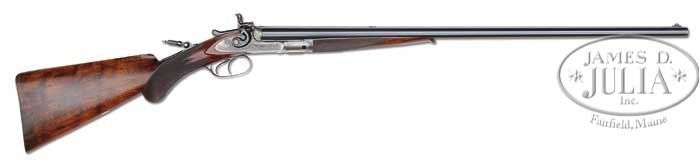
RARE & SPECTACULAR COLT DOUBLE RIFLE. SN 26. Cal. 45-100-470 Sharps (2.6″ case). Wonderful double rifle by Colt with 27-7/8″ drawn steel bbls with flat matted rib, dovetailed ivory bead hunting front sight and a slot blank in the rear seat. Rib is marked “COLT’S PT. F.A. MFG. CO. HARTFORD, CT. U.S.A.”. Left bbl has left hand twist and right bbl right hand twist. Mounted with highly figured checkered Italian walnut with black insert schnable tip splinter forearm and Prince of Wales pistol grip stock with raised side panels 14″ over a smooth steel buttplate. Left side of buttstock is inlaid with a 2-3/8″ x 1-3/8″ oval silver plaque engraved in Olde English style block letters “Blair D. Taylor / U.S.A.”. Bottom of stock has an empty oval silver initial plate. Receiver is lightweight style manufactured specifically for the double rifle with fluted fences and dbl hammers. Lockplates are lightly engraved with fleur-de-lis patterns and the manufacturer’s name on both sides. Bottom of receiver & trigger guard are engraved with light geometric patterns as is the heel tang of the buttplate. Top of wrist is mounted with very early style tang sight with spiral knurled bbl that originally had a flip-out small peep which has been removed with the pin still in place. This sight is marked “PAT. MAY 6 / 84” and was probably installed at about the same time the rifle was made. According to an article by Raymond W. Barth, which appeared in the March 1933 American Rifleman, a copy of which accompanies this rifle, Blair D. Taylor was a Colonel (or more likely a Lt. Colonel) who was in the medical corps stationed in the west at the time of the Custer Massacre. Mr. Barth states that he purchased this rifle directly from Col. Taylor’s daughter who stated that her father had not used the gun in over 50 years. The article also states that Col. Taylor died about four years ago (before this article) at the age of 80. He also relates shooting it with 45-70 and 45-90 cartridges. Also accompanying is a copy of a picture of Col. Taylor in Indian Wars era uniform wearing the epaulets of either a Major or Lt. Colonel. Also accompanied by National Rifle Association Silver Medal #113 awarded to this rifle at the 1971 annual meeting. Medal is in its orig blue box with small wood base plastic stand and award certificate to Eldon J. Owens. Additionally accompanied by a copy of an article by Miguel Hughes which was presented at the 2010 annual Colt Collectors Association Convention. The article is entitled “Just a Pair of Doubles” and it is regarding Colt Double Rifles SNs “21” and “26”. In the article Mr. Hughes relates the history of Colt Double Rifles which is also found in The Book of Colt Firearms, Wilson. Apparently the orig two Colt rifles SNs “293” and “397” were created on the heavier Model 1878 shotgun frame and were probably built in 1879 at the order of Caldwell Hart Colt, Samuel Colt’s son who first suggested the double rifle. After those two “prototype” rifles were produced and it was found they weighed in at around 13 lbs. a new receiver was designed specifically for the double rifle which reduced the weight to 9-1/2 to 10 lbs. and they were given their own serial range beginning with number “1”. It is generally believed that the double rifles known today were gifts to Caldwell Colt’s friends & associates but apparently were available on special order although there is only one known order for a double rifle and that is SN “26” being sold here. The highest known SN for a double rifle is “33” plus the two prototypes which brings the total to thirty-five. The referenced publication speculates that there were less than forty produced in the period 1879-1885. Additionally accompanying is a copy of a photograph of Caldwell Colt. This rifle was sold in October 2004 in the auction of The Eldon Owens Estate Collection by the Julia Auction Company. Information developed at that time disclosed that Blair Dabney Taylor was a cadet at the Virginia Military Institute, Class of 1866, during the Civil War and fought at the Battle of New Market, 15 May 1864. After the war he finished his education, became a physician and spent the rest of his career as a Union military doctor. Apparently in about 1948 this rifle came into the possession of Mr. Fred P.L. Mills of Old Deerfield, Mass. which prompted him to conduct research on these rifles and in 1953 he published a 51-page booklet dealing with the information he learned. In the book Mr. Mills states that this rifle was made for a military officer who ordered it to shoot buffalo while stationed out west but was transferred to Atlanta before this could happen. Given the fact that Mr. Barth purchased this rifle in the Atlanta area gives a reasonably solid trail of provenance. Mr. Owens received “a Colt” under the provisions of Mr. Mills’ will and later, in 1962, Mr. Owens purchased the remainder of the estate. On the inventory of the estate collection this rifle was number one. PROVENANCE: Blair D. Taylor; Blair D. Taylor Family; Raymond W. Barth Collection; Fred P.L. Mills Collection; Eldon J. Owens Collection; Bob Everhart Collection; Miguel A. Hughes Collection. CONDITION: Extremely fine. Bbls retain 98-99% strong orig rust blue with only faint muzzle edge wear and slight wear at the breech end of the bbls. Receiver retains about all of its orig case colors, mostly fading to silver with stronger colors in the most sheltered areas. Lockplates retain most of their orig brilliant case colors. Right hammer retains about all of its orig bright case colors with the left hammer fading to silver. Buttplate retains about 85% bright case colors showing wear around heel & toe. Wood is sound with a few light handling & use nicks & scratches with sharp edges around raised panels and checkering showing light diamond point wear and overall retains just about all of its orig hand rubbed oil finish. Mechanics are crisp, brilliant shiny bores. Medal and other accompanying items are fine. 4-42282 JR170 (90,000-120,000)
Auction: Firearms - Fall 2011 Please Note: All prices include the hammer price plus the buyer’s premium, which is paid by the buyer as part of the purchase price. The prices noted here after the auction are considered unofficial and do not become official until after the 46th day. |