| Image | Lot | Price | Description |


|
1446D
|
$0.00
|
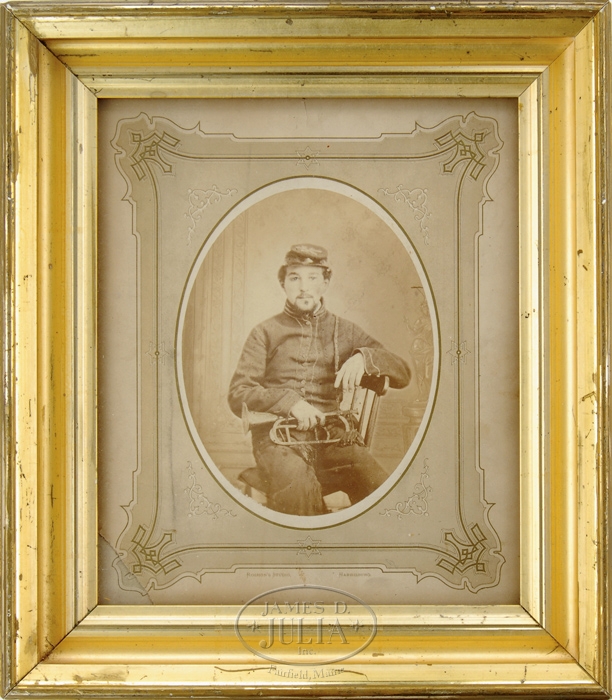
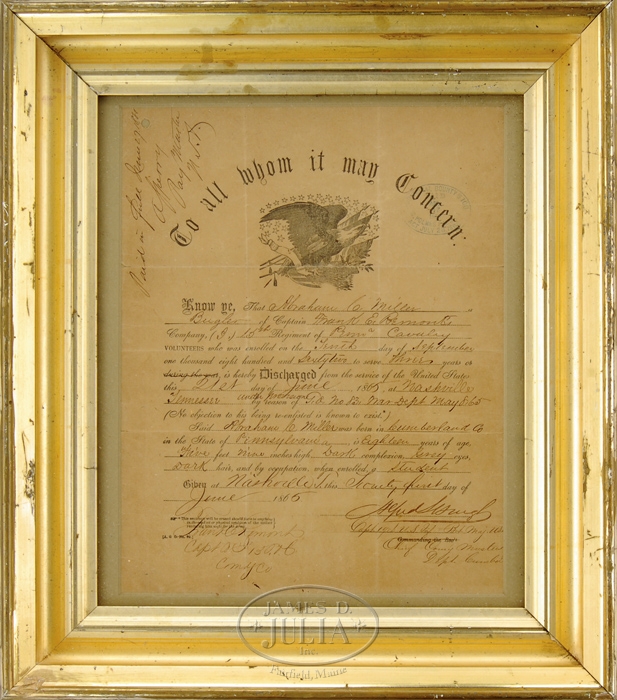
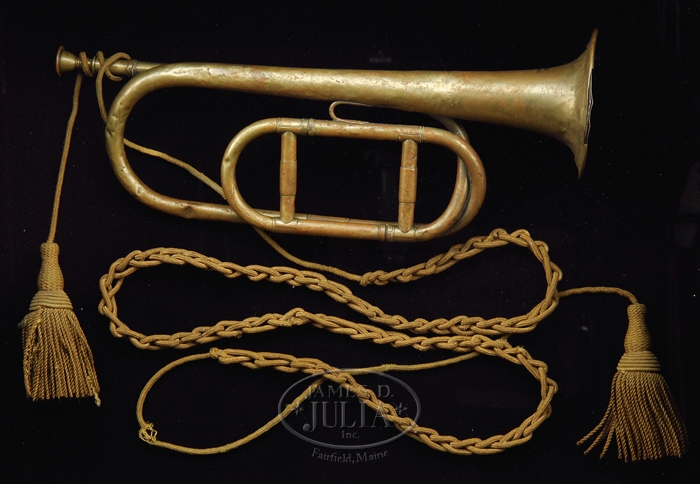
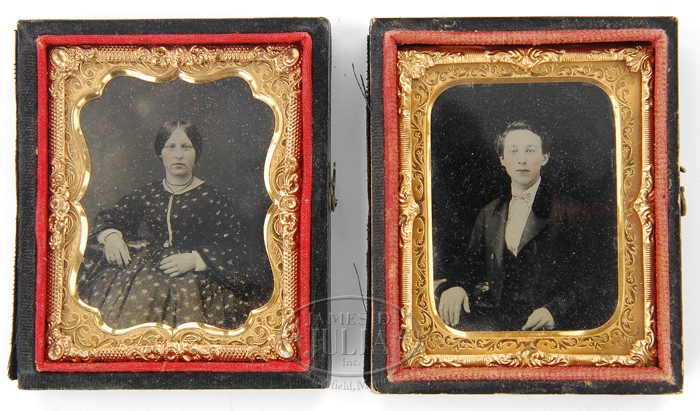
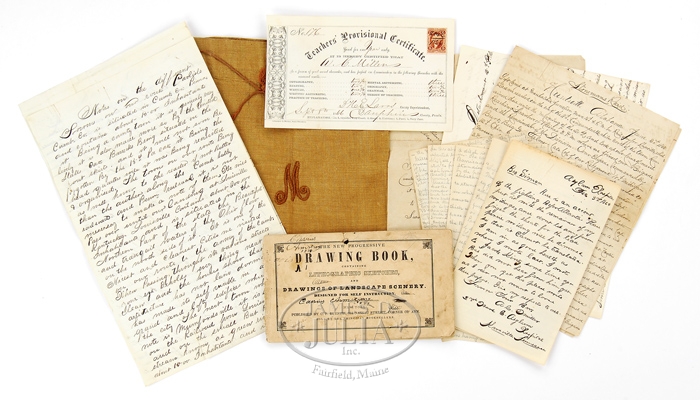
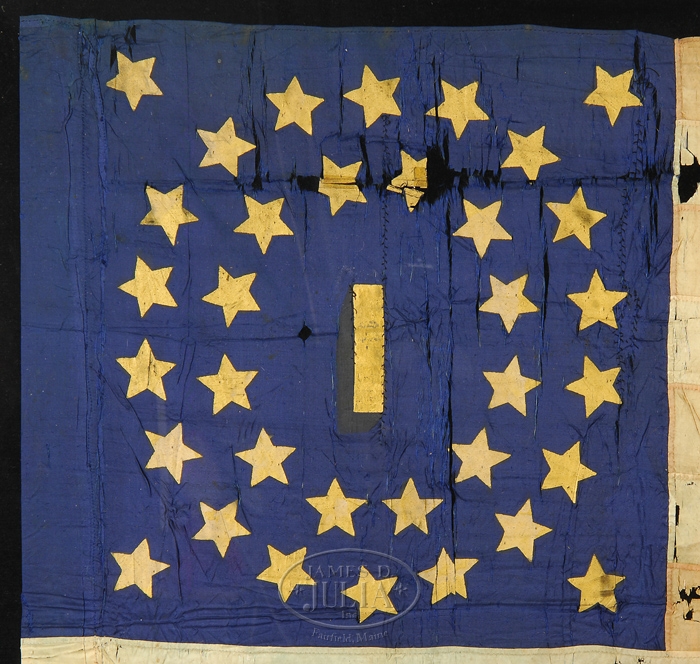
34 STAR, SWALLOWTAIL, CIVIL WAR GUIDON OF COMPANY I, 15TH REGIMENT PENNSYLVANIA CAVALRY, PRESENTED TO THE COMPANY’S BUGLER, CAPTAIN ABRAHAM CLARENCE MILLER. ACCOMPANYING ARE MILLER’S BUGLE, A PHOTO OF MILLER HOLDING HIS BUGLE, HIS DISCHARGE PAPERS, AND 23 FIELD-WRITTEN LETTERS. 34 star, swallowtail, Civil War guidon of Co. I, 15th Regt PA Cav, presented to the company’s bugler, Capt. Abraham Clarence Miller. The flag comes with a tremendous amount of related material and provenance and was kept in Miller’s family until 2003. Accompanying the flag are the following articles: ? Miller’s Civil War-carried brass bugle and sash (archivally framed in period gilt molding) ? An albumen photo of Miller holding this exact bugle with the sash over his shoulder (also archivally framed in period gilt) ? Miller’s discharge papers (also archivally framed in period gilt) ? 23 letters that were written by Miller in the field. ? A pair of ¼ plate tintype photos picturing Miller and a woman who may be his wife, (Margaret), or possibly his sister, together in their original press-decorated gutta-percha cases. ? A fairly extensive number of other related papers and items, including a copy of Miller’s file from the Nat. Archives showing muster rolls, etc., his certificate to teach school (gained in 1866 immediately following the war), a small homespun linen bag with a script initial “M”, found in a mid-19th C. lap desk in the family home, and other interesting paper documents. ? Two early 20th C photographs of the flag and a late 20th C. photograph of the bugle, discharge papers, and albumen photo, as they hung in their previous frame in the family home. This is a real Civil War carried flag that was truly used and reflects that usage. This is the proper state for a flag not put away for safekeeping, but issued to a Civil War unit and carried on horseback throughout the muck, mud and blood-strewn fields, woods, and rivers of the worst war ever witnessed on American soil. This is particularly true for land-use, Union army, Civil War battle flags and guidons, which were made of fine silk with painted stars and other elements. Some flags saw less use than others, of course, but those that were carried for a prolonged period should show appropriate wear. So use is one reason for losses, but other reasons include the acidity of paint and the caustic nature of the mineral salts and other weighting agents used in the fabric. In the period between 1820 and 1850, silk merchants began to sell silk by weight instead of length. To make it heavier, weighting agents were added to the fabric. These increased the price that could be obtained but were harmful to the fabric over time. This is why most all silk flags made between 1820 and the 1st quarter of the 20th century (which encompasses most flags carried by ground forces) exhibit some degree of breakdown. If you have ever visited an armory and seen the state of Civil War period, Union flags rolled on their staffs within glass display cases, know that a combination of hard outdoor use, manner of construction, and manner of storage accounts for their present condition, which, more often than not, is far beyond the largely intact state of this particular swallowtail guidon. The flags eventual owner, Abraham Clarence Miller of Harrisburg, mustered in at the Carlisle, Pennsylvania Barracks on September 10th, 1862 for a three year term of service. He was 18 years old at the time. An experienced veteran soldier by the war’s end, he was discharged as the company bugler in Nashville, TN on June 21st, 1865. Miller then returned to PA, where he became a school teacher (as evidenced by his teacher’s certificate, included in this grouping). He died in Harrisburg in 1906 at the approx age of 62. Sometime after his death the family (or a portion thereof) moved to Hagerstown, MD, taking the flag with them, where it remained until 2003. The aged woman who owned the flag relayed that she was effectively the last of his direct descendents and, having no further use for it in her old age, decided to sell it. Included as part of item (7) on the above list are photos taken inside and outside of her home of the flag and some of the other objects. Twenty three of Miller’s hand-written letters accompany the lot. These detail, among other things, various battles of the war, grumblings about various officers, etc. It is reported that somewhere in the letters Miller speaks of his encounter with David Boone, son of Daniel Boone, who bragged about his father. But we have not had the time to read them thoroughly and so can not attest to the fact. All the documentation one could reasonably wish for and more to accompany Civil War relics is present. The 15th PA. Cav. fought primarily in the Western Theater, particularly in TN and AL. According to “Advance the Colors: A Survey of Pennsylvania Civil War battle flags”, by Richard A. Sauers, Capital Preservation Committee, 1991, this is the only known surviving guidon of the 15th PA. Cav. The guidon of Co L did exist into the 20th C. It was received by the PA State Adj. Gen.l on July 20th, 1920, then sent to the PA. State Arsenal, but it has since disappeared. A relatively large number of Civil War era bugles exist, but an identified bugle with its original sash, pictured with the soldier who carried and blew it during the war, is a very rare find. Though we are sure others exist with such documentation, we have never encountered one and they are remarkably rare. The albumen photo is large in size, which makes it a great visual compliment to the grouping. It was taken by Roshon’s Studio in Harrisburg, and shows Miller in full uniform, complete with kepi, holding the bugle with the sash draped over his shoulder. Roshon Commonwealth Gallery was located at 19 N 3rd St. and a photographer by the name of John W. Roshon was its proprietor. His photographs appear in the State Archives from 1866-1955. The studio evidently provided this beautiful decorative matting with six-pointed Stars of David along the perimeter. Since the photo and the discharge papers were similar in size, they were re-mounted in matching, 19th C, gilded moldings. Gilt frames of similar color, period, and quality were also chosen for the flag and bugle, which makes for a dynamic display. Civil War period, military-issue grade Stars & Stripes flags seldom come available for sale in today’s market. Surplus flags existed after the war and were often gifted to veterans and G.A.R. chapters. These lack a letter in the center of the medallion star field and account for most of the swallowtail cav. guidons that have come up for sale in recent years. With a letter in the flag’s center medallion, however, one can be more certain that the flag was actually carried, as opposed to having become post-war surplus. The most obvious proof of the flag’s use during the war is the state in which it now exists. Losses are greater at the top and bottom of the fly end, where wind damage was greatest, and there is clear indication of its natural wear in the field. Such examples are almost universally in museums and are exceptionally rare on the open market. Most are not available because the state laid claim to government issued flags. In this case, however, according to expert, Howard Madaus, former curator of the Civil War museum in Harrisburg, PA, and the foremost expert in the field of Civil War battle flags, this is a very early war flag and would be exempt from such claims because it was purchased by the volunteer unit with locally donated funds, not with state or federal monies. Madaus viewed this flag shortly after its acquisition from the family. 34 Star Flag History: Kansas was admitted into the Union as the 34th state on January 29th, 1861, about 2 ½ months before the Confederate assault on Fort Sumter that marked the beginning of the Civil War. The 34th star was officially added on July 4th of that year, but most flag makers would have added a 34th star with the addition of KS in Jan. The star count remained official until July 4th, 1863, and 34 star flags would have been produced until the addition of WV in June of that year. In summary, due to the rarity of issued and identified Civil War cav. guidons, the associated history, the beautiful circular star configuration, the single-family ownership, and the small but bold and easily displayable size, this is one of the best, Union army, Civil War guidons that has ever been offered at auction. Only three issued guidons with the company letter gilt-painted in the center of the star field have come up for public sale in recent years. Among them, only this single flag retains such fantastic associated history and the associated items belonging to the soldier who took them home and managed to preserve the artifacts for future generations. This fabulous guidon together with the rare bugle and all the other associated items make for a superb historical grouping which could easily be the centerpiece of any Civil War collection. The guidon is typical of those used by Union troops. Its stripes and canton are of finely hand-sewn silk, while the company letter and the wreath pattern of stars that surrounds it are gilt-painted. The sleeve is created by folding back a section of the stripes and canton over a lining of fabric used for reinforcement. This was formerly finished with treadle-stitching. The staff would slip directly through this open portion if the hoist. SIZE: Item – 27″ x 35.5″ (flag), 6” x 16” + tassel (bugle), 11.25” x 9.5” (photo), 8.5” x 11” (discharge papers); Frame – 37″ x 45″ (flag), 21” x 27” (bugle), 15.25″ x 13.5″ (photo), 15.25″ x 13.5″ (discharge papers) CONDITION: Flag has been pressure mounted in an archival manner behind u.v. protective acrylic. It was then placed in an unusually large gilt frame of the 1830-1860 periods. Bugle and sash were stitched to 100% black cotton twill laid over archival materials. A deep shadowbox was created behind u.v. glass using a period gilt frame with similar the same general coloration. Albumen photo and discharge papers were also framed in an archival manner behind u.v. glass, using matching, period gold gilt frames. Flag is quite complete, but like most silk battle flags, there has been some fabric loss. Flag is brittle and there are many separations. Red stripes have experienced significant fading. Very small amount of clear tape present on the stars. Letter “I” became partially separated and was, at some point, mended with hand-stitching. Overall condition is commensurate with the flag’s construction and use and is similar to other surviving examples. 4-32852(50,000-75,000)
Auction: Firearms - Fall 2007 Please Note: All prices include the hammer price plus the buyer’s premium, which is paid by the buyer as part of the purchase price. The prices noted here after the auction are considered unofficial and do not become official until after the 46th day. |