| Image | Lot | Price | Description |


       |
8
|
$11,850.00
|
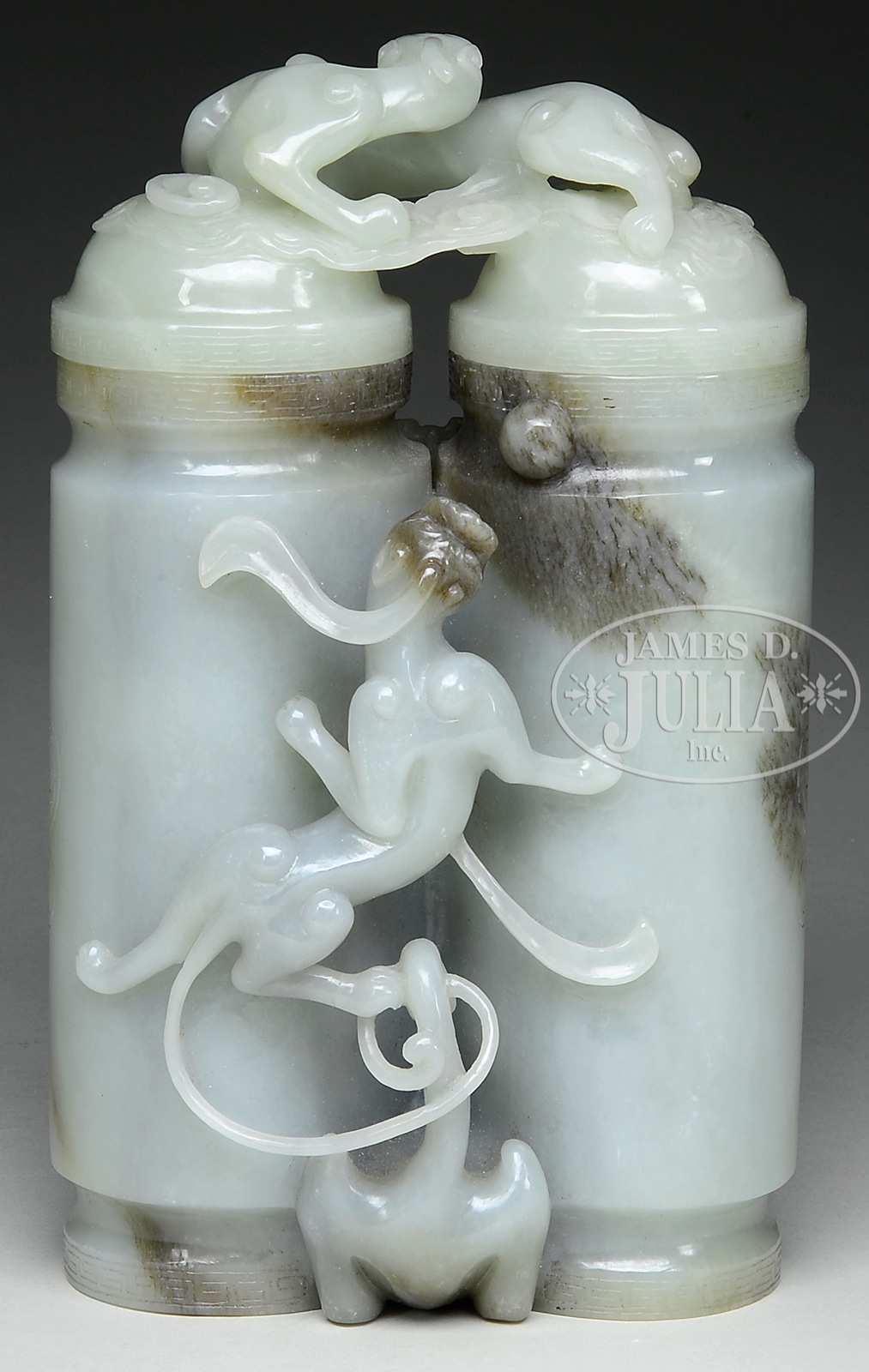
ARCHAISTIC “HERO VASE”.20th century, China. Nephrite: Light yellow-green (celadon) with brown patches. The name of this popular double-cylindered shape, “hero” or “champion” vase, is based on the punning possibilities inherent in the Chinese language. The sounds for the two main decorative motifs of this shape are ying (an eagle) and xiong (a bear), which collectively have the same sound as the compound phrase ying xiong (“hero”), although the written characters are entirely different. The vase is said to have been “given as rewards for military prowess” (Cox, fig. 762), or as a trophy “to winners of sportive contests” (D’Argence, p. 74). The form is ancient, datable back to at least the Western Han, where bronze examples have been uncovered in recently excavated tombs of known date (Watt 2, pp. 156-57; Kerr, pp. 226-27). There have been suggestions of foreign influence on the shape, including a possible Sassanian influence (Gure, p. 156), although that would surely post-date the form’s earliest appearance in China. Watt suggests that the name appears more recent than the form itself (Watt 2, pp. 156-57; and Kerr 2, p. 76). Though the earliest known hero vases are in bronze, the form was translated into hardstone and other materials at least as early as the Song (Gure, pl. 32, #la-b; Green, p. 35, a Sackler example, dated here 11th-12th century: ACGB, p. 99, #320, the same Sackler work, dated 13th-15th century; Watt 2, p. 156, #108, St. Louis example, 12th-13th century; D’Argence, p. 74, dated 10th-13th century; Hai 2, p. 182, #180, a Cleveland version with squat proportions). Later metal versions and occasionally a rhinoceros horn example (SNY 6/3/92, #103) as well as a plethora of jade versions appear in the Ming and Qing (Poor, #64; Kerr, p. 193; CNY 11/27/91, #176, all said to be of the Qianlong period). Hardstone versions from the 19th century are not uncommon (SPBNY 2/28/80, #266). Although the name implies an eagle and bear combination, the later jade versions ofren sport other beasts: the eagle may become more like a puffy quail, sharp-eyed falcon, or elaborately-feathered phoenix. The bear, if present, may be represented only by an indistinct squat creature upon which the major protagonist-a dragon, bird or feline-stands and stretches up the sides of the cylinders. The shape usually includes a connecting link between the double cylinders at the base and possibly on or just below the lip; there may be one joined or two individual lids, perhaps with an animal knob. In more cunning and/or later works, the animals’ posteriors are presented in full round on the reverse, and the base “bear” squats under the central space between the cylinders to emerge at the front, while the dragon or feline may curl sinuously through upper reaches of that space to emerge at the front and rise up towards or even over the top of the cylinders. There may be extremely elaborate shaping of the various creatures, and attached ring handles suspended from mouths or beaks. The carver may have been able to suggest a definite personality for each of the creatures. The dragon may be winged and restless, the bird may look stately or aggressive, the bear downtrodden and displeased. Later works, as might be expected, are more detailed in their presentation of the creatures, and the wings of the dragon or bird often become prominent design elements in their own right. In this hero vase, the bi-colored material makes an important contribution to the overall appearance of the work, and the creatures are strongly sculptural. The lowest of the creatures squats, its limbs akimbo at an acute angle on both front and reverse, and it appears to have a lengthy tail and marked rib area as well as wing-like appurtenances on the elbows of the front paws. A dragon, its thin legs extended and tail joined in a freeform loop with the base creature, strides across and up the reverse of the vase, attempting to grasp the pearl affixed to the neck. On the front, a fancifully winged bird (perhaps a phoenix) with a diving bird headdress, well-developed wing feathers and drum-stick legs perched on the base creature’s head, grasps an independently-moving ring in its beak. The lid is compound, the two cylinder caps united by a well-sculpted dragon and cloud combination on the top. The cylinders themselves are strongly indented at the base and neck, with flanking incised key fret designs which are found also on the base of the lids. Further incised lines, on the lower portions of the cylinders, echo the graceful wings of the bird. The informality of the bi-colored jade material combines harmoniously with the formally-disciplined shape, and the work overall is pleasingly proportioned. Reference: The Yangtze River Collection, Later Chinese Jades published by Helga Wall-Apelt, 1993. SIZE: 9″ x 5.38″ x 3.75″. (22.9 x 13.7 x 9.5 cm.) CONDITION: Stone with small fissures. Very good. 9-95001 (8,000-10,000) – Lot 8
Auction: FAAA - Wall-Apelt Collection - March 2015 Please Note: All prices include the hammer price plus the buyer’s premium, which is paid by the buyer as part of the purchase price. The prices noted here after the auction are considered unofficial and do not become official until after the 46th day. |