| Image | Lot | Price | Description |




|
1264
|
$0.00
|
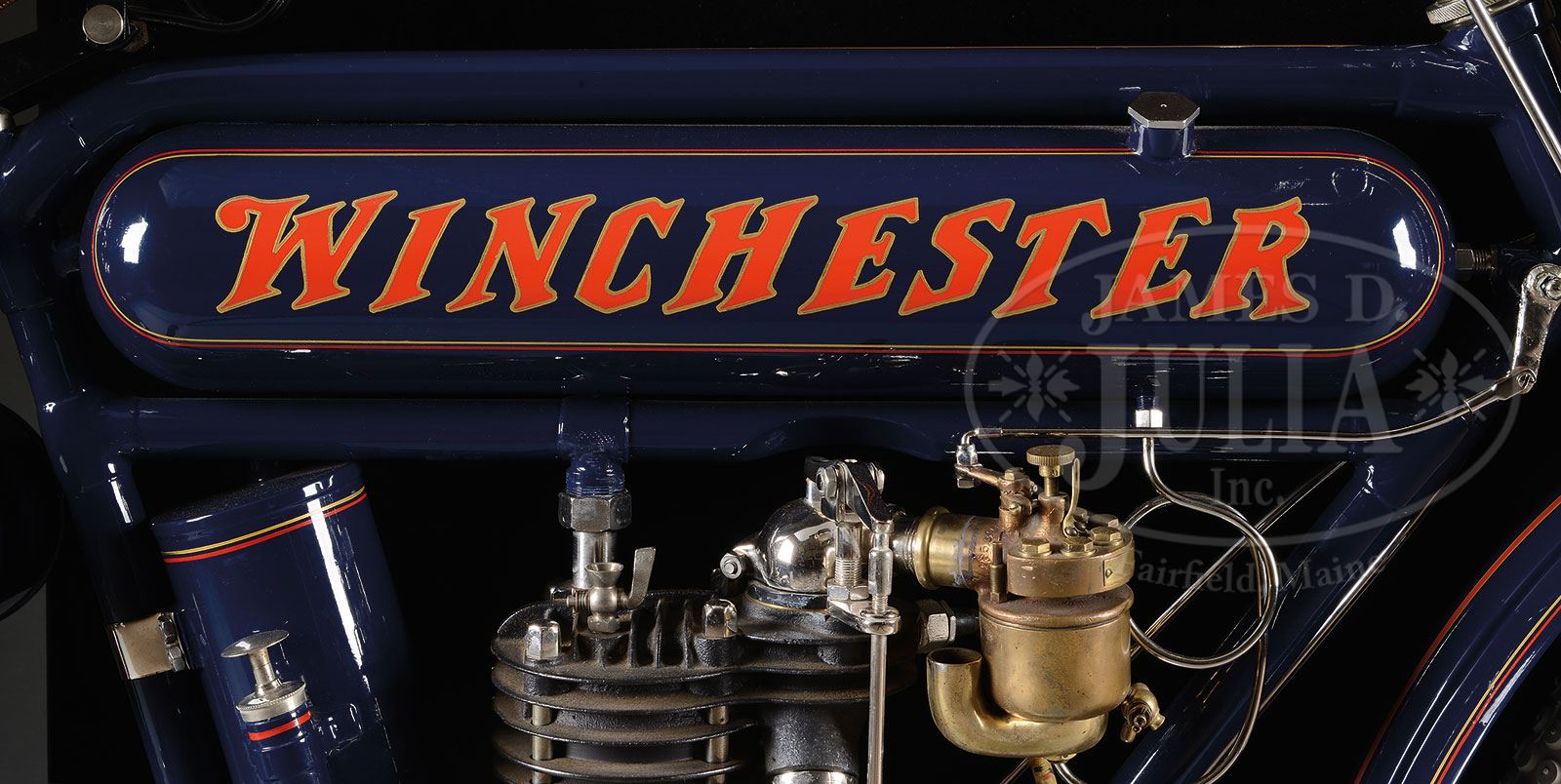
EXCEEDINGLY RARE WINCHESTER MODEL 1910 MOTORCYCLE, ONE OF ONLY TWO WINCHESTER MOTORCYCLES KNOWN OF THE TWO HUNDRED ORDERED BY WINCHESTER 1909-1911.SN 5661. The Winchester Firearms Co. is one of the worlds most recognizable and iconic brands, generally associated with their internationally famous firearms. The company was built by Oliver F. Winchester, an extremely successful shirt manufacturer in the mid 1800s. Mr. Winchester purchased stock in the floundering Volcanic Arms Co., a company that had evolved from the Smith & Wesson Co., manufactures of handguns. They were producing a series of lever action pistols which were not overly successful when Mr. Winchester bought into the company. In April 1857 Smith & Wesson divested themselves of the Volcanic Co. and Mr. Winchester reorganized it into the New Haven Arms Company. That company produced Volcanic pistols until about 1860 when they began producing a rifle based on the Volcanic action which had been designed by B. Tyler Henry, along with a large caliber (44) rimfire cartridge. The Henry rifle was extremely successful throughout the Civil War and remained popular for many years thereafter. In 1866 Winchester introduced a newly designed rifle which became enormously successful and the company was off and running, remaining in the business until the present. In the late 19th century internal combustion engines were introduced along with rapid improvements in bicycles. An enterprising gentleman by the name of Charles H. Metz (1863-1937) co-founded a bicycle manufacturing company in 1893 in partnership with the Waltham Manufacturing Company which had expanded into automobile & motorcycle manufacturing. The Waltham Manufacturing Company was a subsidiary of the Waltham Watch Company. In 1902 Metz left the Waltham Manufacturing Company and founded the Metz Motorcycle Co. in Waltham, Massachusetts, where in 1905 he joined into partnership with David Marsh who had founded the Marsh Motorcycle Co. in Brockton, Massachusetts. The merger became the American Motorcycle Company. They produced the most reliable engines of the time called the “Marsh-Metz”. At about the same time, in 1906, Edwin F. Merry opened his automobile & motorcycle parts business in San Fransisco, CA. where he became very successful. The Merry Company remains in business today as “Merry Sales”. By the early 1900s the Winchester Co. saw declining business sales and so expanded into numerous other enterprises including tools, ice boxes, bicycles and all forms of sporting equipment, all branded with the Winchester name. With the success of these expanded lines Winchester commissioned the Merry Co. to manufacture a test run of 200 motorcycles “utilizing the finest parts available” including several Winchester patent items. There is no record of the actual number of motorcycles produced, however what is known is that there are only two surviving examples known today, the Model 1910 being sold here is the only one of its model known along with a Model 1909 also being sold in this auction which is also the only one of its model known. This motorcycle has a single cylinder, 6-hp Marsh-Metz engine mounted in its all steel frame. It has bicycle style handlebars with throttle control and the suspension is a front leaf spring shock absorbing system and coil springs in the seat. It utilizes bicycles pedals and chain to propel the motorcycle for starting. Once the engine starts the pedals disengage and propulsion is by means of a wide direct drive leather belt on a pulley on the left side of the crank case which connects to a rim attached to the rear wheel. The seat is of cowhide mounted on the vertical post with coil spring shock absorbers. The fuel & oil tanks are mounted in the frame. The rear axle has an attached kickstand which is secured into a clip from the back fender during travel. All the metal parts are painted a bright blue with the iconic “WINCHESTER” trademark on each side of the fuel tank and each end of the parts/tool can which is mounted under the rear fork. This motorcycle was discovered by consignor in the shop of a friend who had purchased it from a very early owner who, as a kid in the 1920s, reportedly rode it in violation of his father’s wishes so the father removed the rear wheel and hid it from the boy. He never rode the bike again but kept it for some forty years thereafter before selling it to consignor’s friend who then owned it for about twenty years before selling it to consignor. The motorcycle was in highly orig condition except that it was missing the rear wheel. Consignor had the bike restored and was able to find a proper rear fender, 40-spoke New Departure hub, sheave & rim which were new old stock. The front fender is original. Both the gas & oil tanks had to be re-made because of rust but the restorer was able to utilize the orig tank ends. This motorcycle also has a Kingston 5-ball carburetor which was offered as an option in the Marsh-Metz parts book vs. the standard, ultra-simple “tomato-can” carburetor. The ignition system is “total-loss” battery system without a charging mechanism. The fuel tank holds enough gasoline for about a 200 mile range. This motorcycle has been started & driven but remains in museum quality today. It was recently on display at the Cody Firearms Museum, Cody, WY where it was the Museum’s center of attraction for over a year. Words fail when attempting to describe the ultimate rarity of this motorcycle. Any early 20th century motorcycle is a great rarity but when one considers that this is the only known example of its type, words simply fail to describe just how rare it really is. CONDITION: Extremely fine as restored. All painted surfaces are crisp and bright with no visible flaws. The seat is bright tan leather, soft & supple. Other attached pieces and parts are equally fine. Drive belt & tires are modern. The engine was not started but it is presumed that it is in running condition after restoration. 4-54057 JR369 (350,000-600,000) – Lot 1264 Click here to view provenance
Auction: Firearms - March 2015 Please Note: All prices include the hammer price plus the buyer’s premium, which is paid by the buyer as part of the purchase price. The prices noted here after the auction are considered unofficial and do not become official until after the 46th day. |