Preview: March 19 & 20, 2018: 9am-5pm and March 21, 22, 23, 2018: 8am-10am
Please Note: All prices include the hammer price plus the buyer’s premium, which is paid by the buyer as part of the purchase price. The prices noted here after the auction are considered unofficial and do not become official until after the 46th day.
SN 1147. Cal. 36. This most popular brass framed revolver was made by Samuel Griswold from converted cotton gin factory near Macon, Georgia. Confederate soldiers lucky enough to be issued a Confederate made “Colt” often wrote of their pride in ownership of such high Southern quality. This is a standard configuration of 1st Model Griswold revolver having rnd bbl housing with crisp well discerned SNs with an overall smooth appearance where twist in cylinder is quite evident. This gun is SN’d “1147” on right side of bbl housing, frame, cylinder and bottom of trigger guard. Secondary number “47” found on wedge, hammer, loading arm and right side of backstrap. A cryptic backwards “B” is found on bottom of bbl near latch. Cryptic “W” is found on back of frame, right side of trigger guard, right side of backstrap, and back of cylinder. A Roman numeral “VII” is found on left side of backstrap and trigger guard. PROVENANCE: Don Bryan Collection; private collection, 1996. CONDITION: Very good overall as refinished and restored. Iron overall is smooth and plum overall with especially crisp cryptic “B” which appear orig. Cylinder retains all 6 safety pins, though all short and worn, ratcheting is still crisp and cryptic discernible. Grips are well fit restorations that fit and match gun well. Secondary number on loading assembly and wedge are not orig but engraved restorations. Other than grips, wedge and loading assembly, gun appears orig and complete and presents beautifully. Mechanically functional with well defined rifling in bore. 51571-9 JS (15,000-18,000) – Lot 1353
SCARCE AND EARLY PRODUCTION CONFEDERATE COOK & BROTHER ATHENS, GEORGIA CAVALRY CARBINE INSCRIBED TO SAMUEL ELLYSON, 3RD VIRGINIA CAVALRY.
SN 2865. Cal. 58. This scarce 1863 dated Cook & Brother carbine is in standard configuration of other examples with 21-1/8″ rnd bbl, brass mounted with captive swivel ramrod. John Murphy and Howard Madaus, in their exemplary 2002 text Confederate Carbines and Musketoons explain configuration and history of these carbines. Being copies of Enfield carbines survival of Cook Brother carbines in complete orig condition are quite scarce and this example has fine overall aesthetics with good patina and surfaces. This gun has matching SNs “2865” found on most every part externally including bbl, bands, nose cap, lock, lock screws and tang screw. Gun appears completely orig with Pvt. Ellyson’s name nicely carved on left side of buttstock “S. W. ELLYSON / CO. F 3d VA / CAV.” The carving is impeccable and no doubt orig and contemporary to the war. The well executed letters were at one time filled with a colored wax that much has chipped away since the war. National Archives records show that Samuel Webster Ellyson was mustered into Company F, 3rd Virginia Cavalry, August 29, 1862 and was paroled at Appomattox April 18, 1865. The 3rd Virginia Cavalry fought with distinction under J.E.B. Stuart and Fitzhugh Lee’s command. 3rd Virginia was a hard fought regiment, Ellyson entered service just in time for the Battle of Antietam which was fought September 17. The 3rd took place in all major battles of the Army of Northern Virginia. At the Battle of Gettysburg the 3rd Virginia fought at the East Cavalry Field and J.E.B. Stuart praised Fitzhug Lee for his command there and he was soon promoted to Major General. The 3rd Virginia had only 3 men surrender at Appomattox, the rest escaping to Lynchburg, Virginia and disbanding April 11, 1865. Ellyson was paroled April 18, 1865 and this carbine with little doubt saw almost every major engagement he was involved. PROVENANCE: Charles M. Glenn, Jr. (who acquired it as a young boy in 1928 from a childhood friend in trade for an ice cream cone); Ben Michel Collection. CONDITION: Very good coverall, appears all orig and matching. Rear sling swivel appears orig to Cook manufacture, but much darker patina than the other brass. The carbine ring is also unusual and copper but appears orig. Markings are especially sharp and carved ID is easily discerned. Stock is sound and solid with a 3-1/2″ inset rear of bbl above lock. Stock has an old varnish finish which shows craquelure in areas. The inset repair noted should be professionally restored as this is such a fine and historic carbine, that few survived. Mechanically functional with discernible rifling in pitted bore. 52863-6 JS (25,000-30,000) – Lot 1354
RARE, EARLY AND FINE NEW ORLEANS PRODUCED CONFEDERATE COOK & BROTHER RIFLE.
SN 41. Cal. 58. This example is, clearly, one of the earliest products of the notable Cook & Brother Confederate arms, and probably the earliest SN known “41”. This rare Cook rifle is standard configuration, brass mounted, 33″ bbl having the distinctive “twist” in metal’s surface and having an attached lug for a sword bayonet, distinctive pedestal front sight and adjustable style Enfield rear sight, correct slotted knurled ramrod. The bbl is marked “PROVED” at the left breech and stamped “N.O. 1861” on top between rear sight and breech. Lockplate is marked “COOK & BROTHER, N.O. 1861” and has the distinctive Confederate 1st National flag stamped above makers mark. The Cook and Brother firm was established in New Orleans at the outbreak of the Civil War. Threatened by the fall of that City early in 1862, machinery was moved to Athens, Georgia where production resumed. Major Ferdinand and Captain Francis Cook were the principals in the firm and both fought as Confederate officers with many of their own factory workers as soldiers late in the war. They fought as a reserve battalion against Sherman’s approach in late 1864. The battalion took part in the battles of Griswoldville, Grahamville, Honey Hill and Savannah where Major. Cook was killed. After the Battle of Griswoldville Gen. P.J. Phillips reported that Maj. Cook and his men “participated fully in the action, deported themselves gallantly and . . . suffered much from wounds and death.” PROVENANCE: Ben Michel Collection. CONDITION: Good to very good overall. Markings are especially strong, though makers mark on bbl is weak. Matching SNs are found on most every part, including lock screws, tang screw, bbl bands and bayonet lug, externally. Stock is sound with old refinish and rounded edges; old crack repair on either side of trigger guard at front of bow. Stock still has a fine, reddish/brown color so often seen on Confederate used walnut. Iron overall is grey with distinct Damascus seen in bbl with staining and pitting at breech. Brass is cleaned and toned a medium mustard color. Sling swivels are excellent restorations and balance of gun is orig and matching. Mechanics are fine with discernible rifling in pitted bore. 52863-7 JS (30,000-40,000) – Lot 1355
EXTREMELY RARE STATE OF NORTH CAROLINA CONFEDERATE CONTRACT 50 CALIBER MENDENHALL, JONES & GARDNER RIFLE.
SN 85. Cal. 50. John Murphy and Howard Madaus in their definitive 1996 text Confederate Rifles & Muskets describe this rare 1862 contract prior to the change to 577 caliber, September 22, 1862. It is thought that less than 100 “Type I” rifles were made. This rifle is in excellent condition for a Confederate arm, still exhibiting raised grain to the stock and no external markings other than the SN “85” stamped in wood opposite lock. This gun is accompanied by well fitting Raleigh-style brass hilted saber bayonet. These Type I rifles were made at the Cedar Hill Foundry and Machine Shop located on Alamance Creek, eleven miles east of Greensboro, NC. Many Type I guns were rejected and few examples are known. SN 66 is shown in the Murphy text fully inspected and maker marked. Other than markings, these guns have identical configuration with 33″ seven land and groove rifling unique to these early contract rifles. This is a beautiful gun that most likely cannot be upgraded. CONDITION: Very fine overall, appears orig and matching with SNs internally matching “85” on stock. Bbl is still bright in protected areas with smooth dark iron patina overall. Lock is a smooth grey. Brass mounts are smooth, medium mustard patina. Stock is sound and solid with good color, areas of raised grain, sharp edges with small dings, dents and scratches. Accompanying Confederate bayonet fits gun well with grey 21-1/2″ blade with old sharpening. Mechanically fine with crisp rifling in pitted bore. 52872-2 JS (15,000-20,000) – Lot 1356
RARE AND EARLY FINE 1863 FAYETTEVILLE RIFLE WITH SABER BAYONET.
NSN. Cal. 58. This is an orig early 1863 dated Fayetteville rifle with bayonet lug and an accompanying brass handled saber bayonet that fits well. Lock is correctly marked forward of hammer with spread wing eagle / “CSA” / “Fayetteville”. Behind hammer lock is dated “1863”. Bbl is also dated “1863” with “VP” proof with eagle head. Inspector’s initials “PB” is found stamped in wood opposite lock. Gun appears all orig and quite a fine example. The iron nosecap is seen only on these very early model guns with saber bayonets, later production of rifles were made of brass. All other hardware on this gun is brass and correctly marked including “CSA” surcharge on the buttplate.This is a fine example with crisp markings and great aesthetics. CONDITION: Very good overall, all orig and complete, ramrod is possibly replacement but fits well. Metal is smooth overall with iron patina with light pitting, brass has old cleaning and medium mustard patina. Mechanically fine with bright crisp rifled bore. 52872-1 JS (15,000-20,000) – Lot 1357
FINE CONFEDERATE DICKSON NELSON RIFLE, EX-JOHN MURPHY COLLECTION.
NSN. Cal. 58. This is a very sharp gun and is pictured on pg 185 and described on page 183 in John Murphy & Howard Madaus’ text Confederate Rifles and Muskets, 1996. Dickson Nelson in Dawson, GA made a majority of their guns for the State of Alabama and are marked “ALA” on locks, as is this gun. This gun is in the typical configuration of other guns of this type with 33″ bbl, brass nosecap, bbl bands, trigger guard, and buttplate. The lockplate is marked forward of hammer “DICKSON / NELSON & CO / C.S.”, rear of hammer is marked “ALA/1865”. This is a beautiful gun with good patina and markings that would grace the finest Confederate collection. PROVENANCE: John Murphy Collection, pictured in “Confederate Rifles and Muskets”, 1996. CONDITION: Very good to fine overall. Iron patina, crisp smooth markings on lock. Smooth, mostly plum color to bbl with traces of blue, pitted at breech. Brass has smooth mustard patina. Stock is sound and solid with repair to wood opposite lock which does not affect the overall aesthetics. The accompanying leather sling is the same one as seen in Murphy text and is sound and solid in matching condition. Mechanically fine with well discerned rifling in pitted bore. 52872-3 JS (20,000-30,000) – Lot 1358
SN 29. Cal. 64. John Murphy and Howard Madaus in their definitive 1996 text Confederate Rifles and Muskets describe in Chapter XXII the variants of these rare Columbus, Georgia made rifles. This particular gun is referred to as Type I rifle by Murphy and Madaus with brass mountings in style of the US Mississippi rifle. Only a handful of rifles are known. Most have 2-digit SNs though possibly as many as 180 guns of this configuration were made. This rifle has a SN of “29” found inside the lockplate, hammer and the bottom of the bbl. The bbl is also marked with Nathaniel D. Cross’ “windmill” inspector’s cartouche. Other Roman numeral assembly markings are found internally. Gun appears orig, authentic and complete. There is no obvious restoration and gun appears orig throughout. CONDITION: Good overall. Bbl is grey overall with staining and pitting at breech. Lock is fairly smooth with crisp maker’s markings. Brass has matching mixed mustard patina. Stock is sound and solid, hand worn patina with several small cracks and small reductions. The bore, originally 58 Cal. and rifled is now 64 Cal. smooth bore. Mechanically functional with pitted smooth bore. 52872-4 JS (15,000-20,000) – Lot 1359
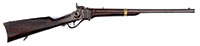
RARE AND FINE EARLY CONFEDERATE S. C. ROBINSON SHARPS CARBINE.
SN 960. Cal. 52. 38″ overall, 21″ rnd bbl with brass bbl band and fixed sights. Confederate Robinson Sharps were made early in the war and generally saw hard service. Though 2000 of these carbines were made, few survive in orig and complete condition. This is a very nice example with crisp lock markings “S.C. ROBINSON / ARMS MANUFACTORY / RICHMOND, VA / 1862” and “960”. Bbl markings “S.C. ROBINSON / ARMS MANUFACTORY” found forward of rear sight and “RICHMOND, VA / 1862” rear of sight, though markings are not as crisp as on lock, they are discernible. Gun appears completely orig, complete and “as found”, fully functional with especially nice stock with soldier’s initials “LSK / “Mobile”. CONDITION: Good-very good overall. Matching SNs found externally on lock and tang. Assembly number “479” found on breech, gun was not further disassembled but appears in correct configuration. Forestock has correct orig brass ferrule and brass band. Metal plum/grey overall with staining and pitting. Stocks are sound with hand worn patina, old varnish, scattered cosmetic blemishes. Mechanically sound with crisp rifling in pitted bore. 52863-5 JS (15,000-20,000) – Lot 1360
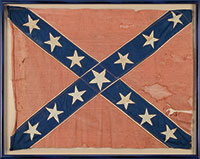
RARE CONFEDERATE BATTLE FLAG, FREEMAN’S TENNESSEE ARTILLERY, NEW TO MARKET FROM DIRECT FAMILY DESCENT.
33″ x 25″ St. Andrews Cross with 13 hand sewn stars. This flag, descended in the family of Edward Curd. Made totally of polished cotton, red field, blue cross with white edging. St. Andrews Cross is attached with two machine stitches, including a chain stitch seen on few other early flags. The hoist edge shows several scattered holes that appear to have been the orig “tacking” to pole. Freeman’s Battery fought in the Western theater within N.B. Forrest’s cavalry. Family documents state that this flag, along with some reunion medals and a Colt revolver (still retained within the family) where maintained by consignor’s grandmother. Edward Curd (1845-1916), who family believe, carried this flag during the war enlisted at the age of 16. His older brother John was in the 7th Tennessee Infantry and died of wounds at Seven Pines. Edward also had several cousins in the war, including Captain William E. Curd who was also killed at Seven Pines. According to correspondence from the Tennessee State Museum found in provenance, this flag will be included in the upcoming State of Tennessee battle flag book There is an accompanying reunion badge of Curd with “Franklin Tenn” stamped above unit to honor Captain Freeman’s death during the Battle of Franklin “where much to the anger of General Forrest, Captain Freeman was killed on the Lewisburg Pike. According to several reports, Freeman was murdered by Federal troops after he surrendered but was unable to escape due to wounds”. Also accompanying lot is Curd’s Southern Cross of Honor and four additional reunion badges. CONDITION: Flag is good to very good overall with light fading and staining to red field. Flag is sewn with scattered stitches to a linen backing in shadow box and displays quite well. Accompanying badges are very good to fine overall. 53108-1 JS (25,000-40,000) – Lot 1361
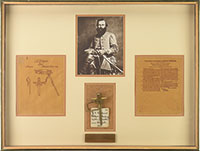
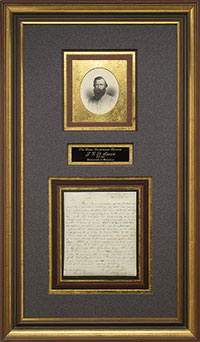
JEB STUART ARCHIVE INCLUDING HIS ORIGINAL PATENT MODEL AND PATENT FOR HIS FAMOUS SWORD HANGER.
JEB Stuart is a household name and among the best known of all Confederate commanders. His cavalry exploits during the Civil War and his prior service on the Plains and Bleeding Kansas are well known among military historians. Few know, however, that JEB Stuart designed and patented an innovative sword hanger just prior to the war. This lot contains: 1) his orig submitted brass working model along with the orig patent office tag, patent number 25, 264 “J.E.B. STUART / METHOD OF ATTACHING / SABERS & BELTS / PATENTED OCT. 4TH / 1859”. 2) 16″ x 10-1/2″ printed circular describing the belt with full page drawing of the device, on verso full page ALS, Ft Riley, Kansas Territory, January 25, 1860 by Stuart to State of Virginia encouraging purchase of his device for state troops since the US government had adopted it. 3) 1-pg ALS from Stuart to Adjutant General, War Department, Washington, August 16, 1859 “I have the honor to submit herewith a manual for Stuart’s Sabre Attachment which I submitted to the Cavalry Board at Carlisle… J.E.B. Stuart 1st Lt. 1st Cav.”. James Ewell Brown Stuart (1833-1864) known to his friends as JEB, graduated from West Point in 1854. He was among the best American officers serving in Texas and Kansas with the US Army prior to the Civil War and was a participant in the capture of John Brown at Harper’s Ferry. He resigned his commission in the U.S. Army when the war began and distinguished himself in numerous battles. As Confederate commander, Stuart would be killed at the Battle of Yellow Tavern, May 12, 1864 at the age of 31 by a member of Custer’s Michigan Cavalry Brigade. Robert E. Lee now truly lost his eyes and ears for the Army of Northern Virginia. This is an incredible archive concerning the most iconic of American cavalry commanders, none better known than possibly George Armstrong Custer. It is amazing that Stuart’s patented sword hanger was rare during the Civil War but saw expanded used after the Civil War in the Indian Wars being manufactured at the Frankford Arsenal almost exactly in the same configuration he designed. PROVENANCE: Patent Model sold at auction by US Patent Office to O. Rundle Gilbert, Garrison, New York; Cliff Peterson, Beverly Hills, CA; Henry Truslow Collection, Sunbury, PA. CONDITION: 1) Fine overall as framed in 32″ x 24″ shadowbox. Brass hanger measures 5″ x 3″. The orig 3″ x 3″ patent card is also very good to fine with dark easily discerned text with light soiling. Frame also contains 7″ x 10″ printed US Patent Office description and drawing of patented device, along with a facsimile photograph of Stuart. 2) Cracked at folds with reductions at central folds, foxing, acid burn, paper brittle but otherwise complete and sound as professionally conserved. Scotch tape stains on same central fold darkening paper where tape removed. Chipping and brown edges at top and bottom barely effecting text. Stuart signature panel is fine. Ink and print all dark and easily discerned. 3) Very fine overall. Creases at folds. Bright, dark ink on laid lined paper. 9-3/4″ x 7-5/8″. 53112-1 JS (20,000-25,000) – Lot 1362
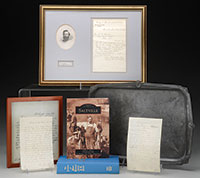
This grouping consists of two wonderful and personal autograph letters of JEB Stuart and a Flora Stuart letter sending a clipped autograph of her late husband. 1) Framed ALS written on Virginia Female Institute March 16, 1886 on personal stationery of Mrs. Gen. J.E.B. Stuart, Principal. She is responding to a request for an autograph of General Stuart which she encloses “cut from an old private letter”. She signs the letter “Mrs. J.E.B. Stuart”. Flora Cooke, the daughter of later US General Philip St. George Cooke married JEB Stuart in 1855. Her brother, John Rogers Cooke, would become a Confederate General. Stuart named his first son, born in 1860, Philip St. George Cooke Stuart in honor of his father-in-law but changed it to J.E.B. Stuart, Jr. in disgust of his father-in-law’s staying in the Union Army. After General Stuart’s wounding at Yellow Tavern, Flora Stuart rushed to be by her husband’s side but he died one hour before she arrived. His last whispered words were “I am resigned; God’s will be done”. Flora wore the black of mourning for the remainder of her life and never remarried. She lived in Saltville, Virginia, for 15 years after the war, where she opened and taught at a school in a log cabin. She worked from 1880 to 1898 as principal of the Virginia Female Institute in Staunton, Virginia, a position for which Robert E. Lee had recommended her before his death ten years earlier. 2) 1-pg 8″ x 5″ autograph letter signed cryptically “KGS” (Knight of the Golden Spurs). This letter written to his niece Nannie “Hdq at the Bower, July 18th 1863” just days after the retreat from Gettysburg. He is sending his niece a cloak which he apparently captured during the Gettysburg Campaign “will my dear Miss Nannie do me the honor to wear when the season permits this cloak which I obtained expressly for her in foreign parts. When it encircles that form, tripping over the wood lawns of Dundee, may it recall remembrances of one who would like once more to share the pleasure of the promenade… the gift is a trifle but when she throws it over her shoulders to take a walk will she not remember “K.G.S.”. This most interesting personal letter to a family member is published in the 1990 limited edition text, The Letters of Major General James E. B. Stuart, pg 329, Stuart-Mosby Historical Society which copy of accompanies this lot. The text has two other letters to his niece, also cryptically signed “Knight of the Golden Spur”. 3) 8″ x 5″ ANS in pencil being actually 18 lines of words to a song all in his hand, initialed “JEB” four times apparently for his lines. Verso has text in another hand “Programme of a Serenade, given by Major General Stuart and staff to the Ladies of the “Bower” Oct 9th 1862″. Another note in pencil with a pair of crossed Confederate flags in colored pencil written by Henry B. McClellan who served with Stuart and wrote the text The Life and Campaigns of Major-General JEB Stuart, 1885, tells the story of this document. Henry Brainerd McClellan (1840-1904) from Philadelphia was first cousin to Union General George B. McClellan and was disowned by his Unionist family as he was convinced in the Confederate cause and love of his adopted Virginia. The Bower, mentioned in previous 2 letters, was the ancestral home of the Dandridge family of Jefferson County (now West Virginia) where Stuart had camped for 3 weeks in September-October 1982. 4) 17-1/2″ x 13-1/2″ decorated silver-plated tray presented “MRS. FLORA STUART FROM SALTVILLE CHURCH”. Accompanying the tray, is a 2006 text Images of America SALTVILLE by Jeffery C. Weaver. CONDITION: 1) Very good to fine. Creases at folds. Clip signature has dark, legible ink. Not examined out of frame. 2) Very good to fine. Creases at folds. 3) Very good. Creases and starting at folds. 4) Good to very good overall. Only remnants of plate still present. Old splatters of paint on reverse. Several bends and numerous scratches and areas of erosion and pitting. Accompanying books are very good to fine. 53112-4 JS (4,000-6,000) – Lot 1363
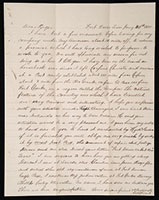
JEB STUART AUTOGRAPHED LETTER SIGNED FROM FT. RILEY, KANSAS TERRITORY.
1-pg 8-3/4″ x 7-1/2″ ALS written from Fort Riley K.T., Dec. 25th 1858 to a Washington Commissioner concerning Stuart’s interpretation of federal law concerning bounty not paid. This 24-line ALS is in beautiful condition, archivally framed with multiple mats and presentation plaque and fine contemporary engraving of the great cavalry commander and Confederate general. CONDITION: Letter on laid paper appears very good to fine overall with light creases at folds, dark, easily discerned ink, curling at edges as mounted. Not examined out of frame. Frame measures 20-1/2″ x 35″. 53112-2 JS (2,000-3,000) – Lot 1364
JEB STUART AUTOGRAPH LETTER SIGNED WITH GOOD TEXAS CONTENT.
1pg 9-7/8″ x 7-3/4″ ALS “Fort Davis Texas, January 30, 1855”. Stuart writes to his West Point classmate Thomas H. Ruger who is currently stationed in New Orleans. “…I have been on the march on horseback ever since I left Corpus Christi and now at a post newly established about 750 miles from Corpus, about 8 miles from the Rio Grande, 180 from El Paso, 335 from Ft Clark, in a region called the Limpia”. Rio Limpia flows through Limpia Canyon, past Ft. Davis which had just being established, now a United States Historic Site named in honor of then Secretary of War Jefferson Davis. “The natural features of the country of which I have traveled are very curious and interesting. I hope you are pleased with your situation under Captain Beauregard”. P.G.T. Beauregard would of course go on to be among the best known Confederate Generals. Stuart also mentions to Ruger that he was having his watch “overhauled by Hyde & Goodrich” of New Orleans and having Ruger send it to him at “Fort Davis via Fort Clarke, Texas”. Stuart goes on to mention other classmates stationed in Texas and ends “I have seen no Indians yet…your sincere friend and classmate J.E.B. Stuart”. The orig envelope also accompanies letter. Thomas H. Ruger (1833-1907) would go on to be a Major General during the Civil War for the Union Army and later Superintendent at West Point. CONDITION: Very good to fine. Paper slightly yellowed and starting at central fold, creases, slight yellowing, dark discernible ink. Envelope had upper right hand quadrant removed that contained stamp. 53112-3 JS (2,000-3,000) – Lot 1365
The Confederate cipher disc is a mechanical wheel cipher consisting of two concentric discs, each with the 26 letters of the Latin alphabet, that was used for the encryption of secret messages of the Confederacy during the American Civil War (1861-1865). It was created by Francis LaBarre (1818-1871), a gold and silver worker, and was based on the “Vigenre System” but called the Vicksburg System by the Confederate States of America. The outer disc measures about 2-3/8″ (57mm diameter, inner disc 41mm). An identical disc was donated to the Museum of the Confederacy by Major Graham Davis who used it to encipher and decipher messages for his Commanding General, S. W. French. Another example is noted in the Smithsonian Collection. In the 2015 text Confederate Agent: A Discovery in History by James Horan, he mentions these specific devices and shows copies of orig codes used by Confederate commissioners where these devices were required to decipher. He states six of these specialty made devices were known to exist. However, our research only shows two in institutional collections as noted. The Crypto Museum and the Spy Museum both have facsimiles. This is a very famous example housed in an early custom Lakeside Press custom box still retaining the cut-out page from the circa 1978 Sotheby’s auction catalog when it was offered from the Phillip D. Sang (1902-1975) Collection. Sang was the premiere collector of Lincoln related objects. Francis LaBarre, Richmond, Virginia, the manufacturer of these discs was living in Washington, DC prior to the beginning of the war, but fled to Richmond where he was contracted by the Confederate Army to produce these ciphers as well as other objects. PROVENANCE: Richard D. Sang (1902-1975) Collection; Sotheby’s, Lot 53, about 1978. CONDITION: Fine overall. Fully functional with deep mustard patina, still retains red and black composite inset into the engraved and stamped letters. 52863-17 JS (15,000-20,000) – Lot 1366
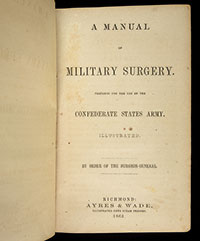
RARE, VERY FINE AND ILLUSTRATED CONFEDERATE IMPRINT SURGEON’S MANUAL, OWNED BY ASSISTANT SURGEON J. B. COAKLEY.
This is the rarest and most desirable of all Confederate manuals, printed by Ayres & Wade in Richmond, VA in 1863 with 297 text pages plus 30 full plate illustrations of amputations, resections and clamping of blood vessels. This example is in very good condition and actually quite fine for a Confederate manual, retaining its French wallpaper boards and buckram spine. Penciled onto front fly leaf “J.B. COAKLEY MD / RICHMOND / VIRGINIA”. Assistant Surgeon J. B. Coakley is listed among paroled Confederate soldiers at Appomattox Courthouse as part of Lightfoot’s Battalion, 2nd Army Corps. CONDITION: Book overall measures 7″ x 4-1/2″. Sound, solid signatures, scuffing to edges and wallpaper covers. Both hinges are starting, foxing, light acid burn, edge is soiled with some bent pages at edge. 52863-13 JS (6,000-8,000) – Lot 1367
SPECTACULAR AND UNIQUE GILDED SILVER & IVORY RATTLESNAKE AND EAGLE POMMEL THOMAS GRISWOLD PRESENTATION CONFEDERATE STAFF OFFICER’S SWORD OF COL. JAMES F. GIRAULT OF NEW ORLEANS.
This is among the most iconic pattern of Confederate presentation swords known. There are no more than 2 or 3 other silver hilted swords known and this is a marvelous example with a unique design of eagle head pommel holding 3 intertwined serpents which form knuckle bow and guard terminating into a serpent head quillon. The hilt is gilded and retains much of its orig gold plate with silver exposed where worn. Scabbard is mounted with distinctive scalloped gold plated and unique florally engraved mounts with beaded sword ring mounts. Blade is full firm marked on one ricasso with “THOMAS, GRISWOLD” in arc above “NEW ORLEANS”. The 29″ blade exhibits 23″ etched panels which include the presentation “CAPTAIN J. F. GIRAULT BY… / NEW ORLEANS OCT. 16TH 1861”. Opposite side of blade is etched with Latin motto which appears to read “TO US ET PRO US”. This sword was purchased from the renown collector Gerald W. Fox in the late 1950’s along with his entire sword collection by Nicholas A. Penachio (1936-2011) and has remained in his estate until recently. The orig Carl Pugliese hand drawn plate used for illustration in William Albaugh’s 1960 text Confederate Edged Weapons also accompanies the sword. This sword has never been published in any Confederate sword text other than by illustration in 1960. James Francis Girault (1821-1889) came from a lineage of Louisiana war heroes. His grandfather, John Girault, took part in the George Rogers Clarke Expedition during the War of 1812 and died at Spanish Fort in December 1814. Both his father, John R. and his Uncle Frank, were American officers at the Battle of New Orleans. John Francis Girault was born in Natchez, Mississippi. After college, Girault studied theology under Bishop Leonidas Polk who he would be assigned to at one point in the Civil War prior to General Leonidas Polk’s tragic at Pine Mountain, Georgia. Like Polk, war interrupted their priestly duties. Girault fought in the 4th Louisiana Regiment under Col. Horatio Davis during the Mexican War, later to become Major in the 1st Louisiana Regiment. In 1861, when the South again asked for soldiers, Captain Girault promptly responded and raised a regiment of “Confederate Guards” but were disbanded before leaving Camp Moore. Girault was promoted to Colonel and served on the staff of General Martin Luther Smith at Vicksburg then reported to his old mentor General Polk in Tennessee. Polk appointed him Inspector General on his staff during the Tennessee-Kentucky campaign of 1863. Girault was again transferred as Inspector General to serve again at Vicksburg under General M. L. Smith with the rank of Major. Girault was captured at Vicksburg but was soon paroled and exchanged. No sooner at liberty, then the dauntless soldier reported again to General Smith at Atlanta becoming General Smith’s Chief of Staff and remaining there until Atlanta fell. Colonel Girault was now assigned to Richmond and reported to Adjutant General Samuel Cooper to serve as Inspector General for the Department of Alabama, Mississippi and Eastern Louisiana. He inspected the fort’s, stores, arms and troops and was at Meridian, Mississippi inspecting a cavalry regiment when the war ended. With the struggle over, Colonel Girault returned to New Orleans and prepared to assume the more peaceful robe of the priestly office he aspired. He was ordained December 1, 1867 and in 1869 built St. Anna’s Chapel on Esplanade Sreett. PROVENANCE: Gerald G. Fox Collection, Longmeadow, Massachusetts; Nicholas A. Penachio, 1959; pictured on pg 99 “Confederate Edged Weapons”, William Albaugh, 1960. CONDITION: Very good to fine overall. Hilt retains most of its orig gold plating as do scabbard mounts. Leather scabbard body is sound and solid with crazing. Middle mount is missing its screw. Blade retains some orig luster with areas of staining and pitting. Etched panels are difficult to read but are discerned when glinted in light. Other etchings include floral panels of grape leaves, tobacco leaves and cotton. Ivory grip has dark patina with several hairlines and chipping on top at eagle’s beak which do not effect aesthetics. Silver wire grip wrap is missing. Special Note: This item(s) contains plant or animal properties that may be covered by the Endangered Species Act (ESA). Please read the Conditions of Sale, section 15, for more information regarding the Endangered Species Act, and your responsibilities as a buyer. 52867-1 JS (40,000-60,000) ESA – Lot 1368
RARE AND FINE KRAFT, GOLDSCHMIDT & KRAFT CONFEDERATE STAFF OFFICER’S SWORD.
This is among the most beautiful and desirable of Confederate staff officer’s pattern swords. There are probably less than 20 examples known and fewer that are all orig with complete orig scabbards with fine etched blades with full maker’s marks. At least one sword of this pattern is identified to a Confederate General, Joseph Kershaw. This pattern exhibits “CS” in a pierced guard of oak leaf and acorns. An identical pattern is pictured as fig. 21-A in William Albaugh’s text Photographic Supplement to Confederate Swords, 1960. The hilt, pommel, and knuckle guard are well finished with traces of gold plating. The grip is leather covered and wrapped with a single strand of copper wire. The blade is beautifully etched in 15″ panels on either side of foliate and patriotic design including a large “C.S”, cannon balls, crossed cannons, patriotic Confederate shield with flags and etched “K.G&K, Columbia SC”. The orig and correct scabbard is brazed with brass mounts with a matching patina to hilt. This is a fine example of a very rare Confederate sword and is the first complete and orig example to come to auction in many years. CONDITION: Very good overall. 32″ blade is gray overall with staining and a “bent” area about 5″ from ricasso showing an area where blade was possibly straightened though etched patterns are unaffected other than a few dents & tool marks as can be seen in photos. Hilt, pommel, scabbard mounts exhibit mustard colored patina where gold gilt is missing. Leather grip is dry and flaking but still appears about 90% intact including orig copper wire wrap. Scabbard throat missing one of its two retaining screws. Scabbard body is brown overall, pitted but smooth with discernible brazed line to overlapped construction, typical of this rare Columbia, SC manufacturer. Otherwise sword appears 100% orig and complete in every regard. 52716-1 (15,000-20,000) – Lot 1369
MAGNIFICENT JEWELED SILVER AND GILDED PRESENTATION STATUE HILT SWORD TO MEDAL OF HONOR WINNER BRIG. GENERAL HENRY V. BOYNTON.
Henry Van Ness Boynton (1835-1905) was recipient of the Congressional Medal of Honor for his actions at the Battle of Missionary Ridge while a Major in the 35th Ohio. Boynton would return to active duty during the Spanish American War as a Brig. General and almost single-handedly is responsible for the formation of the Chickamauga and Chattanooga National Military Parks. This sword of the absolute highest quality of 19th century statue hilts made by Tiffany and other top makers was presented to General Boynton in 1898 in a public ceremony in Chattanooga by Captain L. T. Dickinson, a Confederate veteran. “In appreciation for his tireless work at Chickamauga the citizens of Chattanooga bought Boynton “the beautiful jeweled sword” whose estimated value was $1,000″. The sword has a massive full figure Lady Liberty with shield in gilt and silver with outstretched arm holding furled American flag which forms the knuckle bow and the stars are diamond-like gems. The knuckle bow terminates with flag folded around eagle head quillon with red garnet cabochon eyes. Obverse cross guard, about 3-1/2″ across shows a view of Chattanooga engraved in relief from a perspective on Lookout Mountain showing Moccasin Bend of the Tennessee River and Chattanooga to the right. The reverse folding languette shows Lookout Mountain above the Tennessee River also in relief. The gilded cut-out relief scabbard mounts are embellished with 2 monuments from the battlefield, tower on Snodgrass Hill, a view of Missionary Ridge and it’s lookout tower with raised relief presentation “PRESENTED TO / BRIG. GENL. H. D. BOYNTON / BY THE CITIZENS OF / CHATTANOOGA TENN. / IN TOKEN OF THEIR ESTEEM”. Top mount also in relief lettering reads “CHICKAMAUGA AND CHATTANOOGA / NATIONAL MILITARY PARK”. The sword may have been the most expensive and finest sword ever made by the Pettibone Manufacturing Company of Cincinnati, Ohio. The jewelers circular January 4, 1889 states “The Pettibone Mfg. Co. have made one of the finest swords ever turned out by this house, for the people of Chattanooga, Tenn., who will present it to Gen. H. V. Boynton, of Cincinnati, because he was the prime mover of getting the Chickamauga park on the site of the great battle at that place. The sword cost $1,000 and is made of pure metal. The grip is modeled with the statue of Minerva, encrusted with diamonds and other precious stones. Her arms are outstretched, holding the draping folds of the flag which falls at her feet, the whole forming the guard. The 13 stars are diamonds, the stripes are enamel. A view of Chattanooga and the Moccassin Bend is bas-relief on an oval shield. The blade is of the finest Toledo steel, inlaid with pure gold in elaborate military designs. The foot mount bears the word “Gazette”, to indicate the general’s newspaper”. CONDITION: Very fine overall. 30-1/2″ double-edged blade has 17″, 4-color etched panels in various patriotic motifs, “HENRY VAN NESS BOYNTON” on one panel and “CHATTANOOGA 1898” on the other. The sword retains most of its orig finish which just light wear to high areas. 52863-19 JS (8,000-12,000) – Lot 1370
AMES HIGH GRADE PRESENTATION MODEL 1850 STAFF AND FIELD OFFICER’S SWORD, MAJOR BENJAMIN TRAFFORD, 71ST NEW YORK “THE AMERICAN GUARD” WITH WARTIME ARCHIVE.
This is among the highest grade Ames staff officer’s sword with engraved brass scabbard with applied relief decoration to scabbard mounts, sharkskin grip with extra engraving on hilt and pommel. 32″ blade has Ames finer “spiderweb” etching with military motifs. Blade and scabbard are both marked with full firm address, “AMES MFG CO, CHICOPEE, MASS”. The scabbard has engraved presentation between the top mounts: “PRESENTED TO / MAJOR BENJAMIN L. TRAFFORD / LATE CAPTAIN OF COMPANY E / 71ST REGIMENT AMERICAN GUARD / BY THE MEMBERS OF HIS RECENT COMMAND / NEW YORK OCT. 24TH 1862. Colonel Trafford was born in New York City in 1836. At the age of 18 he entered the 71st NYNG as Private, and was soon after promoted Corporal. When the war began, Trafford was commissioned Captain April 19, 1861, with final rank of Colonel May 13, 1863. Trafford and the 71st participated in the Battle of Bull Run, where he behaved with great gallantry. He served also in the campaign of 1862. When the rebel invasion of Pennsylvania was made in 1863, Colonel Trafford was in command of the regiment. On the arrival of the regiment at Harrisburg, it was brigaded with the 8th N.Y. Regiment. General J. M. Varian was the Colonel command the 8th at the time, and being senior officer he was placed in command of the provisional brigade. The brigade was engaged in the defense of railroads and bridges. On the night of June 21, the two regiments were to take the cars at Chambersburg for Carlisle. It was divided into two wings with one company as skirmishers. Colonel Trafford remained with the skirmishers, that being the most dangerous position. When the troops took the cars, Colonel Trafford missed the left wing of his command, and although Colonel Varian assured him that, excepting the company of skirmishers, the 71st was aboard the cars, Colonel Trafford was not satisfied. The rain was falling heavily and the roads were very muddy; nevertheless Colonel Trafford rode off in the darkness in search of his missing soldiers. Eventually he found them, wet and fatigued after a march of twenty miles. He secured a train of cars and sent them on to join the remainder of his regiment. He returned with his command soon after to assist in quelling the New York draft riots. Colonel Trafford resigned his command of the 71st in 1866, and about this time published a monograph on military tactics, which had a wide circulation. This sword is accompanied by a small archive of Colonel Trafford’s including several war time muster rolls signed by Trafford, name plate from his saddle, Infantry Manual of Arms written by Trafford and published in 1863 for the 71st Regiment, 80 pgs in wraps missing back cover with tape repair to spine, Major and Lieut. Colonel shoulder straps, cased epaulets, straight razor, swatch of his hair with old tag, several copies of his obituaries and many wartime letters and photographs, a few post-war photos of Trafford, 23 Civil War New York state seal buttons that were once on Colonel Trafford’s coat along with gilded sterling sash buckle and 1855 patent coat tightening buckle. PROVENANCE: The esteemed collection of Rafael Cruz. CONDITION: Sword is very good overall. Grey blade with some luster and discernible etching. Brass scabbard mounts and hilt are cleaned with light mustard patina with strong traces of gilt in protected areas. Inscription and engraving all crisp and discernible. Protective washer has been replaced. Sharkskin has typical longitudinal separation but intact, including twisted brass wire wrap with wear through at high spots and loss of much of its black dye. Several muster rolls are broken at folds. Infantry manual is missing back cover and has tape repairs as noted. Buttons, letters, photographs and shoulder straps are all very good. 53073-20 JS (8,000-12,000) – Lot 1371
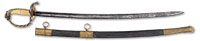
SPECTACULAR CASED SOLID SILVER AND GOLD MEXICAN WAR PRESENTATION SWORD TO MAJOR SAMUEL MARSHALL FOR GALLANTRY AT THE BATTLE OF CERRO GORDO IN THE MEXICAN WAR.
This magnificent gilded solid silver sword has presentation from the State of Illinois PRESENTED BY THE STATE OF ILLINOIS TO / MAJOR SAMUEL D MARSHALL FOR SERVICES IN THE / LATE WAR OF THE UNITED STATES WITH MEXICO / AND ESPECIALLY FOR HIS GALLANTRY AT THE BATTLE OF CERRO GORDO” with his name plate also on the blue and red velvet French fitted mahogany casing. In the 1883 History of White County, Illinois, pg 673 “John Marshall, of Marshall’s Ferry … has in his possession a sword, which is one of those ordered by the State of Illinois and presented to the officers of the Mexican war. It has this inscription: “Presented to Major Samuel D. Marshall for services in the Mexican war.” The sword is beautifully engraved, the battle of Cerro Gordo being represented on one side. It is very heavily plated with gold, as is also the scabbard, the whole being encased in satin in a fine rosewood case. He was an intimate friend of Abraham Lincoln; was in the Legislature with him one term, and was with him on the Harrison electoral ticket in 1840. John Marshall has in his possession a letter from Mr. Lincoln written in February, 1849, to Major Samuel D. Marshall, Shawneetown, Ill.” Samuel D. Marshall (1812-1854). His gravestone at Westwood Cemetery, Shawneetown, Illinois reads “1812-1854 / SAMUEL D MARSHALL / GRADUATED FROM YALE / 1834 / STATES ATTORNEY / GALLATIN COUNTY / 1836 / MAJOR 3RD ILLS VOLS / U.S. WAR WITH MEXICO / 1847- 1848 / SWORD PRESENTED BY ILLINOIS /FOR SERVICES RENDERED AT / BATTLE OF CERRO GORDO / LINCOLN’S FRIEND”. Marshall was indeed a close friend of Abraham Lincoln as the series of letters exchanged between the two men tell of both political and personal details, especially in Lincoln’s life found in various archives. PROVENANCE: Major Samuel D. Marshall, 1847; John Marshall, 1854. CONDITION: Extremely fine. Sword is extremely well preserved in its orig case, retaining most of its orig gold though worn in areas exposing silver. The solid gilded silver grip still exhibits extremely well detailed “Zeus’ head” pommel. The 31-1/2″ blade is firm marked “BALL / TOMPKINS / & BLACK / 247 BROADWAY / NEW YORK”. The blade retains virtually all of its bright blue and gold patriotic decoration including the 7-1/2″ long highly detailed etched panel showing the Battle of Cerro Gordo. Casing is also fine with solid silver, 2-1/2″ x 4″ engraved silver makers plaque. Rosewood casing is sound with minor cosmetic defects, soiling internally and externally. Inset engraved plate with Marshall’s name has a mottled mustard patina. Velvet lining internally very good with light areas of soiling. 52863-18 JS (25,000-35,000) – Lot 1372
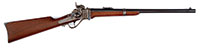
EXCEPTIONAL CIVIL WAR NEW MODEL 1863 SHARPS PERCUSSION CARBINE.
SN C41594. Cal. 52. Standard carbine with usual markings throughout. It has a 22″ round bbl. Bbl is marked forward of sight “Sharps Rifle/Manufg. Co/Hartford Conn” and rear of sight on bbl “New Model 1863″. Frame and hammer have Sharps and Lawrence patent marks as usually seen and typical sling bar and ring on the left side. This is an extremely fine orig and complete example of the Civil War Sharps military carbine. Most of these percussion Sharps made late in the war were converted to cartridge and this is one of the best survivors you will find. CONDITION: Bbl retains about 95% of thinning dull blue finish turning plum with scattered areas of staining and pinprick pitting. Lock, hammer and frame retain 60-70% of their bright and muted case colors with small areas of staining and pinprick pitting. Stocks are sound and solid, raised grain with small dings and dents. Mechanically crisp with bright shiny bore. 52863-9 JS (6,000-8,000) – Lot 1374
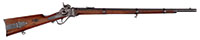
SN C35210. Cal. 52. Standard configuration Civil War Sharps rifle with 30″ rd bbl, nickel silver sight blade on a rectangular base. Rear sight is standard Lawrence Patent ladder style graduated to 800 yds. Bbl has standard 3-line Hartford marking just forward of the rear sight and “NEW MODEL 1863” back of the rear sight. Receiver & lock plate have standard markings & lock plate has automatic primer feed. Mounted with straight grain American walnut including full length forearm secured with 3-band and nosecap. Middle band has a sling swivel with corresponding swivel in the buttstock. Stock has straight grip with Sharps semi-crescent buttplate. This particular gun is listed by SN as being issued to William H. Bennett, Company K, 1st US Infantry, Veteran Reserve Corps. CONDITION: Very good overall. Gun appears orig, complete and matching with two crisp inspector cartouches. All markings are crisp. Stocks are sound with scattered cosmetic defects and one large stain on right side of buttstock. Metal is overall dark grey/brown. Crisp mechanics and bright, well defined rifled bore. 52802-4 (4,000-6,000) – Lot 1375
SN N/A. Cal. 58. This is a fine example of a Civil War era Model 1855 rifled musket in standard configuration with 40″ bbl with “V / P / eagle head” on left side of breech. Lock and bbl are both dated 1858. Lock is marked with “U.S. / SPRINGFIELD” forward of hammer, well struck eagle on Maynard tape primer door. Buttplate surcharged “US”, stock has barely discernible inspector’s cartouche, brass nosecap, retains orig leather sling. CONDITION: Fine overall. Iron is grey overall with well discerned lock and breech markings. Stock is sound and solid with worn edges and as noted cartouche only visible in outline. Mechanically crisp with bright shiny bore. 52802-2 (4,500-6,500) – Lot 1376
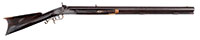
EXCEPTIONAL BRASS MOUNTED HEAVY BARREL SAMUEL HAWKEN SINGLE KEY PLAINS RIFLE.
NSN. Cal. 48. This gun apparently saw little use as it retains orig brown to bbl and much of its orig varnish, crisp rifling and mechanics. Gun measures 48″ overall with a 31″ oct bbl, weighing just over 12-lbs, top bbl flat just rear of buckhorn sight “S. HAWKEN ST. LOUIS”, double set triggers. Gun appears orig and complete including ramrod and front German silver sight with copper dovetailed base. PROVENANCE: The esteemed collection of Rafael Cruz. CONDITION: Fine to very fine overall, an exceptional “as found” gun other than broken at wrist and has an old glued repair. Bbl is overall plum with areas of staining and pitting. Breech, lock and hammer are grey/plum with pitting especially at breech and nose of hammer. Stock is sound and solid other than noted repair at wrist, retaining about 80% orig varnish except at repair which has added varnish. Mechanics are fine with crisp 7-land and groove rifling. 53073-6 (27,500-37,500) – Lot 1378
TRULY SUPERB, HIGH ORIGINAL CONDITION, PAIR OF SAW-HANDLED PERCUSSION DUELING/ TARGET PISTOLS BY RICHARD CONSTABLE OF PHILADELPHIA, WITH ORIGINAL CASE AND LABEL.
NSN. Cal. .45 Smooth bore. 16-1/2″ Overall. 10″ Skelp twist octagon bbls are engraved “constable philadelphia” (working 1817 – 51) in old English script on top flats which are mounted with silver bead front sights. Bottoms of bbls are stamped with Birmingham black powder proofs, and are fitted with under ribs with plain pipes holding ebony ramrods with German silver tips and tails (steel worms are under caps). Patent breeches are nicely filed, have platinum blow-outs and three gold bands surrounding some well cut scroll engraving. Case hardened breech irons engraved with open scroll have integral rear sights. Case hardened back action locks mounted with broad rounded body serpentine hammers have back sliding safeties which engage at half cock. Locks and hammers are engraved with exceptionally well done open flowing acanthus scroll. Feather engraved German silver flash guards extend forward from locks under breech plugs. Trigger plates are charcoal blued, and have stylized pineapple finials. Temper blued triggers are set (with no adjustment screws). Scroll engraved and blued trigger guards have finger spurs. American walnut half stocks are cut from the part of tree where trunk flares into root. They have German silver tips, are saw-handled and terminate in flared grips. Ends are surrounded by feather engraved German silver bands, and have German silver ovals on flat bottoms. Grips are fully checkered with flat top diamonds and mullered borders. There are silver rectangular crest plates on side panels. Bbls attach to stocks with temper blued steel captive side bolts through rectangular silver escutcheons. These very high quality pistols are housed in their original dovetailed American walnut case having pivoting hook closure in English fashion, with inset brass rectangular crest plate on top. Interior is lined in blue velvet with rare small paper R. Constable label in lid. Partitions fit guns very well. Accessories in case include a steel nutcracker ball mold marked “60”, copper bodied 3-compartment powder flask/ ball and patch flask marked “Dickson & Son”, hickory, brass, and horn loading rod, and another walnut handled steel loading rod (steel head acts as a powder measure). There are two covered compartments with walnut tops and ring handles, one holding the orig key. CONDITION: Excellent, as found, with no evident restoration or repairs. Bbls retain over 90% of their orig brown pattern, with evidence of very light cleaning on left sides, with a few light flecks overall. Locks and breech irons retain over 90% of their orig case hardening color, which has faded a bit, and shows some very light frosting. Charcoal blue of trigger plates and trigger guards is superb, rating well over 90%. Thimbles show some flaking and wear to their blue from contact with case. Stocks retain nearly all of their French polish finish with some light marks and a few deeper dings, as well as some scratches and marks associated with storage in case. German silver shows some toning. Band on grip of one gun has lifted a bit toward front. Locks are crisp. Safeties and triggers work. Bores are excellent. Case exterior is excellent with some marks and scratches, and a few stains. Interior cloth has faded somewhat, and has a number of rubs and marks. Label is fine, a bit foxed, with considerable black soiling at center from contact with flask. Flask is good with loss to varnish on body and with numerous scratches and marks. Other accessories are fine. A lovely pair of American high quality pistols in remarkable untouched condition. 52863-11 MGM (12,000-15,000) – Lot 1379