| Image |
Lot |
Price | Description |
|
|
1225
|
$6,900.00 |
SCARCE AND FINE 1862 DATED MODEL 1861 SPRINGFIELD RIFLED-MUSKET WITH BAYONET.
NSN. Cal 58. 40″ bbl. This is a very nice example of Civil War model 1861 Springfield dated 1862 which over 450,000 were made in 1861 and 1862 but few survive in high condition as this was the workhorse musket of the Union Army during the early phases of the Civil War. Indeed these muskets were often captured and saw continued use by the Confederacy. This gun is consistent with other 1861 Springfield’s being iron mounted, fitted with three flat bands that are spring retained, two leaf rear sight and swelled tulip tip ramrod. This gun is properly marked “US/SPRINGFIELD” with Eagle forward of hammer on lock and “1862” on tail of lock and on bbl flat and “VP/Eagle Head” proof. There are two inspectors cartouches crisply stamped opposite lock as can be seen in photos, one being ESA (Erskine S. Allin). This is not a surplus gun and no doubt saw service but is in wonderful condition and a very fine survivor of the early Civil War. As noted this particular model Springfield is hard to find in nice condition and appears 100% orig and complete in every regard including bayonet. CONDITION: Fine overall. Metal is mostly bright with scattered pitting, especially at bolster. Lock and bbl markings are all crisp and well defined. Stock is sound and solid, still exhibiting raised grain with two bright cartouches and a small two character sub-inspector stamp on stock just rear of trigger guard tail. Bayonet is in matching condition. Mechanically gun functions well with crisp well defined bore. 51388-4 JS (3,000-5,000) – Lot 1225
|
|
|
1226
|
$1,610.00 |
1853 DATED MODEL 1841 HARPER’S FERRY “MISSISSIPPI” RIFLE.
NSN. Cal .58. 33″ bbl. This Harper’s Ferry Rifle has well marked lock with eagle over “US” forward of hammer and “HARPERS / FERRY 1853” at tail. The bbl has no discernible markings other than remnants of Harpers Ferry inspector on left side of breech. Gun is properly brass mounted with exception of an iron nosecap without sling swivel utilized from another longarm. This gun originally was made in 54 Cal. but has been bored out for Civil War service and now measures just over 58 Cal. There is a large “27” stamped on left side of butt opposite patchbox. CONDITION: Gun overall is good. Iron overall is dark grey/brown with pitting especially at breech. Brass mounts have been cleaned and have toned to a light mustard colored patina. Stock is sound and solid, old refinish, no discernible markings with scattered dings, dents, scratches and burned out area rear of bolster showing gun has seen a lot of action and firing. Brass tipped ramrod is of correct style but appears to be a reproduction. Mechanically gun will not hold at half cock, otherwise functional. Rifling in bore is discernible. 51388-2 JS (1,000-2,000) – Lot 1226
|
|
|
1227
|
$0.00 |
EXTREMELY RARE AND FINE CIVIL WAR “STATE OF NEW YORK” DELAFIELD RIFLED FIELD GUN, SERIAL NUMBER 3.
SN 3. This particular cannon is in beautiful condition with great markings and wonderful carriage utilizing orig iron hardware. This cannon is number “3” of 13 delivered to the Commissary General of the State of New York, March 18, 1862 and was thought to have been issued and used by the “Excelsior” State New York Battery. Richard Delafield (1798-1893) was a Major General during the Civil War and Chief of US Engineers and former Superintendent of the United States Military Academy at West Point. Delafield was in charge of the defenses of New York Harbor in 1861, when he designed this cannon that shot a pre-engraved projectile which was unique at the beginning of the war, but later adopted for other rifled cannon. Cannon measures 78″ overall with bore length of 72-1/2″. Cannon is marked on top between trunnions “S.N.Y.”. Right trunnion marked “MMW & CO”. (Moores M. White & Co., finisher), over “IGJ” (Isaac Gale Johnson, foundry). Left trunnion dated “1862” above Richard Delafield’s initials “R.D.”. Muzzle face at top “No 3” and “3.67”. Cannon weight is stamped under cascabel “1016” lbs, just over weights of M-1841 six-pounders, for better power in the battlefield. Accompanying cannon is an orig Civil War albumen photograph of Delafield, about 7″ x 5″ oval mounted on larger board. There is also a photograph of the cannon being fired by present consignor at the N-S.S.A. Nationals in Winchester, VA. 1980 where it won a 2nd place award for live fire accuracy at 200 yards. Also included are old copies of the 1861 engineering diagram drawn up General Delafield with notes. Additional information provided by consignor can be seen in provenance. These three items are all in one large frame. Of the four known Delafield rifles of this contract, this example is by far the best and one of only two privately owned. This is an impressive and great rarity among Civil War cannon. PROVENANCE: Jack Singer, Peekskill, NY, 1971; Bernard and Ken Kurdt, Wappingers Falls, NY, 1975. CONDITION: Fine overall, markings mostly crisp. Slight weakness in trunnion and muzzle marks, but still all discernible as can be seen in photos. Cannon measures 136″ from muzzle to trail, 80″ hub to hub. Carriage is very good to fine with strong wood components professionally restored, utilizing some orig irons with pitting and other good restorations that are overall smooth. Carriage properly painted with additional 1-1/2″ red painted bands on hubs for visibility when used in recent demonstrations, easily painted over black to match. Accompanying projectile with malleable iron pre-engraved rifling on sabot is 9-1/2″ tall, weighing 12-1/2″ lbs with pewter Parrott time fuse. The frame of documents measures 25″ x 19″, orig albumen photograph of Delafield is mounted on a 10-1/2″ x 8″ board is light faded, foxed with light staining 51089-1 JS (60,000-90,000) – Lot 1227
Click here to view provenance
|
|
|
1228
|
$86,250.00 |
EXCEPTIONAL AND FINEST COLLECTION OF RAREST VARIETIES OF CHARLESTON, SOUTH CAROLINA, “SLAVE HIRE” OCCUPATIONAL TAGS 1800-1864 INCLUDING SEVERAL UNIQUE EXTREME RARITIES.
Charleston, South Carolina, was the only city in the antebellum South to issue these tags or badges which had to be worn by any slave that was “hired out”. Each year a slave owner who hired out a slave had to pay a tax and the slave had to wear a brass “Slave Tag” proving the tax had been paid. The greater the skill and training required, the higher the tax. Charleston slave tags were authorized from 1800 up to the Civil War with the last badges made in 1865. We have offered several great groupings of slave tags in past auctions, but now offer, undoubtedly, the only complete collection of rare slave trades including the finest and only 1800 Huckster known. This badge is unique. Also included is the ultra-rare Carpenter of which no more than 4 or 5 examples are extant. Also in this grouping is the only known serial number “1” badge known and it is a pristine, non-excavated 1864 dated Mechanic. All badges in this collection are in very good to excellent condition with no repairs and all complete. All of these badges were family heirlooms or souvenirs excavated around various sites around Charleston and all with exception of 1864 serial number “1” Mechanic are of the earlier large varieties that are the most difficult to find. Slave Badges and the Slave-Hire System in Charleston, South Carolina, 1783-1865 by Harlan Greene, Harry S. and Brian E. Hutchins, 2004 is a wonderful, scholarly text that explains the quantities and makers of each badge and the census of known examples. All badges are authentic, original, and collected by a leading numismatics authority over a 30 year period. Almost all are maker marked and the other badges are noted as to maker as documented in the Greene/Hutchins text. Quoted portions of badge descriptions are from their text: 1) 1800 octagonal “HUCKSTER” No. 49. 1800 is the first year that badges were made which had to be worn at all times by new Charleston law. Few badges from this date are known and as noted this is the only known Huckster and it is maker marked “Atmar”. Ralph Atmar, Jr., a jeweler, was the first manufacturer of slave hire badges for the city of Charleston. No other city had such strict regulations and no other city required slaves to wear badges. The original ordinance published September 3, 1799 in the City Gazette stated the following: “Denomination” and price of said badges are as follows: Huckster, not under 30 years of age, $6 per badge. Mechanic, $3. Porters and Cart and Drayman, $2. Fishers and hired servants $1. These indeed were the categories and prices established by the ordinance. The terms in the press give us clues as to what the words on the badges were: “Huckster”, “Mechanic”, “Porter”…..” This unique badge was totally unknown to the trade until now. Two other Hucksters are known, both dated 1803, one of which is in the historic Charleston Confederate Museum at 188 Meeting Street. 2) 1810 octagonal “FISHER” No. 28. Another rare badge which is rarely offered. This badge is maker marked “Lafar” on verso. John Joseph Lafar was the official badge maker for the City of Charleston for about 20 years. He owned slaves and also served as City Marshal from 1818-1830, a total of 656 badges were made in 1810 of all types. The survival rate on slave badges is extremely low. For instance, even though 644 badges were made in 1808 and 1809, no examples are known. During the Civil War, copper for these badges was so scarce that it was advertised for by manufacturer to buy old copper, no doubt many old badges which had no value to their owners now were recycled. 3) 1813 octagonal “CARPENTER” No. 35. This badge is maker marked “Lafar” on verso and few Carpenter badges were made. Based on the great rarity of this particular trade, there are only 4 or 5 Carpenters known, one being 1811 and the others being 1813. The highest serial number noted is “69”. 4) 1815 diamond “FRUITERER & c” No. 74. This badge is maker marked “Lafar” on verso and few Fruiterer badges are known. Fruiterer is a very unusual occupation by today’s terms and was not a fruit picker but actually a vendor. Lafar is unique in his badges that he added “& c”. Earlier badges had Fruiterer only. “It shows the confusing arising from the term, for a Fruiterer sold more than fruit”. 5) 1818 square “PORTER” No. 604. This badge is maker marked “Lafar” on verso. Porter was the 2nd most common of slave hire badges made, but this is a fine example from an early year where the shape had been changed to square instead of diamond. 6) 1819 diamond “PORTER” No. 583. This badge is also made by Lafar, and note the change from 1818 back to a diamond shape. 7) 1823 diamond “SERVANT” No. 1328. This badge is maker marked “JJ Lafar” on obverse. This particular Lafar mark is scarce and only occurred for a few years. “It is estimated that only 1,261 badges were sold (1823) and that number of slaves were hired out, a great decrease from the year before, suggesting that the Denmark Vesey Rebellion, and fear of those slaves that hired their time, might have an impact on the practice in the year after the dramatic events. One slave who had an 1823 badge was “Mary”, a washer woman on the green. Her badge is No. 471, her owner stated in an ad seeking her return (Courier, March 26, 1823)”. 8) 1824 square “MECHANIC” No. 24. This badge, like the last, is maker marked on the obverse “JJ Lafar”. Mechanic badges are among the rarer badges found and this is the first of 3 fine, rare examples in this collection. 9) 1825 diamond “SERVANT” No. 1013. This badge is maker marked “Lafar” on obverse and has a beautiful copper patina, well struck with excellent markings. Servant badges were the most common badges made and this is a fine representative of an early example. 10) 1828 square “MECHANIC” No. 219. This badge is the last year that Lafar marked his badges and this badge is maker marked “Lafar” on verso. Lafar continued to make badges, though he no longer marked them with his name. All Mechanic badges are very scarce and this is a great example with a most unusual associated document. The document also dated 1828 (April 1st), is a Charleston Bill of Sale of two slaves “Sambo and Carolina”, both bricklayers who would have been required to wear a Mechanic slave tag when working in Charleston. 11) 1836 diamond “MECHANICK” No. 357. This badge is in remarkable, beautiful condition with a beaded border around misspelling or colloquial “Mechanick”. This badge was made by William M. Rouse. “William M. Rouse had been selected, perhaps because of his low bid (Courier, November 18, 1835)…estimates are that 3707 badges were sold for 1836”. Later badges by Rouse had Mechanic spelled correctly. 12) 1864 diamond “MECHANIC” No. 1. This is one of only two known serial number “1” badges of any type for any year and is exceedingly rare. This badge was made by William Veronee and was the last contracted slave badge maker in Charleston. Less than 1,500 badges total were made during the last 2 years of the Civil War and very few have surfaced. Scarcity of brass for these badges is noted in that “many if not all badges from these years show striking on both sides, a practice carried out by Veronee”. This is a beautiful rarity with an impeccable surface. CONDITION: Very good to fine overall. All badges have well discerned markings including cartouches, serial numbers, dates, occupations and makers marks. Badges have varying surfaces from quite smooth to pitted. 51803-1 JS (90,000-125,000) – Lot 1228
|
|
|
1229
|
$9,775.00 |
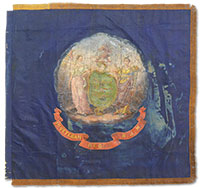
EXTREMELY RARE REGULATION CIVIL WAR ERA REGIMENTAL COLOR OF THE 1ST NEW JERSEY VETERAN MILITIA REGIMENT.
Civil War Era regulation regimental flags quite rare outside of institutions and this is one of few that have ever come to auction. Regulation flag measures just over 6′ square at about 71″ x 74″ including the 2-1/4″ silk fringe and blue silk sleeve hoist. The state seal and ribbon with regimental markings is about 46″ high and 37″ across. The state seal of New Jersey is beautifully painted on both sides by a Philadelphia contractor Evans & Hassall. The painter of this state seal was very gifted, not a typical sign painter seen on so many painted flags, the details of Liberty holding “Liberty Cap” on a pole and Ceres, Roman Goddess symbolizing abundance, holding her bountiful cornucopia, very fine details to faces and garments. The state seal of horse head over shield with plows and the state motto “LIBERTY & PROSPERITY” are also finely detailed and highlighted. At least a dozen other regimental flags in the New Jersey State and New Jersey National Guard Militia Museum were of the same contractor early to late war. The 1st New Jersey Militia was formed in Trenton prior to Lee’s invasion into Pennsylvania, June 17, 1863, as a 30-day regiment. The unit never left the state. Most men went on to other units once Lee was defeated at Gettysburg and additional troops were needed to protect the state as the threat was now gone. Organization of 1st Veteran Militia is not found in wartime records and unit probably saw no wartime service and only mention is in 1861 in Adjutant General’s report which praised the unit “discipline and training were first rate”. This is among the best preserved silk regulation Civil War era regimental colors extant. PROVENANCE: Ex-William Kazar Collection of New Jersey Militaria. CONDITION: Blue silk is mostly intact as can be seen in photos, including all fringe. Hoist is torn at edge, but appears intact. As can be seen, there’s large area of light staining on one side of state seal. Paint is 95% intact with numerous cracks and reductions as can be seen in photographs. The flag has old conservation and sewn to a piece of blue polished cotton backing. 51642-1 JS (20,000-30,000) – Lot 1229
|
|
|
1230
|
$48,875.00 |
VERY RARE CONFEDERATE “NORTH CAROLINA” 10-STAR FIRST NATIONAL FLAG.
This beautiful hand sewn company-sized polished-cotton Confederate Stars and Bars has great collection history, though its unit is unknown. This flag no doubt commemorated North Carolina secession May 20, 1861 and was most likely made about that time and prior to secession of Tennessee (11th State), June 8, 1861. Flag has beautiful aesthetics and patina, still retaining bright indigo blue and red bars have patinaed to a pleasing orange/rust. This flag has great collection history and was most likely a captured Union souvenir based on the pencil description on white bar “Confederate Flag”. This is a very rare flag with 6-pointed stars and few are known. At the time of Confederate flag expert and authority Howard Madaus’ letter of authentication written in 1979, he noted only six with 6-pointed stars of which four were identified to North Carolina units. Madaus also states that the first state flags issued to North Carolina units in 1861 also bore 6-pointed stars. See accompanying Madaus report. This flag has been professionally conserved and framed by Textile Preservation Associates (TPA) of Keedysville, MD and Fonda Thomsen’s report accompanies. The flag is framed by TPA utilizing welded aluminum pressure mount which is still considered the state of the art by most institutions displaying flags. SIZE: 23-1/2″ hoist, 36″ fly. Frame 31″ x 44″. PROVENANCE: Reading, PA; Ex-Collection of Civil War historian and authority William G. Gavin, 1950; Ex-Collection Lewis Leigh, 1979; Ex-Collection Charlie Salter, Roswell, GA. CONDITION: Flag is intact with only minor damage at the bottom of the fly end. Flag retains four pairs of 3-1/2″ polished cotton ties. There is a 1-1/2″ x 1/4″ hole in the bottom fly corner. The top bar has 1-1/2″ “L” shaped tear near the center bottom. The upper fly corner has 1″ horizontal tear. The lower leading edge corner of the fly has a 1/2″ square hole. The leading edge has seven holes arranged in three pairs plus one extra at the top and above the ties at the bottom of the canton that appear to be from tacks. The obverse of the flag is soiled with one area in the end of the canton and smaller dark stains in the top bar. The reverse has diagonal soiling in the top bar. The edges of the reverse stars are folded over. Some of the stars have an additional tacking thread repair. The flag has creases from a prolonged period of being folded. 51540-1 JS (20,000-30,000) – Lot 1230
Click here to view provenance
|
|
|
1231
|
$270,250.00 |
Revised: 3/30/2017
Please Note: The painting of Captain Rutherford is not offered with this lot. The painting is on display at the National Maritime Museum, Greenwich London, Greenwich Hospital Collection.
RARE AND EXTRAORDINARY CASED 100 GUINEA LLOYD’S PATRIOTIC FUND PRESENTATION SWORD FOR HERO OF BATTLE OF TRAFALGAR.
Captain William George Rutherford (1764-1818), Commander of HMS Swiftsure, at the Battle of Trafalgar was given this magnificent sword with presentation on blade, “FROM THE PATRIOTIC FUND AT LLOYDS TO W.G. RUTHERFORD ESQr CAPtn OF H.M.S. SWIFTSURE / FOR HIS MERITORIOUS SERVICES IN CONTRIBUTING TO THE SIGNAL VICTORY OBTAINED OVER THE COMBINED / FLEETS OF FRANCE AND SPAIN OFF CAPE TRAFALGAR, ON THE 21ST OF OCTOBER 1805”. Secondary inscription on brass plaque mounted on casing “FROM THE PATRIOTIC FUND / LLOYD’S LONDON / to CAPTAIN WILLIAM GORDON RUTHERFORD / OF H.M.S. SWIFTSURE / 1805”. Rutherford is shown wearing this sword and belt in painting from the National Maritime Museum, in London. “Swiftsure” was sixteenth in Nelson’s line between “Revenge ” and “Defiance”, Oct. 21, 1805 the battle which ensued became the most decisive naval victory in world history to that date. Lord Nelson’s 27 ships of the line defeated 33 French & Spanish ships. The Franco-Spanish fleet lost 22 ships, without a single British vessel being lost. Admiral Nelson was mortally wounded in this great fight and “Swiftsure” was damaged losing 17 men. “Swiftsure” proved decisive in several of the Trafalgar engagements, engaging several times with the 80-gun Spanish ship “Argonauta” and the 74 French ship “Achille”. From T.A. Heathcote’s Nelson’s Trafalgar Captains & Their Battles, 2005, pgs 149-150. “H.M.S. Belleisle had been dismasted and was being pounded by three enemy ships when from the gun smoke emerged the “Swiftsure”, her crew cheering and her guns firing double-shotted rounds into the enemy, principally the “Achille” which was dismasted and caught fire, flames racing through the wooden ship. As thousands of panicking French sailors jumped into the sea, Rutherford ordered his ship’s boats to rescue as many survivors as could be found, pulling hundreds aboard his ship but losing several men when the “Achille’s” magazines suddenly detonated, swamping one of his boats. “Swiftsure then tried to engage the 74-gun “Aigle” and the 80-gun “Neptune”. “Aigle” moved away, however, when her captain spotted the arrival of the H.M.S. Polyphemus. Following the battle, the barely damaged “Swiftsure” took the sinking “Redoutable” in tow but was forced to cut the line when the French ship suddenly sank. Amongst the hundreds who drowned were five “Swiftsure” men. Rutherford returned to Gibraltar and from there traveled to Britain, where he was rewarded for his part in the action.” William Gordon Rutherford no doubt was the only Trafalgar Captain to have been born in the United States; Wilmington, NC. During the Revolution, his Loyalist family moved to the Caribbean and at only 14 years of age, Rutherford was put to sea on the H.M.S. Suffolk and proved to be a very capable sailor. He advanced through the ranks serving with distinction in the West Indies Campaigns at Martinique, St. Lucia and Guadalupe. In 1794, he was promoted to Commander of the 16-gun sloop “Nautilus”, then H.M.S. Dictator, H.M.S. Brunswick, H.M.S. Decade. In May 1805, “He became acting Captain of the “Swiftsure”, a new 3rd rate seventy-four [74 guns], and at Nelson’s express wish, was given permanent command in July. In this vessel, he took part in Nelson’s famous pursuit of Villeneuve’s Fleet – the Toulon Fleet – which had sailed for the West Indies in the summer of 1804, in order to draw the British Admiral from the neighborhood of the channel to cross which for the invasion of England, Napoleon was waiting at Boulogne”. While on his return from the West Indies, Captain Rutherford wrote his brother August 4, 1805 describing his transition as Captain and the pursuit of the French fleet which would result in the great British victory at Trafalgar. This information taken from Janet Schaw’s Journal of a Lady of Quality; Being the Narrative from the Journey from Scotland to the West Indies, North Carolina, and Portugal, Yale University Press, 1921, this text has good biographies of Rutherford family along with details of the descendency of this sword. “Thus, “little Billy”, born in North Carolina, stands in history as one of the “Heroes of Trafalgar”. In his will, he leaves his Trafalgar sword and medal to his nephew, his sister’s son, and these interesting relics, the outward marks of a notable career… That Captain Rutherford would have been promoted by Nelson himself to be a Captain of a ship of the line was a rare distinction…North Carolina should take pride in being the birthplace of so noteworthy a man.” PROVENANCE: William Gordon Rutherford, 1805; left in his will to nephew, 1818; Royal United Services Museum; de-assessed in 1962 and purchased by Val Forgett (1930-2002); pictured in Leslie Southwick’s 1982 article. Special Note: This item(s) contains plant or animal properties that may be covered by the Endangered Species Act (ESA). We have taken care to ensure that this item(s) meets the standard for sale under the ESA. However, certain states and other countries have laws that are more restrictive than the ESA. It is the bidder’s responsibility to ensure that it is lawful to purchase or transport this item(s) into their state, and to obtain the necessary import and export approvals. Delay or failure to obtain any such permit or approval does not relieve the buyer of paying for the item(s) and consummating the purchase. CONDITION: Very fine-extremely fine overall. 32″ x 1-1/2″ wide blade, gold & blue decoration are vivid and 98% bright, intact and discernible. 3-line presentation is excellent and among the finest you will see. Brass hilt, scabbard & decoration retain over 95% of their orig gold plating. Velvet backgrounds to scabbard panels have lost some of their velvet nap. Scabbard is excellent, complete and mounts retain 95%+ orig gilting with fine detailed chased engraving and relief casting. The certifiable antique elephant ivory grip has a fine mellow patina with light hairline crack unaffecting aesthetics. The accompanying sword belt is in equally fine condition showing light wear, but bullion stitching is virtually all intact with wear to nap, gilting of buckle is virtually all intact. The orig mahogany veneered case is very good to fine overall, with normal nicks, scratches and other minor blemishes to surface associated with 200 years. Interior of box is very good retaining good nap & color to the green felt lining. Richard Teed’s vellum label in case is very good and complete. No doubt, this is the finest Trafalgar sword to ever be sold in American auction. 51687-9 JS (150,000-250,000) ESA – Lot 1231
Click here to view provenance
|
|
|
1232
|
$28,750.00 |
UNIQUE AND EXTRAORDINARY CONFEDERATE STAFF OFFICER’S SWORD BY B. DOUGLAS, COLUMBIA, SC.
This magnificent sword is pictured on pages 88-89 of John McAden’s and Chris Fonvielle’s text Louis Froelich: Arms-Maker to the Confederacy , 2008. This is the only heavy bladed and wood scabbard example known by Douglas. Other Douglas’ known are lighter weight with blue or red dyed grips, denoting infantry or artillery. Grip on this sword appears white, most likely denoting general staff. This unique sword is actually “heftier” than the standard pattern made by Louis Froelich at his Confederate States Armory in Kenansville, NC. Douglas Cavalry officers sabers are also known with wood scabbards with very similar shaped drags unique to this maker. This sword is also in exceptional condition with bright blade and beautiful patina. Sword also retains its orig chamois shipping bag with an Adam’s Express label from Richmond, VA. PROVENANCE: Cliff Young Collection; John McAden Collection. CONDITION: 32-1/2″ unstopped fullered blade retains most of its orig polish and luster showing tool marks and small laminated flaws. Hilt has a small bend to the letter “C”. Leather grip is complete and tight with its orig twisted brass wire wrap. Scabbard is sound and solid with long hairline crack between throat, toward middle mount. The scabbard has become unglued from mid-mount down where sword was apparently dropped and the soldered seam to drag is now open (can easily be repaired). Scabbard body retains virtually all of its orig black paint with craquelure. The accompanying chamois wrapper is soiled with multiple reductions. Paper label is dry and has yellowed reductions, but is still discernible as can be seen in photos. 51613-1 JS (25,000-30,000) – Lot 1232
|
|
|
1233
|
$23,000.00 |
EXTREMELY RARE AND FINEST EXAMPLE KNOWN OF CONFEDERATE STATES ARMORY “HEAVY PATTERN” STAFF AND FIELD OFFICER’S SWORD.
This exquisite sword is pictured on pages 48-49 of John McAden’s and Chris Fonvielle’s text Louis Froelich: Arms-Maker to the Confederacy, 2008. There are only a handful of this heavy bladed pattern and this has matching assembly numbers “IV” on hilt and scabbard throat. Sword is much heavier then the standard staff’s of this maker, with blade about 1-1/4″ wide at ricasso and 1/3″ thick, about 1/3 larger than the standard model, though blade is slightly shorter. These heavier swords are known by Froelich in a different pattern staff which is also quite rare with “CSA in ribbon” hilt, but subject sword is even scarcer in standard cutout CSA pattern making it among the great rarities by this maker. McAden and Fonvielle’s book tells the history of Froelich and his Confederate States Armory being one of the largest manufacturers of Confederate edged weapons at Wilmington and later Kenansville, NC. This sword is extremely well known and has been in several of the best known Confederate collections over the past 50 years. This sword is in beautiful, “as found” condition, retaining much of its orig red lacquer finish to scabbard and cannot be upgraded. PROVENANCE: Ex-Bob Owens Collection, Cypress, TX, 1968; Ex-Fred Edmunds Collection, 1992; John McAden Collection. CONDITION: Very good-fine overall. 30″ blade is grey overall with scattered areas of staining, light pitting and a few nicks to cutting edge. Hilt is slightly loose as protective washer is missing. Brass retains unmolested, dark mustard/copper patina. Grip retains 95% orig leather wrap with some chipping at high spots with tight, single iron wire wrap with patina. Lap-seamed scabbard retains unique brass “rocker” shaped throat, two brass ring mounts and iron drag, 60%+ orig red lacquer is still found on scabbard body. Balance of scabbard has iron patina and some pitting, especially at drag. 51539-1 JS (20,000-30,000) – Lot 1233
|
|
|
1234
|
$18,400.00 |
EXTREMELY RARE JAMES CONNING, MOBILE, ALABAMA CONFEDERATE STAFF OFFICER’S SWORD.
This is a rarely found orig, complete and authentic James Conning staff officers sword. Throat is inscribed “MADE BY / JAMES CONNING / MOBILE”. Each part of this sword has matching assembly number “297” which can be found externally on blade and each scabbard mount. This is a Confederate copy of the US Model 1850 Staff and Field Officers sword with florally decorated hilt with letters “CS” cast. James Conning was one of the few Confederate sword makers to set up manufacturing of high quality officers swords early in the Civil War. Jacob Faser headed the operation from June of 1861 until April 1862; Faser had previously been a sword maker and silversmith working for Horstmann of Philadelphia for 15 years prior to coming to Mobile. Conning also was a jeweler and silversmith prior to the Civil War and sold and decorated American swords prior to Alabama’s secession. CONDITION: Very good overall. 30-1/2″ blade is grey overall with scattered areas of staining and pitting, especially near tip. Assembly number is crisp as are assembly numbers on each scabbard mount. Leather grip and brass wire wrap appear mostly complete and tight with some reductions in leather, but wood exposed has taken on similar color and patina not affecting aesthetics. Hilt is sound and solid with inward bend of quillon with mustard patina with traces of gilt in protected areas. Leather scabbard body is sound, dry with old scuffing with about 2″ open sewn seam near drag. Maker markings on throat are easily discerned, mounts show old cleaning with mustard colored patina, drag has several bends and dents. 51574-5 JS (20,000-30,000) – Lot 1234
|
|
|
1235
|
$24,150.00 |
RARE CONFEDERATE KG&K, COLUMBIA, SC “WADE HAMPTON STYLE” CAVALRY OFFICER’S SABER.
These massive Confederate cavalry sabers made by Kraft, Goldschmidt & Kraft of Columbia, SC are associated with General Wade Hampton as several of his officers are known to have carried them. It is thought Hampton personally had these swords made, as Hampton’s cavalry were known to be real fighters and Hampton’s officers would carry the largest of all Confederate Cavalry officer’s sabers. These 38″ long double edged blades are Solingen imports, 3-fullered and etched in the fullers among patriotic motifs inscribed in Spanish with the translation; “DRAW ME NOT WITHOUT REASON; SHEATH ME NOT WITHOUT HONOR”. Possibly the heaviest of all Confederate manufactured cavalry swords, this huge sword, orig made with a leather finger ring to assist the user in holding on to this weapon when it is swung with enthusiasm. This sword exhibits a rare and unique combination of authentic beauty and deadly utility, which reflects Wade Hampton’s tactical view that mounted cavalry would fight on horseback. Hampton himself, owned at least two of these swords and was witnessed to kill several Yankees with them. Lore tells of one instance when, with a swift downward stroke, he cleaved a Yankee’s head in two, down to the neck. Interestingly, the other Civil War Cavalry General best known for horse mounted sword charges (other than Nathan Bedford Forest) was the Union’s famous General George Armstrong Custer, who also carried this sword, which he captured from from a South Carolinian, and was his primary battle sword of choice for the balance of the war. This sword is found in two distinctive hilt patterns, one being US like (Model 1860) and the second, like our example here, is the most desirable with Confederate massive “Prussian Style” hilt with overlapping decorated branches. The massive lap-seamed iron scabbard is mounted with distinctive brass KG&K ring mounts and pinned throat. With most of these rare swords in museums, this is a rare opportunity to find such a beautiful example available to the public. CONDITION: Very good overall. Leather grip appears complete and orig with the fine, twisted brass wire wrap. Blade is overall grey with old cleaning and scattered areas of staining and buttplate. Etched panels are partially discernible. Protective leather washers both present, though finger loop has been removed. Hilt is complete with two soldered repairs to outside branches, which have both sprung loose (can easily be repaired by conservator). Scabbard is sound and solid, retaining much of its orig black paint, with small dents, especially near drag along with pitting and touched up paint at drag. 51574-1 JS (20,000-30,000) – Lot 1235
|
|
|
1236
|
$20,125.00 |
EXTREMELY RARE IVORY GRIPPED DUFILHO OFFICER’S SWORD WITH BLADE PRESENTATION TO LT. DAVID MCCOARD, CONFEDERATE GUARDS.
Among the rarest of all Confederate Foot Officer’s swords are the ivory gripped examples made by New Orleans cutler Agrider H. Dufilho. This example has full firm marking with etched blade with “CS” on one side and presentation on other reading “To David McCoard from his friends in Confederate Guards Co. D”. David McCoard is shown mustering into Louisiana Confederate Guards Infantry March 1, 1862 as 1st Lieutenant. Dan Hartzler in his 1988 text Confederate Presentation and Inscribed Swords and Revolvers shows another ivory handled Dufilho sword with identical style inscription that the author believes to have been etched by J.F. Zimmerman. Hartzler categorizes Zimmerman as among the finest Confederate master etchers who “incorporated rococo… flowery style of ornamentation characterized by excessive curved lines…excessively ornate and highlighted with line etching”. Ivory handled Confederate swords rarely come to market and this is a beautiful with good collection history. PROVENANCE: Ex-Al Lewis collection, Ex-Jim Harris collection. Special Note: This item(s) contains plant or animal properties that may be covered by the Endangered Species Act (ESA). We have taken care to ensure that this item(s) meets the standard for sale under the ESA. However, certain states and other countries have laws that are more restrictive than the ESA. It is the bidder’s responsibility to ensure that it is lawful to purchase or transport this item(s) into their state, and to obtain the necessary import and export approvals. Delay or failure to obtain any such permit or approval does not relieve the buyer of paying for the item(s) and consummating the purchase. CONDITION: 29″ blade is overall gray with staining, pitting and old cleaning. 22″ etched panels are all discernible, makers mark is lightly struck so some letters are weak. Leather on scabbard is heavily chipped, scuffed and dyed black for good presentation. Wood body is intact and sound. Scabbard mounts exhibit fine chocolate/mustard colored patina with strong traces of gilt on top to mounts, hilt have similar matching patina and traces of gilt. Ivory grip exhibits fine patina with several long longitudinal cracks; original triple brass wire wrap is complete and tightly wound. 50412-51 (20,000-30,000) ESA – Lot 1236
|
|
|
1237
|
$11,500.00 |
EXTREMELY FINE CONFEDERATE THOMAS, GRISWOLD NEW ORLEANS FOOT OFFICER’S SWORD.
This is probably the finest Thomas, Griswold foot officer’s sword extant. Sword exhibits bright polished blade with original polishing marks over most of its length with very fine grip retaining original leather, wire, much original gilt to hilt and mounts. Thomas, Griswold artillery and cavalry sabers are much more often encountered than this pattern and I have never seen a nicer standard production example. CONDITION: 29-3/4″ blade exhibits most of its original polish and luster, overall white/gray with areas of staining and 3 small nicks in cutting edge. Firm name is well struck though die was slightly larger than blade as can be seen in photo. Grip leather is complete with tight twisted brass wire with wear and light scuffing to high areas. Much original gilt is present especially in protected areas of hilt and mounts. Scabbard is sound and solid with slight shrinkage though still fits sword well and snugly, mounts are very good with 1 small dent in drag, drag is missing its retaining screw. Leather scabbard body is chipped and missing much of its original surface though still aesthetically pleasing being dyed black which covers most of the scuffing. 50412-53 JS (15,000-25,000) – Lot 1237
|
|
|
1238
|
$24,150.00 |
EXTREMELY RARE AND HISTORIC HYDE & GOODRICH, NEW ORLEANS PRESENTATION OFFICER’S SWORD OF CAPTAIN CHARLES A. COLHOUN OF THE ALLEGHANY SPRING GRAYS, VIRGINIA.
Hyde & Goodrich marked Confederate swords are extremely rare, no more than a handful of examples are known. Hyde & Goodrich was a famous New Orleans fancy goods dealer which had been in business for 50 years but was dissolved 3 months after the Civil War began, so their Confederate products are virtually unknown. This example is well known being once part of the Fred Edmunds collection. 7-line inscription on top scabbard mount reads “Presented to Capt. Charles A. Colhoun of the Alleghany Spring Grays by the visitors at the Alleghany Springs August 1861”. Alleghany Springs is found near Cheat Mountain and a battle was fought at Camp Allegheny December 13, 1861. Confederate troops were commanded by Colonel Edward Johnson during this campaign in western Virginia and he would receive the nickname “Allegheny” Johnson for his heroic effort and after battle remained in area commanding troops at Camp Alleghany. Camp Alleghany battlefield in on the National Register of Historic Places and is designated as a top 10 endangered battlefield due to proposed wind turbines being built and destroying existing entrenchments. Not only is this among a few Hyde & Goodrich marked Confederate swords, it is among the few and possibly only inscribed sword relating to Alleghany Springs Virginia (Now West Virginia). CONDITION: Sword overall is fine with 29-3/4″ gray blade still showing some finishing marks with scattered staining and light pitting. Makers mark is very good as can be seen in photos. Original red cloth washer is retained. Grip is complete retaining all its original brown leather with much original polish and tight complete twisted wire wrap. Hilt and top 2 scabbard mounts retain matching patina with traces of gilt. Drag is possible replacement as patina is much lighter but correct configuration. Leather scabbard body is intact though weak and unsewn scabbard retains small percentage of original polished surface with balance scuffed. 50412-52 (15,000-25,000) – Lot 1238
|
|
|
1239
|
$12,650.00 |
EXTREMELY FINE THOMAS, GRISWOLD CAVALRY OFFICER’S SABER.
You are bidding on one of the most popular of Confederate swords among collectors and the finest example we have encountered. These swords were so popular in their day that several Confederate Generals carried them and even one Union General was known to have carried one that he must have captured at some campaign during the war. Though New Orleans fell early in the war, they produced some of the best made swords in the Confederate service. This cavalry officer’s, as many of their products, had their signature solid brass scabbard. Blade is full firm marked “Thomas, Griswold & Co., New Orleans”. This example is no doubt as fine an example that you will find. CONDITION: 34-1/2″ blade is overall gray with scattered light staining. Makers mark is crisp as seen in photos. Blade is still quite sharp, and appears contemporary sharpened to time of use. Grip retains 95% of its original leather with polish, scuffing and chipping, there is about 1/2″ chip of wood at base of grip unaffecting aesthetics as wood there has dark patina. Twisted brass wire wrap is tight and complete. Brass hilt and scabbard have fine matching dark mustard colored patinas. Scabbard body has 2 light dents. 50412-54 JS (15,000-25,000) – Lot 1239
|
|
|
1240
|
$0.00 |
VERY RARE MEMPHIS NOVELTY WORKS STRAIGHT BLADED ENLISTED CAVALRY SABER.
You are bidding on a rare variant cavalry saber with massive 36-3/4″ double-edged straight blade. This sword is the 2nd largest of Confederate fighting swords. Only the straight bladed cavalry sabers made by Kraft, Goldschmidt & Kraft for Wade Hampton’s men is larger, like the officer’s example sold also in this sale. This example, like the standard sabers, is marked with three lines on top of hilt “MEMPHIS / NOVELTY WORKS / THOS LEECH & CO.” This is possibly the finest of no more than a handful of examples known with a bright lustrous blade. CONDITION: Blade is white/bright with scattered areas of staining and pitting. The leather grip is almost totally intact with only wear to a few high spots, showing the unique Leech cord construction only noted by this particular manufacturer of Confederate swords. The thin, twisted copper wire has old repair, but appears complete and is tightly fitted. Brass hilt and pommel retain much of an old gilted surface with balance chocolate brown patina. Markings are discernible, but typically only partially struck as can be seen in photos. Brass scabbard mounts are cleaned with scattered scratches and staining, light mustard patina. Lap seamed scabbard body is brown with heavy iron patina. 51574-2 JS (10,000-15,000) – Lot 1240
|
|
|
1241
|
$5,750.00 |
VERY FINE AND RARE “BOYLE, GAMBLE & MACFEE, RICHMOND, VA” MAKER MARKED FOOT OFFICERS SWORD.
This is a very fine “as found” “BOYLE, GAMBLE & MACFEE / RICHMOND / VA” cast in relief in hilt, complete with excellent grip and scabbard. Accompanying orig scabbard still retains sword belt straps. This particular pattern sword is unique to the Confederacy with several other scarce examples known by Conning of Mobile, AL and McElroy of Macon, GA. Most Boyle & Gambles encountered are not maker marked, and this is a great opportunity to buy a rare Confederate Virginia maker marked sword. CONDITION: 29″ unstopped fullered blade retains some orig luster. Overall grey with scattered staining and pitting. Tip of point is chipped. Large orig leather washer is present, but the smaller leather washer which tightened sword is missing. Grip leather is complete with its fine, twisted brass wire wrap. Grip retains much of its orig black surface with freckling. Scabbard mounts and hilt have similar brass patinas. The drag on the scabbard appears to be a war time replacement pinned in place by about 10 small holes at edge. The top mount has an indiscernible field inscribed ID, though initials “WJR” can be read. Scabbard body is back-sewn and fairly solid, but with open seam and several folds, overall scuffed but retains about half it’s orig black dyed surface with craquelure. Orig sword hangers are still present, though the longer of two straps are broken, both are weak, but brass has matching patina to sword. 51574-4 JS (6,000-8,000) – Lot 1241
|
|
|
1242
|
$6,900.00 |
RARE FULL FIRM MARKED THOMAS, GRISWOLD, NEW ORLEANS, CONFEDERATE ARTILLERY OFFICER’S SABER.
Nice example of a full firmed marked “THOMAS, GRISWOLD & CO / NEW ORLEANS” brass scabbarded artillery officer’s saber. Sword is orig, authentic and complete throughout with great complete grip and an exemplary well struck maker’s marking. CONDITION: 31-1/2″ blade is grey with scattered areas of staining and pitting. Maker’s mark is well struck and complete as can be seen in photos. Leather grip is 95% intact with several chips and wear to high areas. Protective leather washer appears to be an old replacement. Twisted brass wire is complete, tight and intact. Brass hilt and pommel show old cleaning, turning to a yellow/white mustard patina. Scabbard is sound and solid with several large flat bends and several smaller dents, one crack about 6″ from drag with numerous small scrapes and scratches under a light chocolate/bronze patina. 51771-1 JS (6,000-8,000) – Lot 1242
|
|
|
1243
|
$0.00 |
VIRGINIA MANUFACTORY SABER ALTERED FOR CIVIL WAR USE.
This is a fine example of the Virginia Manufactory of Arms alteration of a horseman’s saber for the “modern cavalry”. This sword originally had much longer blade and scabbard and has the standard 2nd model iron hilt having a slotted iron guard, bird’s head profile pommel and backstrap. Grip is of wood covered in black leather. Blade has been armory slimmed and trimmed down to 34″. Sword has been fitted with an iron scabbard with iron throat and cast brass carrying rings. This alteration was done for the state of Virginia prior to the Civil War by N. P. Ames in Springfield, Mass. A wonderful example of a Virginia Manufactory saber altered for later Confederate use, ricasso is stamped with “7”. The Virginia Manufactory of Arms made long arms, pistols and swords for the Virginia State Troops from he late 18th to early 19th century. Confederate altered products are quite desirable and scarce. CONDITION: Very good overall. Blade is gray/bright with old sharpening and a few small nicks in cutting edge. Grip leather is about 70% complete and retains about half its wire. Scabbard is very good with no dents and retains traces of orig black paint with balance smooth iron patina, several small dents and blemishes. Hilt is a matching smooth grey to brown iron patina. 51574-3 JS (5,000-7,000) – Lot 1243
|
|
|
1244
|
$0.00 |
EXTREMELY FINE AND HIGH GRADE INDIAN WARS PRESENTATION STAFF AND FIELD OFFICERS SWORD, BRIG. GENERAL DAVID CRAIGIE, 12TH US INFANTRY, FT YATES, NORTH DAKOTA.
This exquisite sword imported by Shannon, Miller & Crane, New York City was made in Solingen with 30″ double edged blade with American patriotic etched panels with gold highlights and Craigie’s name on blade. This is the highest grade of Model 1860/1872 you will likely even encounter. Scabbard is mounted with cut-through relief decorated gilted brass mounts with unusual and finely etched military motifs and inscription “PRESENTED TO CAPTAIN D. J. CRAIGIE, / BY THE ENLISTED MEN OF THE 12TH U.S. INFT’Y / AT FORT YATES, N.D.”. David Craigie, who was born in Scotland in 1840, had distinguished Civil War service serving originally with the 8th Iowa Infantry in 1861, being wounded and taken prisoner at the Battle of Shiloh serving until end of war and being transferred to Leavenworth, KS. After the Civil War he was commissioned 2nd Lt. in the 12 U.S. Infantry serving on the Pacific Coast for several years when in 1887 the regiment was stationed at Ft. Yates (named for Custer officer George Yates, killed at Little Bighorn). Craigie commanded a company on the Sitting Bull Sioux Campaign during Winter of 1890-91. Craigie’s long service was rewarded by promotion to Brig General just before his retirement in 1903. He died in 1913 and is buried at Arlington National Cemetery with a large memorial (Section 1, Grave 307). Accompanying sword is fine framed MOLLUS membership document dated 1885, signed by General Winfield Scott Hancock. Large file of research accompanies this lot. CONDITION: Fine-very fine overall, blade retains luster and much of it’s gold etched background. Gilt on multi-branched decorated hilt and scabbard mounts is 90%+ intact. Slab grips appear Mother-of-Pearl and are excellent and intact. Attached sword knot is in matching fine complete condition. 51685-1 (6,500-8,500) – Lot 1244
Click here to view provenance
|
|
|
1245
|
$5,750.00 |
LOT OF THREE FINE CIVIL WAR CAVALRY SABERS.
1) Extremely fine Horstmann cavalry officers saber, decorated gold plated hilt, black sharkskin grip with deluxe finely twisted gilted wire wrap. Sword retains its orig red felt washer and the blade exhibits full firm mark “W H HORSTMAN / & SONS / PHILADELPHIA”. 16″ etched panels have finely detailed patriotic motifs including panoplies of arms. Sword is accompanied by its orig wood lined iron scabbard. 2) Ames 1850 dated heavy cavalry saber with matching inspector marks on pommel, blade and scabbard. About as fine as this is found with complete grip, orig washer, bright blade and scabbard. 3) Ames 1864 dated light cavalry saber in fine matching condition to other two swords. This is as fine a grouping as you will find of three really beautiful classic Civil War cavalry sabers. CONDITION: 1) Fine overall. 32″ blade is overall bright, retaining most of its orig frost and luster, light staining and some lamination peeling of thin plate. Grip complete, tight. Gilting is 90%+ intact, scabbard sound and solid with old cleaning, light staining and pitting. 2) 35-1/2″ blade is white/grey with light staining, crisply marked on ricasso “AMES MFG CO / CABOTVILLE / 1850” and “US / ADK”. Grip is sound, solid and complete with scuffing and chipping at high points and twisted brass wire is tight. Brass has light mustard patina. 3) 34-3/4″ blade retains much of its orig polish, marked on ricasso “AMES MFG CO / CHICOPEE / MASS” and “US / AHK / 1864”. Grip is complete with chipping in leather finish, complete with tight, twisted brass wire. Scabbard is sound and solid with old polish, wear at drag and one small dent. 51687-11 JS (3,000-5,000) – Lot 1245
|
|
|
1246
|
$6,325.00 |
FINE GROUP OF EIGHT BRITISH OFFICERS SWORDS OF THE EARLY 20TH CENTURY.
Swords in this grouping are all in beautiful condition, in orig scabbards with either King Edward or George V cyphers. Three are made by Wilkinson and are SNd which can be found in Wilkinson’s files. Several swords are British military broad arrow proofed and made by Mole. Most blades have fine etched panels, one including numerous battle honors and several have unit markings. Swords are in overall beautiful condition, several with orig frogs; one with sword white buff hangers and sword knot. Accompanying this lot is a ninth sword which is an American Model 1902 officers sword. CONDITION: Very good to excellent overall. Interested individuals should view this lot, but swords are typically better than average found in the market. 51687-10 JS (3,000-5,000) – Lot 1246
|
|
|
1247
|
$80,500.00 |
RARE, SPECTACULAR, MASSIVE AND MOST RECENTLY DISCOVERED HENRY SCHIVELY BOWIE KNIFE.
There are few collections that can claim to own a Henry Schively Bowie. Long considered to have been the cutler who made a Bowie knife for Jim or Rezin Bowie during their visit to Philadelphia in August of 1832. “H. SCHIVELY / PHILAD” stamped on ricasso of the 11″ blade, 1-3/4″ wide, .22″ thick. A unique feature of the handful of these large Bowie’s known, is the flat obverse side of blade, not provided with a false edge while the reverse has a distinct, sharpened 5″ false edge giving the appearance of a clipped point. Knife is German silver mounted with 3-1/4″ S-shaped crossguard. Checkered ivory grips retained by German silver pins and shaped escutcheons. Matching orig scabbard is skeletal German silver with leather core, typical only of this manufacturer. Still attached is the orig blue cloth belt with brass adjusters. This knife was just purchased in the last few years from a New York estate where it appears unmolested for over 100 years. The blade still retains most of its orig polish and shine. This is a good example of the quintessential Jim & Rezin Bowie associated cutler. PROVENANCE: Ex-New York Estate; Ex-Bernie Levine, 2012. Special Note: This item(s) contains plant or animal properties that may be covered by the Endangered Species Act (ESA). We have taken care to ensure that this item(s) meets the standard for sale under the ESA. However, certain states and other countries have laws that are more restrictive than the ESA. It is the bidder’s responsibility to ensure that it is lawful to purchase or transport this item(s) into their state, and to obtain the necessary import and export approvals. Delay or failure to obtain any such permit or approval does not relieve the buyer of paying for the item(s) and consummating the purchase. CONDITION: Fine overall. Blade is bright with scattered areas of staining and light pitting. There are several tiny chips on cutting edge. German silver mounts retain much of their silver plate though scabbard mounts only retain traces of silver, especially in protected areas. “Certified antique” ivory grips are fine showing little wear and one small 1/4″ chip on reverse grip at toe adjacent to guard. Scabbard is sound and solid as is belt. Leather scabbard body where exposed is chipped missing much of its orig surface. This knife is a wonderful survivor that apparently has not been cleaned in 100 years and has some dark soiling on surface of external metal which would clean easily if wanted 50412-57 (50,000-100,000) ESA – Lot 1247
|
|
|
1248
|
$51,750.00 |
EXCEPTIONALLY RARE, UNIQUE AND FINE SILVER AND IVORY MOUNTED SAMUEL BELL BOWIE KNIFE, CIRCA 1835.
Samuel Bell no doubt is among the finest and most unique craftsmen of Bowie knives known to America and his iconic knives are highly sought. There are only about 25 examples of his work known and this unique example is among the few identified to owner. Samuel Bell ran an ad in the Knoxville, TN Register in 1846 “GOLD AND SILVER MOUNTED BREAST KNIVES, MANUFACTURED SUPERIOR TO ANY MADE IN THE UNITED STATES…” This may be the only Samuel Bell Bowie that truly fits the description in this ad, as instead of a frog button, there is a large 2″ silver T-bar pin found to attach inside the breast of a coat. This is the only example known, otherwise this classic early ivory mounted knife exhibits all of Bell’s trademark characteristics including his unique engraving, though less profuse on this example possibly early feature. Knife measures 12-1/2″ overall with 8-1/4″ fullered spear-point blade with sharpened 5″ beveled false edge. The silver scabbard form fits blade in unique style with groove in scabbard fitting the 3-1/2″ fuller. Grip is semi-coffin shaped with silver engraved rectangular ferrule and tombstone shaped silver engraved pommel. The tapering rectangular grip is carved ivory with three panels having long, carved raised flutes and the main panel with raised checkered panel with inlaid silver pins. Bell Bowies made in Knoxville typically have forged bolsters and later in Texas do not. This knife most likely made early in Knoxville, TN and possibly among the earliest as there is a simulated forged bolster which is actually a 1/2″ turned silver bolster fitted between ricasso and grip, along with threaded capstan rivet, not seen on any other Bells. The knurling on either end is in suite to rectangular base of ferrule. This knife was orig purchased as being the property of Col. F. T. Keelar, a wealthy, prominent citizen and merchant during the Gold Rush in Skagway, Alaska. There is an interesting orig 8″ advertising photograph of Keelar and his storefront with large painted marquees; his card states he “owns mines, saw mills, timber lands, town sites, steam boats and more land than any man in Alaska, buys gold, loans money, sells exchange, daily pack trains, stage lines and dog teams…” This is a great knife owned by a colorful Alaskan entrepreneur. Special Note: This item(s) contains plant or animal properties that may be covered by the Endangered Species Act (ESA). We have taken care to ensure that this item(s) meets the standard for sale under the ESA. However, certain states and other countries have laws that are more restrictive than the ESA. It is the bidder’s responsibility to ensure that it is lawful to purchase or transport this item(s) into their state, and to obtain the necessary import and export approvals. Delay or failure to obtain any such permit or approval does not relieve the buyer of paying for the item(s) and consummating the purchase. CONDITION: Knife overall is fine with blade showing orig tool marks, grey/white overall light staining and pitting. Silver mounts and scabbard have several small dents. The unique round ball sheath tip has large dent on bottom as seen in photos. “Certifiable antique ivory” grip has hand worn patina, ivory patina, several hairline cracks that do not effect esthetics. Threaded tang protrudes about 3mm through capstan rivet which is knurled in suite to bolster. 50412-81 (50,000-70,000) ESA – Lot 1248
|
|
|
1249
|
$12,075.00 |
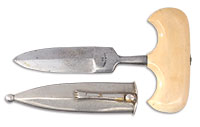
RARE WILL & FINCK, SAN FRANCISCO PUSH DAGGER WITH IVORY GRIP.
This is possibly the finest example known of this large 7″ overall push dagger with 4-3/4″ blade. This example has the rare Circa 1870 Will & Finck patented belt clip in shape of human hand and arm. The handle, typical of San Francisco cutlers, is made from walrus ivory which exhibits a fine patina. PROVENANCE: Pictured Pg 71 Bernie Levine Knife Makers of Old San Francisco, 1977; Ex-Norm Flayderman Collection; Pg 357 The Bowie Knife – Unsheathing an American Legend by Norm Flayderman, 2004. Special Note: This item(s) contains plant or animal properties that may be covered by the Endangered Species Act (ESA). We have taken care to ensure that this item(s) meets the standard for sale under the ESA. However, certain states and other countries have laws that are more restrictive than the ESA. It is the bidder’s responsibility to ensure that it is lawful to purchase or transport this item(s) into their state, and to obtain the necessary import and export approvals. Delay or failure to obtain any such permit or approval does not relieve the buyer of paying for the item(s) and consummating the purchase. CONDITION: Fine overall. Blade retains much of its orig polish and shine with makers mark on ricasso as can be seen in photos. The silver plated scabbard and belt clip retain 98% orig silver overall. 50412-98 (15,000-25,000) ESA – Lot 1249
|