| Image | Lot | Price | Description |



|
2447
|
$57,500.00
|
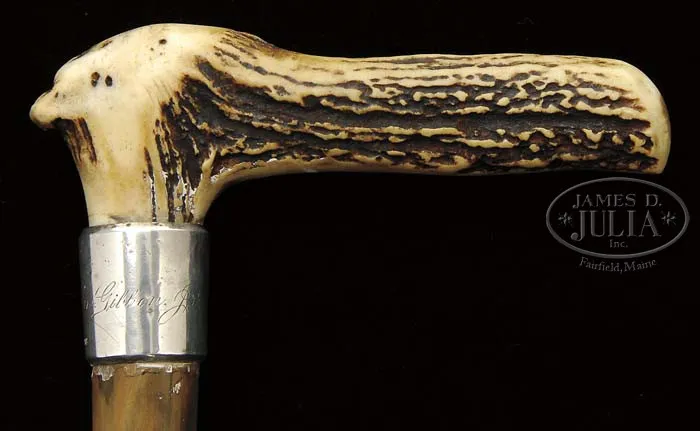
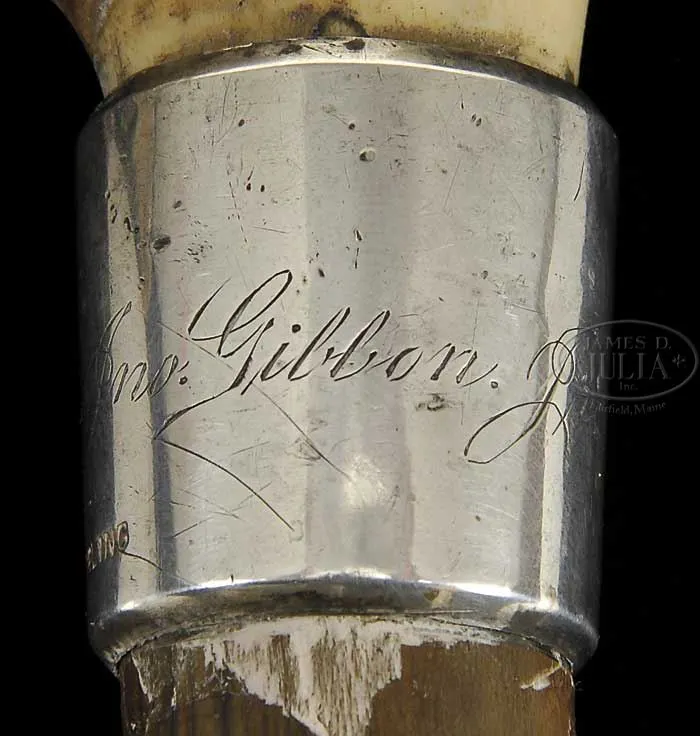
EXTRAORDINARILY RARE SPRINGFIELD TRAPDOOR SPECIAL OFFICER’S MODEL RIFLE WITH A MARKSMAN’S RIFLE-TYPE STOCK DOCUMENTED TO MAJOR GENERAL JOHN GIBBON. SN NSN. Cal. 45-70. One of a kind rifle produced at the Springfield Armory in 1884 and documented in government records as having been made for “Col. John Gibbon” with the date January 4, 1884 and is described as “Officer’s Model / Marksman’s Stock, no tang sight”. The cal. is noted as “45” with the cost of $27.00, listed on p. 263 of that document and delivered to Cheyenne Ordnance Depot. This is the only Officer’s Model rifle listed in the records that was produced without a tang sight and also the only one listed in the records with a Marksman’s-like stock. This information is corroborated by renowned Springfield collector, authority and author, Albert Frasca, Ph.D. and Richard A. (Dick) Hosmer, noted Springfield collector and author of the book The .58 and .50 Caliber Rifles and Carbines of the Springfield Armory 1865-1872. Mr. Hosmer is completing a sequel to his book which will encompass rare firearms of Springfield 1873-1893, which will include this rifle. A Xerox copy of p. 263 REGISTER OF ORDNANCE STORES SOLD IN 1884, which itemizes the January 4 transaction to Col. Gibbon, accompanies this lot. This rifle is described as resembling a standard Model 1875 Officer’s Model with 26″ rnd bbl that is mounted with an F.A. Freund Rocky Mountain style front sight and a Freund altered & marked Winchester Model 1876 sporting ladder rear sight. The breech block is marked “U.S. / MODEL / 1873” and the lockplate is marked “US / SPRINGFIELD” and a small American eagle. Trigger is single-set type of the 1875 Officer model. Mounted in a very highly figured, 1-pc American walnut stock with center crotch flame grain patterns through the buttstock, with coarse checkered forearm and thick pistol grip stock that has a flat grip cap with the recess for a rnd nameplate, which is missing. Forestock tip is inlaid with the silver plated pewter nosecap in oak leaf pattern like the Model 1875 Officer’s Model. It has a sgl bbl band retained by a spring keeper. Bottom of bbl has a single iron guide which contains its orig silver or nickel plated, brass tipped, hickory ramrod. Buttplate is usual Springfield configuration without trap. The lockplate, hammer, breech block, latch, bbl band, forend cap, top tang, trigger guard & buttplate tang are all engraved similar to the Officer’s Model rifles of that period. The receiver is stamped with the date “1881” where the SN on a trapdoor rifle would ordinarily be found. The presence of the Freund sights is easily explained by the fact that this rifle was shipped to the “Cheyenne Depot” at Cheyenne, Wyoming during which time the then Col. Gibbon was Commander of the 7th U.S. Infantry in Montana. At that same time Freund Brothers were operating their gun making & outfitters shop in Cheyenne under the name of “Wyoming Armory”, the purveyors of long range hunting & target rifles, established in late 1867. Mr. Freund patented the sights found on this rifle between 1875 and 1880. He advertised and touted them as superior to standard sights which certainly would have made them attractive to someone with a new rifle desirous of better accuracy. This rifle has remained in the consignor’s family continuously since at least the early 1950s. Consignor has provided a notarized statement to that effect stating that he is currently 61 years old and recalls playing with it as a child and personally removed the nameplate from the grip cap and that he recalls it having been inscribed “Gibbon”. He also states that his family history, specifically his grandfather & father, referred to it as a “Civil War General’s gun”, “the General’s gun” and “Gibbon’s gun”. He additionally states that his father told him that the rifle was “given to the family and that his mother “told me that it was always in the family”. John Oliver Gibbon was born in 1827 in Philadelphia and as a child moved with his family to Charlotte, NC, where he remained until he entered West Point in the Class of 1847. He fought in the Florida Seminole Indian Wars and then became an artillery instructor at West Point for five years. In 1861, at the outbreak of the Civil War, he was Captain of the 4th Artillery at Fort Leavenworth, Kansas. He resigned that position and moved East and became the Chief of Artillery in Gen. McDowell’s division and became Brig. General of Volunteers in May 1862. His division participated in numerous major battles, then in November he became the Commander of 2nd Division, I Corps and was badly wounded at Fredericksburg. At Gettysburg his division was instrumental in repulsing Pickett’s Charge and he was again wounded and carried from the field. After recovering he resumed command and in June 1864 was promoted to Maj. General and in January 1865 was given command of the XXIV Corps and was one of the Commissioners designated to receive the surrender of the Army of Northern Virginia. After the War he reverted to the permanent rank of Colonel, in charge of the 36th Infantry and in 1869 commanded the 7th Infantry on the frontier in Montana, Wyoming & Dakota Territories. His 7th Infantry was to have linked up with Custer at the Little Big Horn but the ill advised action by Custer before Col. Gibbon could reach him resulted in the famous massacre. However, Col. Gibbon’s arrival immediately after the battle probably saved Maj. Reno’s command from annihilation. The 7th Infantry and personnel from Maj. Reno’s command buried Custer’s dead and retreated to their individual posts. The following year Col. Gibbon conducted a successful campaign against the Nez Perce Indians, overtaking them near the Big Hole River in Montana. Col. Gibbon’s troops inflicted heavy casualties on the Nez Perce but also suffered their own heavy casualties and in fact Col. Gibbon was pinned down by Indian sniper fire and only escaped when another Army advance party arrived the next day. During this battle he was again wounded. In 1884 he was Commander of the Dept. of the Platte and in 1885 was promoted to Brig. General and took command of the Army of the Pacific Northwest in Seattle, during which time, in 1886, he placed Seattle under martial law to control the anti-Chinese rioting. He was forced to retire, due to age restrictions in 1891. He moved to Baltimore where he died in Feb. 1896. Accompanied by a packet of copied material detailing most of the above information regarding Gen. Gibbon. Also accompanied by a knobby wooden cane about 35″ long with stag handle and a sterling silver band engraved in period script “Jno. Gibbon. Jr.”. Consignor, in his notarized statement, relates that the cane has always been with the rifle. There is no indication that Gen. Gibbon was a “Junior”, so it is likely the cane may have come from another family member. CONDITION: Fine. Bbl retains about 80% orig blue with fine surface etching and one area of light pitting; receiver, breech block, lockplate & hammer retain traces of case colors, being mostly a silver/brown patina; buttplate, trigger guard & bbl band are also a silver/brown patina; pewter nose cap retains 85-90% orig silver; wood is sound showing light diamond point wear on the checkering of the grip and moderate to heavy wear on the forestock, with nicks, scratches & dings and a couple of small gouges and overall retains most of its orig hand rubbed oil finish; ramrod is sound retaining a smooth old patina on the wood and about 60% orig nickel on the tips. Mechanics are crisp, bright shiny bore with some scattered very fine pitting, may clean better. 4-45218 JR473 (50,000-100,000)
Auction: Firearms - Spring 2012 Please Note: All prices include the hammer price plus the buyer’s premium, which is paid by the buyer as part of the purchase price. The prices noted here after the auction are considered unofficial and do not become official until after the 46th day. |