| Image | Lot | Price | Description |




|
2257
|
$25,875.00
|
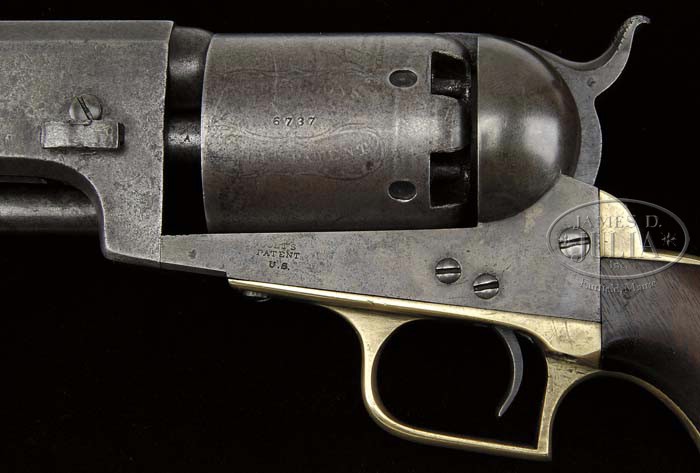
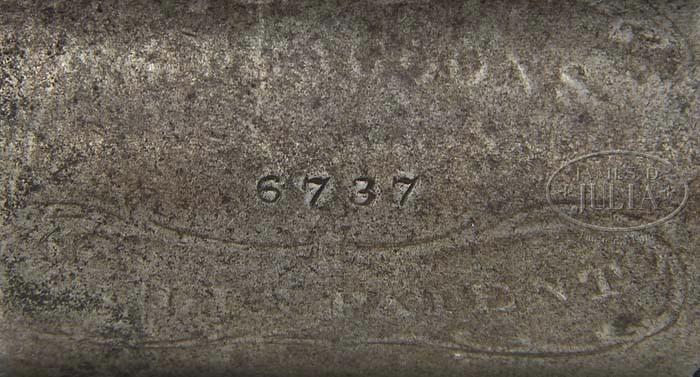
VERY RARE MARTIALLY MARKED COLT 1ST MODEL DRAGOON PERCUSSION REVOLVER THAT BELONGED TO CONFEDERATE BRIGADIER GENERAL ROSWELL S. RIPLEY. SN 6737. Cal. 44. Revolver is standard 1st Model, martially marked with 7-1/2″ oct to rnd bbl, German silver front sight and 1-line left hand New York City address. Left side of frame has small “COLT’S PATENT” over a tiny “U.S.”. Cyl is usual 6-shots with oval stop notches and Dragoon/Indian fight scene roll marking. Roll marking includes the usual panels above and below the SN with the top panel “U.S. DRAGOONS”. The square back brass trigger guard & backstrap contain a 1-pc walnut grip that has the SN in the buttstrap channel. Left side of grip has the outline and partially legible cartouche and the right side a partially legible “WAT” (Capt. William A. Thornton) cartouche. Both sides of grip are stamped in block letters, “RSR”. Various parts are stamped with small inspector initials including the grip. Curiously the V-shaped hammer spring has a small metal wedge in between the arms of the spring about 5/16″ up from the bottom, apparently to provide more spring tension to the hammer. This wedge is held in place by a small braided cotton cord. Roswell Sabine Ripley was born on March 14, 1823 in Worthington, OH and died March 26, 1887 in New York City. He was an 1843 graduate of West Point, ranking 7th of 39 cadets. He was assigned to garrison duty and became an artillery instructor. In the Mexican-American War he served in Mexico under Gen. Zachary Taylor and Gen. Gideon Pillow, seeing action in the Battles of Monterey, Vera Cruz, Cerro Gordo, Contreras, Churubusco, Molino del Rey, Chapultepec and the capture of Mexico City. He was breveted Captain for gallantry at Cerro Gordo and again to Major for gallantry at Chapultepec. Major Ripley published A History of the Mexican War in two volumes in 1849. He also fought in the Seminole War in Florida in 1849 after which he was assigned to garrison duty. In 1852 he married a woman from South Carolina, resigned from the Army in 1853 and moved to Charleston to settle his wife’s estates. He became a successful businessman and a supporter of States’ rights. He joined the South Carolina Militia and became a Major of Ordnance. When South Carolina seceded from the Union he was appointed Lt. Colonel of Ordnance in the Army of South Carolina and it was he who helped direct the fire of an artillery battery during the bombardment of Fort Sumter in Charleston Harbor on April 13, 1861, which was the first engagement of the Civil War. Following the surrender of Fort Sumter Gen. Beauregard placed Ripley in charge of Fort Sumter’s repairs and On Aug. 15, 1861 appointed him Brig. General and assigned him command of the Dept. of South Carolina which post he maintained from Dec. 1861 to May 1862. In Nov. 1861 Gen. Robert E. Lee replaced Gen. Beauregard who had been transferred to Virginia. Lee & Ripley had a difference of opinion regarding the defenses of Charleston but before their differences were settled, Lee was transferred back to Virginia and Maj. Gen. John Pemberton assumed command over Ripley. Ripley also disagreed with Pemberton’s ideas for Charleston’s defenses and requested a transfer, which was granted and he was transferred to the Army of Northern Virginia and placed in the 5th Brigade under Gen. D.H. Hills. His brigade fought at Mechanicsville, Gaines Mill & Malvern Hill in the Peninsular Campaign where they sustained heavy losses. He remained in service and participated in Lee’s invasion of Maryland and fought at South Mountain & Sharpsburg. During the Battle of Sharpsburg Gen. Ripley was severely wounded in the throat but after his wound was dressed returned to the battle. In Nov. 1862 his brigade participated in the defense of Fredericksburg and the Battle at Antietam. In 1863 Gen. Ripley returned to South Carolina and took charge of the first military district and repelled a Union Navy attack in April 1863 and continued in command until late 1864 when the city was evacuated. Gen. Ripley, in his disagreements with Generals Beauregard & Pemberton, had proposed heavy reinforcements further out from Charleston but was overruled. He proposed heavy reinforcements on Morris Island, site of Battery Wagner (the subject of the motion picture, “Glory”) which suggestion was also ignored by his superior officers. As Gen. Ripley had predicted Union forces had gained a foothold on the lightly defended Morris Island and mounted an attack on Battery Wagner with the 54th Massachusetts Infantry and other regiments, a prolonged siege which ultimately forced the Confederate evacuation. Gen. Ripley was involved in a dispute with his new commander Maj. General Sam Jones wherein it was claimed that Ripley was unfit for duty for drinking and carousing and although Gen. Beauregard was sent to investigate the situation and issued a scathing attack on Ripley (apparently due to his dislike of Ripley), Gen. Ripley survived and remained in command. After the war Gen. Ripley, whose wife & daughter had left him, resided in England for over 20 years. In 1885 he returned to New York City and on March 29, 1887 suffered a massive stroke and died. Per his request he was buried in Charleston with a massive funeral with the bells ringing continuously from 8am until the services at 10am. In 1894 there was a monument erected to him in the cemetery where he is buried with another erected in Worthington, Ohio, his place of birth. Gen. Roswell S. Ripley was the nephew of Union General and Chief of Ordnance, James Wolfe Ripley. Accompanied by a 6-page letter by noted Colt author & historian R.L. Wilson which extols the virtues of this revolver. Also accompanying is a large 4-ring binder with numerous muster rolls in his name, lists of artillery & supplies and numerous correspondence beginning in 1860, about the time of southern secession. Also accompanying is about 87 pages of transcription of Confederate military correspondence over the signature of various generals, politicians and especially Gen. Ripley, many of which deal with after-action reports. Additionally accompanying is a letter dated Feb. 19, 1981 on well-known & respected collector and Colt authority Jeff Horn letterhead over the signature of “Jeffrey Horn” wherein he states “I purchased this Colt 1st Model Dragoon (Government Contract Issue), serial #6737, from the direct descendants General Ripley.” The second paragraph states “According to the family’s history this gun was once the property of Brigadier General (C.S.A.) Roswell Sabine Ripley. Prior to my purchase this gun has always been in the family.” Martially marked 1st Model Dragoons are, themselves, a substantial rarity and those with remaining cyl roll marking of “U.S. DRAGOONS” are even more rare. However rare one of these “ordinary” 1st Model Dragoons may be, their rarity pales in comparison to one identified to a Confederate Officer, especially to such an intrepid and courageous General officer. PROVENANCE: Jeff Horn Collection. CONDITION: Very good to fine, all matching except wedge which is a period of use replacement with two different numbers “333” and “410”. Overall retains a smooth, even, plum/brown patina showing light muzzle edge wear. Frame & hammer retain traces of smoky case colors in sheltered areas. Screws are all fine. Cyl has matching patina with both panels, above & below the SN, mostly legible. Cyl retains 30-40% Dragoon/Indian fight scene roll marking. Trigger guard & back strap were never silver plated and now retain a medium mustard patina. Grip is sound with minor chipped toes and retains a dark hand worn patina. Mechanics are fine, strong sharp bore with moderate pitting. 4-42089 JR281 (25,000-40,000)
Auction: Firearms - Spring 2011 Please Note: All prices include the hammer price plus the buyer’s premium, which is paid by the buyer as part of the purchase price. The prices noted here after the auction are considered unofficial and do not become official until after the 46th day. |