| Image | Lot | Price | Description |

|
2588
|
$2,875.00
|
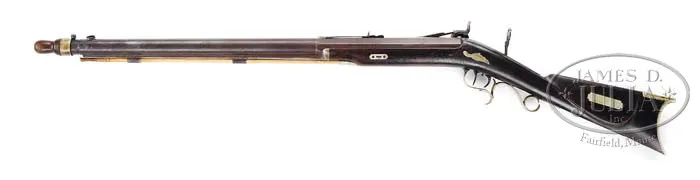
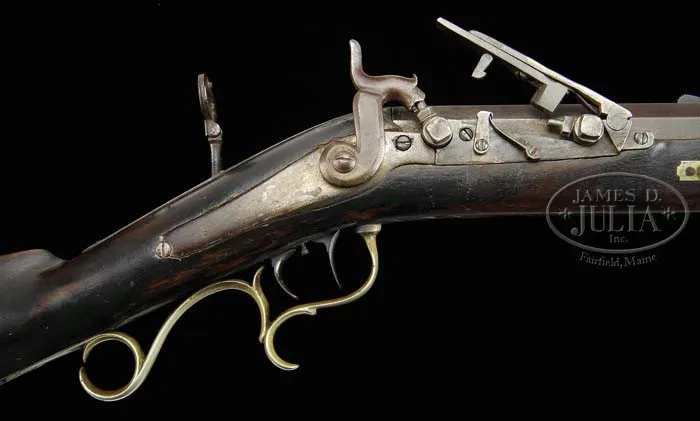
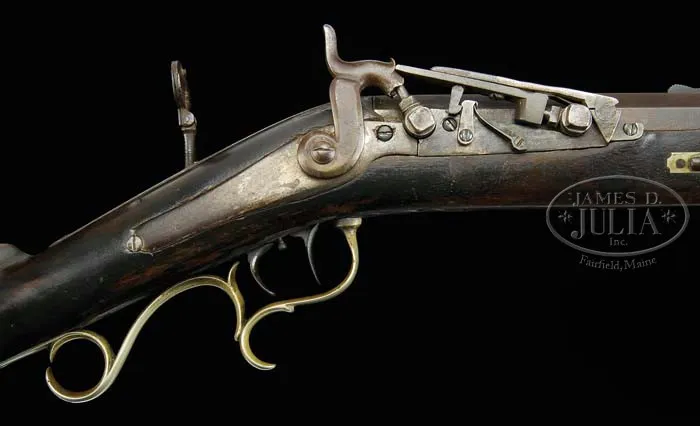
EXTRAORDINARILY RARE & PREVIOUSLY UNKNOWN H.L. LEONARD SUPERPOSED LOAD MULTI-SHOT PERCUSSION RIFLE. Cal. about 46. Extraordinarily rare rifle with 26-3/8″ rnd bbl with its extremely rare wood, brass and steel false muzzle/bullet starter. It has a replacement dovetailed front sight and it orig folding lollipop tang sight with screw elevation and drift windage adjustments mounted at top of wrist. Top flat has a modern Remington semi-buckhorn rear sight. Bottom of bbl has a full length iron rib with two plain guides containing a replacement rod. Rifle is mounted in 1-pc American walnut stock with pewter nose cap and German silver furniture with rectangular escutcheons for the sgl key in the forestock. Left side of the wrist has an inlaid leaf pattern and right side of butt has 2-pc patchbox. Trigger guard has smooth flared bow with long lower tang and hook finger rest. Lockplate is back action and flat with square edges and a rnd tail and has a beveled edge flat-side hammer. The unusual mechanism to fire this superposed load rifle is unique. The rear nipple is conventionally mounted in a square end drum for direct striking by the hammer. The front nipple, like its sister to the rear, is mounted in an identical conventional drum about 2″ toward the muzzle. There is a flat, tapered steel bar that extends from the rear drum under the forward drum and is attached to side of bbl with two screws. Attached to this bar, forward of the front drum, is a 2-pc swinging arm that is spring-loaded into the raised position. Once the superposed charges have been loaded and the nipples capped the hammer is placed at half cock and the swinging arm depressed and locked into position by a small spring loaded latch attached to the steel bar with a screw. When one wishes to fire, the hammer is fully cocked and fired which strikes a sliding bar attached to the swinging arm by a screw in a slot which allows the force to be transferred to the forward nipple firing the forward charge. To fire the second charge the hammer is recocked which releases the swinging arm to retract into its upward, unlatched position and the rear charge is fired conventionally. Altogether a simple operation but extremely complicated for its time and, in some respects, quite dangerous to the careless person. Obviously the mechanism would require careful & regular cleaning in order to maintain its proper operation. Apparently given the scarcity of Mr. Leonard’s firearms surviving today, with only three Leonard marked multi-shot firearms known as of this writing, a rifle and two pistols. While his multi-shot arms may have been popular in their day in Maine, few survive to the present although there are a few other unmarked pieces that have been attributed to Mr. Leonard which have been converted to single shooters by having their mechanisms removed. According to the book Maine Made Guns & Their Makers, Dwight B. Demeritt, Jr., Hiram L. Leonard (1831-1907), born in Sebec, Maine, began making firearms in the 1850’s in Bangor, Maine, probably in the shop of well known gunmaker, Charles V. Ramsdell. It is unknown how many firearms Mr. Leonard made but undoubtedly, given the few surviving specimens, he didn’t make very many. There are several written accounts of hunters & trappers in Maine attempting to purchase or be desirous of Leonard multi-shot firearms. Mr. Leonard is substantially more famous for his building of some of the world’s finest split bamboo fly rods, which he began making in Bangor in about 1871. Prior to that time Mr. Leonard was extremely famous and known throughout the northeast as one of the finest, strongest and most durable hunters. He apparently spent a great deal of time in the woods supplying meat to the lumber camps and hides to Manly Hardy, well known resident and fur buyer of Brewer, Maine, who also wrote articles for Forest and Stream magazine, one of which described one of Leonard’s multi-shot rifles. Mr. Leonard’s fly rod making enterprise apparently prospered and in 1874 he began a program in the Sebec Lake, Maine area to restore the Atlantic Salmon. The project was apparently unsuccessful, at the time, but it gives insight into Mr. Leonard’s apparent financial success to have been able to support such an undertaking. The Leonard Fly Rod Company became so successful that in 1881 he moved the enterprise to Central Valley, New York and built a factory there where he continued in business supplying New York City’s major outfitters with his wonderful fly rods, until his death on Jan. 30, 1907. He is buried in Highland Mills, New York. The Leonard Fly Rod Company continued in business for nearly another 100 years before it closed and was only recently reopened with an outlet store here in Kennebunkport, Maine. That Mr. Leonard was a successful, famous and respected hunter & outdoorsman is further attested to by an article written by none other than Henry David Thoreau in July 1857, about a trip via stagecoach through the Maine woods from Bangor to Monson, Maine, with Mr. Leonard also a passenger. He was very complimentary of Mr. Leonard’s gentlemanly appearance and unassuming personality and referred to him as “probably the chief white hunter in Maine, and was known all along the road” and reported that he was also a gunsmith. He related a story about how Mr. Leonard had saved the stage driver and two passengers from drowning in the Piscataquis River in Foxcroft, Maine on that very road, “having swum ashore in the freezing water and made a raft and got them off — at great risk to himself”. His article further reports that there was an Indian on the stagecoach who knew Mr. Leonard and called him “the great hunter”. Page 160 of the referenced publication has a reprint of a photograph from the 1860’s of Mr. Leonard in hunting garb holding an over/under rifle which the author speculates is “probably a four-shooter”. This rifle is an opportunity to own a very rare firearm built by one of America’s least known but very innovative firearms makers and would compliment the H.L. Leonard marked pistol being sold elsewhere in this auction. CONDITION: Good to very good. Bbl and bottom rib retain about 80% orig brown finish with some thinning and a clean spot near the front sight. Lockplate and hammer also retain dark brown patina with chipped hammer nose and moderate pitting around the rear nipple area. Stock appears to be sound, but may have an old repaired break in the wrist and is overall a very dark blackish patina. Set triggers need adjustment, otherwise mechanics are fine, strong bright bore with scattered pitting. False muzzle shows moderate wear with 1 broken pin. 4-39968 JR423 (3,500-5,000)
Auction: Firearms - Spring 2010 Please Note: All prices include the hammer price plus the buyer’s premium, which is paid by the buyer as part of the purchase price. The prices noted here after the auction are considered unofficial and do not become official until after the 46th day. |