| Image | Lot | Price | Description |

|
1385
|
$51,750.00
|
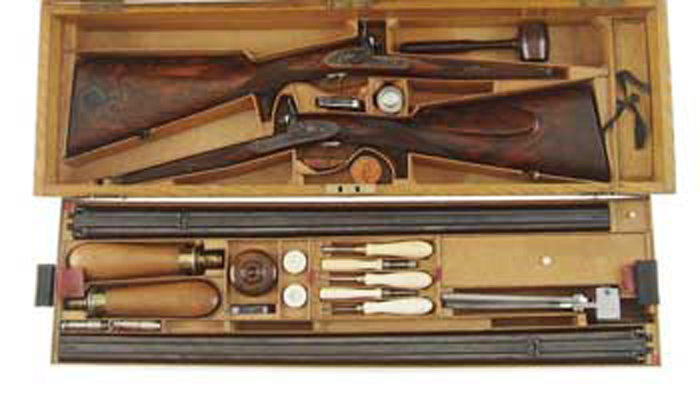
EXCEPTIONAL CASED PAIR OF JOHN DICKSON & SON MUZZLE LOADING DOUBLE-BARREL RIFLES. Cal. 50. SN 3795 & 3796. Spectacular pair of rifles built in April 1883 for eccentric Scottish collector Charles Gordon. Mr. Gordon, in about 1875, began ordering firearms from the Dickson Company and continued through February 1906 until his death. During this period he ordered approx. 300 separate firearms, mostly in unusual or obsolete calibers or configurations. This set is unusual in two respects. One is its completeness and condition, and the other is the fact that one set of bbls is steel and the other Damascus. The steel bbls are 27-1/2″ and the Damascus bbls are 29-1/2″. Both have Whitworth rifling & both have low bead front sights and platinum-lined, 3-leaf express rear sights, one standing, and two folding with leaves marked 100, 200, & 300 yds. The steel bbls are numbered “1” and the Damascus “2.”. They are mounted in exceptionally beautiful marbled Circassian walnut 1-pc stocks with checkered forestock, single wedge and straight grip with raised tear-drop side panels and a dainty cheek piece, 14-1/2″ over a checkered steel buttplate with long stepped engraved tang. The tangs, lockplates, hammers, trigger guards, and small, 2-pc patch boxes are beautifully engraved with exceptionally fine English-style foliate arabesque patterns. The maker’s name is on each lockplate. The lockplates have niter blued stalking safeties. The trigger guards are also niter blued with long, checkered finger rests and stocks and bbls have sling eyes. Accompanied by its orig oak and leather-lined trunk case compartmented in the bottom for the stocks, a German silver capper, a round Hawksley oil bottle, an ebony or rosewood mallet, a tin of unopened Joyce caps, and an oak box with sliding lid filled with lead bullets. The lift-out top tray is compartmented for the two sets of bbls, the original hollow base bullet mold with sprue cutter, numbered to the rifles. It is also compartmented for two leather-covered Hawksley bag flasks, two nipple picks, another German silver capper, five ivory-handled tools, including nipple wrench, deburring tool, thread cleaner, and two turn screws. It also has two screw top ivory parts boxes, numbered “1” & “2”, containing two nipples each. There’s also a screw top rosewood box. There are other covered and uncovered compartments, for which the purpose is unknown. Accompanied by a letter from John Dickson & Son Company fully identifying this set as having been made April 27, 1883 for Charles Gordon. Also accompanying are various letters of provenance beginning in 1925 in Canada by someone named MacDonald, who was “ex-army” in Saint John, who got them from a castle “selling out in Scotland.” It further states he gave them to Gordon Kennedy in 1935, and Kennedy gave them to R. Vaughan for gas at a filling station in 1939. There is a bill of sale dated January 30, 1969, from L. L. Vaughan of Sydney, NS, selling this pair of rifles. There is a copy of a page of the register of John Dickson, giving the specifications of these rifles, and there is a copy of an article by Christopher Austyn, which appeared in Classic Sporting Rifles. This is most certainly one of the more complete sets in existence and by far the finest condition. CONDITION: Exceptionally fine. Appears to be unfired. Retains virtually all of their pristine factory finish to both metal and wood. Bbls have a small nick or two and the wood a minor handling and storage mark. Blue and Damascus patterns are brilliant, as are the case colors, and the wood is pristine. All the bits and pieces are equally new. Case is equally fine, with minor scratches and storage marks. Maker’s label in the lid is slightly yellowed with a small stain on the left edge. A truly exceptional set worthy of the most discriminating collector or museum desirous of an example of Dickson’s workmanship. 4-56674 JR643 (45,000-65,000)
Auction: Firearms - Spring 2006 Please Note: All prices include the hammer price plus the buyer’s premium, which is paid by the buyer as part of the purchase price. The prices noted here after the auction are considered unofficial and do not become official until after the 46th day. |